Ancient Greek warfare depended heavily on the equipment carried by individual soldiers. Among the most important pieces were the shield and helmet. These objects provided physical protection, but they also expressed technological skill, social identity, artistic taste, and military organization.
Greek armor was not produced in a single uniform style throughout antiquity. Designs changed across centuries, regions, and military traditions. A warrior from the Archaic period could carry equipment that differed significantly from that of a Classical or Hellenistic soldier.
Nevertheless, Greek craftsmen developed highly sophisticated methods for producing weapons and protective equipment from materials such as:
bronze,
iron,
wood,
leather,
linen,
and organic fibers.
The creation of a shield or helmet required a detailed understanding of materials. A poorly designed shield could be too heavy to carry. A helmet that provided maximum protection but prevented the wearer from seeing or hearing properly could become dangerous in battle.
Greek armorers therefore had to balance protection, weight, mobility, durability, and cost.
The Importance of Armor in Greek Warfare
Greek warfare was strongly associated with the hoplite, a heavily armed infantryman who fought primarily in a close formation known as the phalanx.
A hoplite's standard equipment could include:
a shield,
helmet,
spear,
sword,
body armor,
and greaves protecting the lower legs.
Not every soldier owned identical equipment.
Quality depended upon wealth and period.
However, the shield and helmet were particularly important because they protected vulnerable parts of the body.
The Hoplite Shield
The most famous Greek shield is commonly called the hoplon, although modern scholars often use terms such as aspis for the large round shield associated with the hoplite.
The shield was generally circular and large enough to protect a substantial portion of the warrior's body.
Its design became closely associated with Greek infantry warfare.
Why the Shield Was So Important
A Greek shield did more than protect the individual carrying it.
In a tightly organized formation, each soldier's shield could contribute to the protection of neighboring soldiers.
The phalanx depended upon cooperation.
A gap in the line could create danger.
The shield therefore became both a defensive object and a symbol of collective responsibility.
The Basic Structure of the Shield
The hoplite shield was generally constructed around a wooden body.
The wood provided the primary structure.
Additional materials could be added to improve:
strength,
durability,
appearance,
and protection.
The exterior could include a thin bronze facing or other protective materials depending on the design and period.
The interior contained a system of grips that allowed the soldier to control the shield.
The Porpax and Antilabe
A particularly important feature of the hoplite shield was its grip system.
The warrior inserted the left forearm through a central band known as the porpax.
A second grip, called the antilabe, was held closer to the edge of the shield.
This arrangement distributed the shield's weight along the arm.
The system made it easier to control a large and relatively heavy defensive object.
Why the Grip System Was Effective
If a shield is held only by a single handle, the entire weight can strain the hand and wrist.
The Greek system allowed the forearm to support much of the load.
The second grip provided additional control.
This made the shield practical for prolonged use.
It also helped the warrior maintain a stable defensive position.
The Shield as a Piece of Engineering
A good shield required several properties.
It needed to be:
strong enough to absorb impact;
large enough to provide protection;
light enough to carry;
balanced enough to maneuver;
durable enough to survive repeated use.
These requirements could conflict.
Increasing thickness could improve strength but also increase weight.
Using more metal could improve resistance but make the shield heavier and more expensive.
Craftsmen therefore had to make practical compromises.
The Role of Wood
Wood was the foundation of many Greek shields.
Different types of wood could offer different properties.
The material needed to resist splitting and withstand repeated impacts.
It also needed to be shaped.
Craftsmen could create a curved profile rather than a completely flat surface.
This curvature improved how the shield interacted with the warrior's body.
Bronze Shield Facing
Some shields incorporated bronze sheets or fittings.
Bronze could provide additional resistance to cutting and puncture.
It also created a distinctive visual appearance.
However, bronze was valuable.
The amount of metal used depended upon economic resources and the particular type of shield.
A heavily decorated shield could also communicate wealth or status.
Shield Decoration
Greek shields could display symbols.
These symbols are often called shield devices.
A device could represent:
an animal,
a mythical creature,
a letter,
a religious symbol,
or another recognizable image.
The design could help identify a warrior or community.
One famous example involves the Spartan use of the Greek letter lambda, although the widespread association of a uniform lambda device belongs particularly to later representations and should not be assumed for every Spartan warrior throughout all periods.
The Shield and Identity
A shield could therefore function as more than armor.
It could communicate:
city identity,
military affiliation,
family status,
personal symbolism,
and social prestige.
In Greek art, shields frequently appear with elaborate decoration.
These artistic representations demonstrate the visual importance of military equipment.
The Helmet
The helmet protected the head, one of the most vulnerable areas of the body.
Greek helmet design changed dramatically over time.
Several important types include:
Corinthian helmets,
Illyrian helmets,
Chalcidian helmets,
Attic helmets,
and later Hellenistic forms.
Each design represented a different balance between protection and mobility.
The Corinthian Helmet
The Corinthian helmet is perhaps the most recognizable Greek helmet.
It often covered much of the head and face.
The design included:
openings for the eyes;
a narrow opening for the mouth;
extended cheek protection;
and a strong upper section.
The helmet provided substantial protection.
However, the extensive coverage could restrict hearing and peripheral vision.
Making a Bronze Helmet
Producing a bronze helmet required advanced metalworking.
Bronze is an alloy primarily composed of copper and tin.
The exact properties of the finished metal depended upon composition and manufacturing.
The basic process could involve:
obtaining and preparing the metal;
melting or casting it into an initial form;
hammering and shaping the metal;
repeatedly heating the metal when necessary;
refining the shape;
adding decorative elements;
polishing the surface;
attaching interior padding or fittings.
The finished object could be shaped from a single sheet of bronze through careful hammering.
Hammering and Annealing
Metal becomes harder and less flexible as it is repeatedly worked.
Craftsmen could therefore heat the bronze through a process associated with annealing.
Heating helped restore workability.
The craftsperson could then continue shaping the object.
This cycle could be repeated many times.
The process required experience.
Too much heat or improper handling could damage the material.
The Shape of the Helmet
A helmet could not simply be a metal bowl.
It had to fit the human head.
Craftsmen needed to consider:
skull shape,
facial structure,
neck movement,
visibility,
and the location of impact.
The design therefore represented an understanding of anatomy and combat.
Cheek Pieces
Many Greek helmets included cheek guards.
These protected the sides of the face while leaving enough space for the wearer to breathe and see.
Different helmet styles used different arrangements.
Some provided extensive facial coverage.
Others used more open designs.
The variation demonstrates changing military preferences.
The Illyrian Helmet
The Illyrian helmet provided strong protection while leaving the face relatively open.
It became popular in parts of the Greek world during the Archaic period.
Its design illustrates a different balance from the Corinthian helmet.
Rather than enclosing most of the face, it emphasized accessibility and visibility.
The Chalcidian Helmet
The Chalcidian helmet developed another approach.
It often provided significant protection while allowing greater hearing and visibility than the more enclosed Corinthian form.
This illustrates an important trend in military technology.
Maximum coverage was not always the best solution.
A soldier needed to perceive what was happening around him.
The Attic Helmet
The Attic helmet became especially influential in artistic representations.
It generally featured an open-faced design with cheek guards.
Later versions became associated with Greek and Roman military imagery.
The style demonstrates the continuing development of helmet technology.
Crests and Horsehair
Some helmets included decorative crests.
These could be constructed from materials such as horsehair.
A crest could make a warrior appear taller and more impressive.
It could also communicate status.
However, not every helmet required an elaborate crest.
A practical soldier's equipment depended upon circumstances, wealth, and military tradition.
How Was the Crest Attached?
A helmet could contain a fitting or socket designed to support the crest.
A central ridge might reinforce the upper structure while providing a location for attachment.
The crest itself could be mounted on a support.
This required cooperation between:
metalworkers,
leatherworkers,
and artisans capable of preparing organic materials.
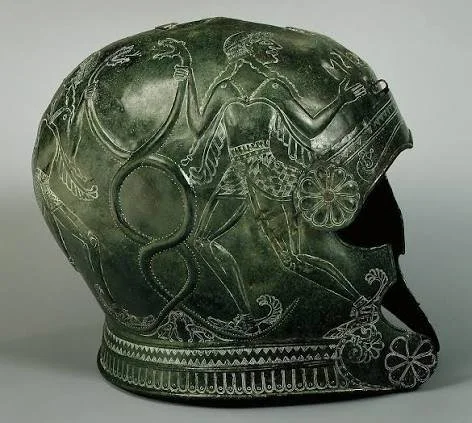
Decoration and Embossing
Greek helmets could be decorated with engraved or raised designs.
A craftsman might create:
geometric patterns,
animal imagery,
religious symbols,
or elaborate ornamental forms.
Some helmets were highly functional military objects.
Others also served as displays of wealth and craftsmanship.
Armor as Social Status
In many Greek communities, citizens were expected to provide at least some of their own military equipment.
Because quality armor was expensive, military service could be connected with economic status.
A wealthy individual could potentially afford:
a high-quality helmet;
bronze body armor;
an elaborate shield;
and expensive weapons.
A poorer soldier might use simpler equipment.
Military appearance could therefore reveal social differences.
The Cost of Bronze
Bronze required access to raw materials.
Copper and tin were not equally available everywhere.
The production of bronze depended upon trade networks.
This meant that a helmet could represent resources extending beyond the individual craftsman.
The final object was connected to:
mining,
transportation,
trade,
metalworking,
and military demand.
Workshops and Specialized Craftsmen
The production of military equipment encouraged specialization.
A skilled bronze worker could produce:
helmets,
greaves,
armor fittings,
weapons,
and decorative objects.
Other specialists worked with:
wood,
leather,
textiles,
and bone.
A complete set of armor could therefore represent the labor of multiple craftsmen.
Repairs and Reuse
Armor was valuable.
A damaged bronze object did not necessarily need to be discarded.
Metal could be repaired, reshaped, or recycled.
The economic value of bronze encouraged reuse.
Archaeological evidence shows that ancient societies frequently recycled metals.
This means that the number of surviving helmets represents only a small portion of the equipment originally produced.
The Shield in the Phalanx
The design of the Greek shield became especially effective within the phalanx.
Soldiers stood relatively close together.
Their shields created a defensive line.
Each warrior had to maintain position.
The effectiveness of the formation depended upon discipline and cooperation.
The shield therefore represented an important military principle:
individual survival depended partly upon collective action.
The Psychological Role of Armor
Armor could also influence morale.
A soldier wearing a strong helmet and carrying a large shield may have felt more protected.
At the same time, the appearance of a disciplined line of armored infantry could intimidate opponents.
Military equipment therefore had psychological value.
The gleam of bronze, the sound of movement, and the visual unity of a formation could contribute to the experience of battle.
Art and Military Equipment
Greek artists frequently represented warriors in pottery, sculpture, and other forms of visual art.
These images provide valuable evidence for the appearance and development of armor.
However, artistic representations must be interpreted carefully.
An artist might idealize a warrior.
The image may not represent ordinary battlefield conditions.
Archaeological discoveries and experimental reconstruction help historians compare artistic images with physical evidence.
Experimental Archaeology
Modern researchers sometimes reproduce ancient shields and helmets using historically appropriate materials and techniques.
This field is known as experimental archaeology.
By making and using replicas, researchers can investigate questions such as:
How heavy was the equipment?
How did it affect movement?
How long did manufacturing take?
How effective was the grip system?
How did helmet design influence hearing and vision?
Experiments cannot perfectly recreate ancient experience, but they can test practical possibilities.
The Balance Between Protection and Mobility
The history of Greek armor demonstrates a continuous balance between competing needs.
More armor could provide greater protection.
But additional armor also increased:
weight,
heat,
fatigue,
and cost.
A completely enclosed helmet could protect more of the head.
But it could reduce awareness.
A larger shield could protect more of the body.
But it could become more difficult to maneuver.
Greek armorers therefore created designs based upon compromise.
The best equipment was not necessarily the heaviest.
It was equipment that performed effectively within the realities of combat.
The Legacy of Greek Military Craftsmanship
Greek shields and helmets influenced military equipment throughout the Mediterranean.
Greek colonization, trade, warfare, and cultural exchange spread technological ideas.
Later Hellenistic and Roman equipment developed within a world already shaped by centuries of Greek military innovation.
The visual image of the Greek warrior remains powerful today.
However, the real historical achievement lies not simply in appearance.
It lies in the craftsmanship behind the objects.
Conclusion
The art of making Greek shields and helmets combined engineering, metallurgy, woodworking, artistic design, and military experience.
A hoplite shield required careful attention to weight, strength, curvature, and grip design. The combination of the porpax and antilabe allowed a large shield to be supported and controlled effectively.
Greek helmets required equally sophisticated craftsmanship. Bronze had to be shaped through repeated working, heating, and refinement. Different helmet styles reflected different priorities involving protection, visibility, hearing, and mobility.
These objects were also more than military equipment.
They could communicate wealth, identity, status, and civic belonging. Decorative designs transformed practical objects into symbols.
The Greek shield and helmet therefore reveal an important truth about ancient technology: even before industrial machinery, highly skilled craftspeople could produce complex objects by combining knowledge of materials with generations of practical experience.
Behind every surviving helmet and shield was a long chain of work—from the extraction of raw materials to the final shaping, polishing, fitting, and decoration.
Greek warriors carried the finished products into battle.
But their effectiveness began long before the battlefield—in the hands of the craftsmen who knew how to transform wood, leather, and metal into instruments of protection.