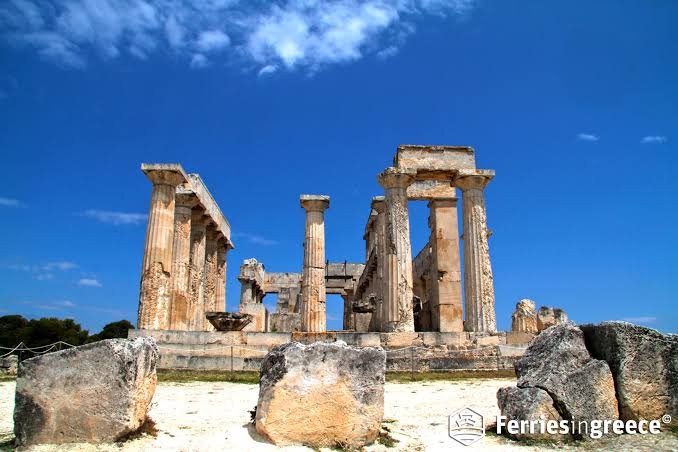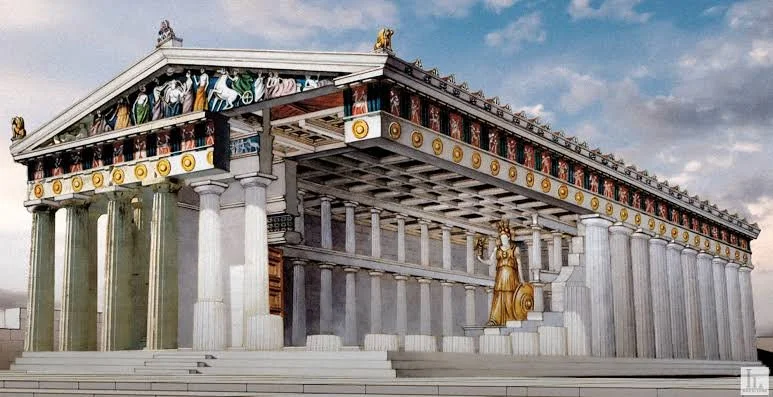
Ancient Greek temples are among the most recognizable architectural achievements in world history. Structures such as the Parthenon on the Athenian Acropolis continue to impress modern observers because of their enormous stone blocks, carefully proportioned columns, sophisticated decorative sculpture, and remarkable visual harmony. Their construction raises an obvious question: How were the Greeks able to build such monumental structures without modern cranes, electric drills, concrete pumps, steel reinforcement, computer modeling, or heavy construction machinery?
The answer lies in a combination of human labor, specialized craftsmanship, mathematical knowledge, carefully organized logistics, simple but effective machines, and generations of accumulated architectural experience. Greek builders did not construct temples through brute force alone. They developed highly organized methods for quarrying, transporting, lifting, shaping, and assembling massive pieces of stone.
Greek temples demonstrate that sophisticated construction does not necessarily depend on modern technology. Ancient builders used the physical principles of leverage, balance, friction, inclined planes, pulleys, and counterweights to accomplish tasks that remain technically impressive today.
The Temple Was a Highly Organized Construction Project
A large Greek temple required far more than architects and stoneworkers.
Construction involved numerous specialists, including:
architects,
master builders,
quarry workers,
stonemasons,
sculptors,
carpenters,
metalworkers,
painters,
transport workers,
rope makers,
and general laborers.
The construction process also required political organization and financial resources.
A city or sanctuary needed to obtain materials, organize labor, and maintain supplies over many years.
A temple was therefore both an architectural project and an economic system.
Choosing the Location
Before construction could begin, builders needed to select and prepare a suitable site.
Greek temples were often constructed in places of major religious importance.
Some stood within urban sanctuaries.
Others occupied elevated areas or prominent landscapes.
The location could influence:
visibility,
access,
foundation stability,
drainage,
and the transportation of building materials.
A major temple was not simply placed wherever empty land was available.
Its location was closely connected with religion, civic identity, and the surrounding landscape.
Preparing the Ground
Large stone buildings require stable foundations.
Before raising columns or walls, Greek builders prepared the ground and created a strong base.
Depending on local geological conditions, builders could level rock, construct foundation courses, or use carefully arranged stone.
The foundation had to distribute the weight of the structure.
A temple's columns and walls placed enormous pressure on the ground.
Poor preparation could produce cracking, shifting, or structural instability.
Quarrying the Stone
One of the most demanding stages occurred before construction even began.
Greek builders needed to obtain enormous quantities of stone.
Different regions used different materials.
These could include:
limestone,
marble,
poros stone,
and other locally available materials.
The Parthenon, for example, was constructed primarily from Pentelic marble.
The selection of stone depended upon availability, cost, appearance, and structural properties.
Extracting Stone Without Modern Machinery
Ancient quarry workers used hand tools to separate blocks from natural rock formations.
Tools could include:
iron picks,
chisels,
wedges,
hammers,
and wooden or metal implements.
Workers identified natural weaknesses in the rock and created channels around the intended block.
They could insert wedges into prepared spaces.
Through mechanical force, the stone could eventually be separated.
This process required detailed knowledge of the material.
A poorly controlled cut could crack or damage a valuable block.
Why Marble Was Difficult to Work With
Marble was highly desirable because of its appearance and ability to take a refined finish.
However, transporting and shaping it was extremely demanding.
A large architectural block could weigh several tons.
Every unnecessary movement increased labor and risk.
For this reason, ancient builders often performed some preliminary shaping near the quarry.
A partially prepared block could be easier to transport and later finish at the construction site.
Transporting Massive Stone Blocks
Once extracted, stone had to travel from the quarry to the building site.
The difficulty depended upon distance and terrain.
Builders could use:
sledges,
wooden rollers,
carts,
wagons,
temporary roads,
and ships.
Transportation was one of the most important logistical challenges of ancient construction.
The larger the block, the more carefully its movement had to be controlled.
Sledges and Rollers
One method involved placing heavy objects on sledges.
Workers or animals could pull the sledge across prepared surfaces.
Another method used cylindrical rollers beneath an object.
As the stone moved forward, rollers could be repositioned.
These methods reduced friction compared with dragging a block directly across rough ground.
However, they still required significant labor.
Transportation by Water
Where possible, water transportation could be more efficient than land transport.
Ships and barges could carry heavy materials across rivers or seas.
This was particularly useful in the Greek world because many communities were located near the coast.
The ability to move building materials by water expanded the range of resources available to architects.
A city was no longer restricted entirely to stone found immediately beside the building site.
The Role of Simple Machines
Greek builders understood practical mechanical principles.
They did not need electric motors to lift heavy objects.
They used devices based upon:
levers,
pulleys,
ropes,
cranes,
winches,
and inclined planes.
These machines multiplied human force.
A relatively small number of workers could move loads that would otherwise be impossible to lift directly.
Ancient Greek Cranes
By the Classical period, Greeks had developed lifting technology capable of raising heavy architectural blocks.
Ancient cranes used wooden structures, ropes, pulleys, and lifting mechanisms.
Workers could apply force through systems that increased mechanical advantage.
The use of pulleys meant that lifting a heavy block did not require one person—or even one group—to provide the entire force at once.
The system distributed the work.
Evidence from Stone Blocks
Some ancient stone blocks preserve physical evidence of how they were lifted.
Archaeologists have identified cuttings and attachment points associated with lifting devices.
These marks reveal that construction methods were integrated into the design of individual stones.
A block was not merely cut and placed.
It was engineered for transportation and assembly.
After installation, certain lifting marks could be removed or concealed.
Ropes and Their Importance
Rope technology was essential.
Without strong ropes, cranes and lifting systems could not function.
Ancient ropes could be made from various plant and animal fibers.
The strength of the rope depended upon:
material,
thickness,
twisting technique,
and maintenance.
A rope failure during construction could be dangerous and costly.
Builders therefore needed reliable materials and experienced workers.
Wooden Scaffolding
Workers also needed to reach elevated areas.
Greek builders used wooden scaffolding and temporary platforms.
These structures allowed workers to:
shape stone,
position architectural elements,
install decorative features,
and apply paint.
The final temple was made of durable stone, but much of the construction process depended upon temporary wooden structures that have rarely survived archaeologically.
Precision Stone Cutting
One of the most impressive features of Greek architecture is the precision with which stone blocks could be fitted together.
Builders shaped blocks so carefully that joints could become extremely narrow.
This did not happen accidentally.
Stoneworkers used measuring tools and repeated adjustments.
The process could involve:
rough shaping;
measuring;
marking;
cutting;
testing the fit;
correcting imperfections;
final finishing.
The final appearance of a temple depended upon thousands of such individual decisions.
Dry Construction
Greek temples often relied upon precisely fitted stone rather than modern cement.
Blocks could be arranged through their weight, shape, and careful contact with neighboring stones.
This is sometimes described as dry masonry.
The effectiveness of the system depended upon precision.
A poorly cut block would not fit correctly.
The immense weight of the structure also helped stabilize the arrangement.
Metal Clamps and Dowels
Greek builders sometimes strengthened connections between stone blocks using metal components.
Clamps could connect adjacent blocks.
Dowels could help align or secure stones vertically.
To protect metal from corrosion, builders sometimes used protective materials such as lead.
This demonstrates that Greek construction was not based solely on stacking stone.
It could involve sophisticated systems of hidden reinforcement and connection.
Building the Columns
Greek columns appear simple from a distance.
In reality, they could involve numerous carefully shaped components.
A large column was often constructed from separate cylindrical sections called drums.
Each drum was cut and transported separately.
The drums were then stacked to form the complete column.
This method made transportation more manageable.
Moving one enormous complete column would have been far more difficult.
Aligning Column Drums
The drums needed to be positioned accurately.
If one section was slightly misaligned, the entire column could appear crooked or become structurally unstable.
Builders therefore used careful measurements and alignment techniques.
Dowels or other connecting systems could help maintain the correct position.
The final surface could then be refined.
Fluting
Many Greek columns contain vertical grooves called flutes.
These were not simply decorative.
They created patterns of light and shadow and contributed to the visual rhythm of the building.
Creating flutes required precision.
A mistake could permanently damage the column surface.
Workers therefore needed to understand geometry and maintain consistent spacing.
Entasis: Why Greek Columns Are Not Perfectly Straight
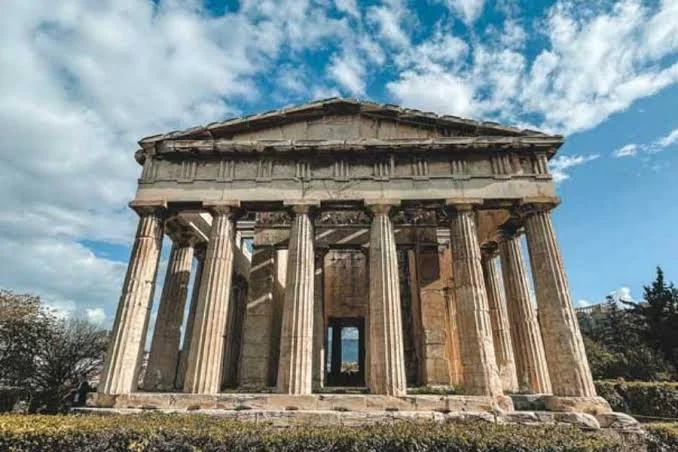
One of the most sophisticated features of Greek architecture is entasis.
Some columns are designed with a subtle outward curvature.
Instead of being perfectly straight from bottom to top, the shaft may swell slightly before narrowing again.
This creates an optical effect.
A perfectly straight column can appear visually concave from a distance.
By introducing slight curvature, architects could make the column appear straighter to the human eye.
Optical Refinements
Greek architects did not always design buildings according to rigid mathematical straight lines.
They understood that human vision can distort perception.
As a result, temples could include subtle refinements.
These might include:
curved platforms,
slightly tilted columns,
variations in column spacing,
and carefully adjusted proportions.
The Parthenon is especially famous for such refinements.
The building demonstrates that Greek architects were concerned not only with structural correctness but also with visual experience.
The Stylobate
The upper platform on which temple columns stand is called the stylobate.
This surface was not necessarily perfectly flat.
In some major Greek temples, subtle curvature was incorporated into the platform.
These refinements helped create a visually harmonious structure.
The difference might be almost invisible to a casual observer.
Yet it required extraordinary planning and precision.
The Role of Geometry
Greek architects relied upon geometry to organize proportions.
Measurements helped determine:
column height,
column diameter,
spacing,
building width,
roof dimensions,
and decorative placement.
Greek architecture was therefore based upon systems of relationships.
The beauty of a temple did not result only from expensive materials.
It resulted from proportion.
Architectural Orders
Greek temples developed recognizable architectural styles known as orders.
The three major orders are:
Doric
The Doric order is characterized by relatively sturdy proportions and capitals of a simple form.
Ionic
The Ionic order includes capitals with distinctive volutes, or spiral forms.
Corinthian
The Corinthian order became famous for elaborate capitals decorated with acanthus leaves.
Each order followed a set of architectural conventions.
However, builders could still adapt these conventions.
Greek architecture was systematic without being completely uniform.
Raising the Roof
After columns and walls were completed, builders constructed the roof.
Greek temple roofs were typically supported by wooden frameworks.
Tiles covered the roof.
Depending on the building, tiles could be made from:
terracotta,
marble,
or other materials.
The roof protected the interior and contributed to the temple's overall visual form.
Marble Roof Tiles
Some important temples used marble roof elements.
These could be heavy and required careful installation.
The roof therefore presented another major engineering challenge.
Builders needed to create a framework capable of supporting the weight while maintaining the desired shape.
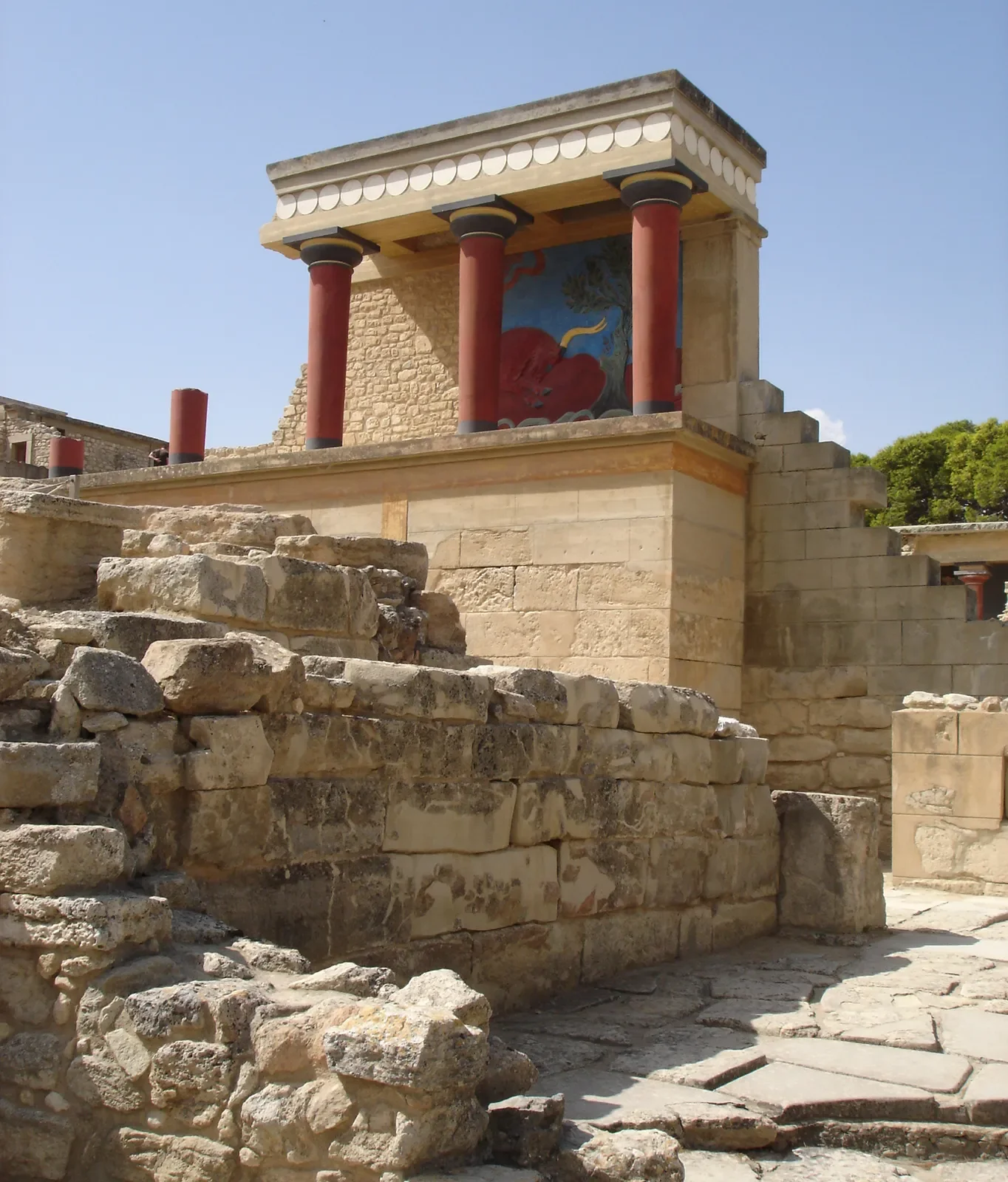
The Temple Was Originally Colorful
Modern visitors often imagine Greek temples as completely white.
This is misleading.
Many temples and sculptures were originally painted.
Architectural elements could contain vivid colors.
Sculptural decoration was also painted.
Over centuries, much of this color disappeared because pigments weathered and faded.
The modern white appearance is therefore often the result of survival rather than original design.
Sculptors Worked Alongside Builders
A temple was not simply an empty stone structure.
Sculptors created:
pedimental scenes,
friezes,
metopes,
statues,
and decorative elements.
These could communicate religious and political messages.
The Parthenon's sculptural program, for example, included complex mythological and civic imagery.
Architecture and sculpture were therefore closely connected.
Planning Before Construction
A major temple could not be built without extensive planning.
Builders needed to determine:
the building's dimensions;
the number of columns;
the source of stone;
transportation routes;
labor requirements;
and the sequence of construction.
Mistakes made early could affect the entire project.
Construction therefore required something similar to modern project management, even though the tools were entirely different.
The Architect's Role
The Greek architect was responsible for more than drawing a beautiful design.
The architect could be involved in:
planning,
measurement,
material selection,
worker coordination,
and technical decision-making.
Architecture combined artistic vision with practical engineering.
A successful architect needed to understand both.
Labor Organization
Large construction projects required a hierarchy of skills.
Highly trained specialists performed difficult work such as:
stone carving,
sculpture,
metalwork,
and architectural measurement.
Other workers performed transportation and general labor.
Some projects employed free citizens, resident foreigners, enslaved people, and specialized craftsmen, depending on the city and historical period.
Ancient construction was therefore also shaped by the social and economic systems of Greek society.
How Long Did Construction Take?
Large temples could take years or even decades to complete.
Construction depended upon:
funding,
political stability,
access to materials,
labor availability,
and changing architectural decisions.
A temple was a long-term commitment.
Workers could spend years contributing to a building they would never personally see in its final historical form.
The Parthenon as an Example
The Parthenon was constructed during the fifth century BCE on the Athenian Acropolis.
It required enormous quantities of Pentelic marble.
The project involved:
quarrying,
transportation,
precision stone cutting,
column construction,
roofing,
and extensive sculpture.
Despite the absence of modern construction machinery, the builders produced a structure of remarkable complexity.
The achievement depended upon organization.
Every stone had to arrive at the correct location.
Every architectural element had to fit into a larger system.
Ancient Construction Was Not Primitive
It is important to avoid describing Greek construction as “primitive” simply because it lacked modern technology.
Ancient builders possessed highly developed practical knowledge.
They understood:
mechanical advantage,
geometry,
material behavior,
structural weight,
visual perception,
and large-scale labor organization.
Their technology was different from modern technology.
It was not necessarily unsophisticated.
Knowledge Passed Between Generations
Architectural knowledge did not appear suddenly.
Builders learned through experience.
Techniques were transmitted between craftsmen.
Construction traditions developed over generations.
Later architects could build upon earlier discoveries.
This accumulation of knowledge allowed increasingly ambitious structures to be created.
The Importance of Human Skill
Modern machines can lift enormous weights.
Greek builders relied more heavily upon human expertise.
A skilled stonemason could recognize how stone should be cut.
A carpenter could construct scaffolding and lifting equipment.
A rope maker could produce strong materials.
An architect could coordinate proportions.
A crane operator could safely raise a heavy block.
The temple was therefore the result of collective specialization.
Conclusion
Ancient Greeks built their temples without modern tools by combining human labor with sophisticated engineering principles.
They quarried stone using hand tools, transported heavy blocks with sledges, rollers, carts, and ships, and raised architectural elements using cranes, ropes, pulleys, and other mechanical devices.
They carefully shaped stone blocks so that they fitted together with extraordinary precision. Columns were assembled from individual drums. Metal clamps and dowels strengthened important connections. Wooden scaffolding allowed workers to construct higher portions of buildings.
Greek architects also understood that buildings were experienced through human vision. Subtle curves, adjusted proportions, and optical refinements created structures that appeared balanced and harmonious.
The greatness of Greek temples therefore did not depend upon a single invention.
It resulted from the combination of geometry, craftsmanship, logistics, mechanical knowledge, artistic vision, and organized human labor.
The surviving ruins continue to demonstrate an important truth about ancient technology: a society does not need electricity, computers, or modern machinery to achieve extraordinary engineering.
What it needs is knowledge, skill, planning, cooperation and the ability to transform simple tools into solutions for complex problems.