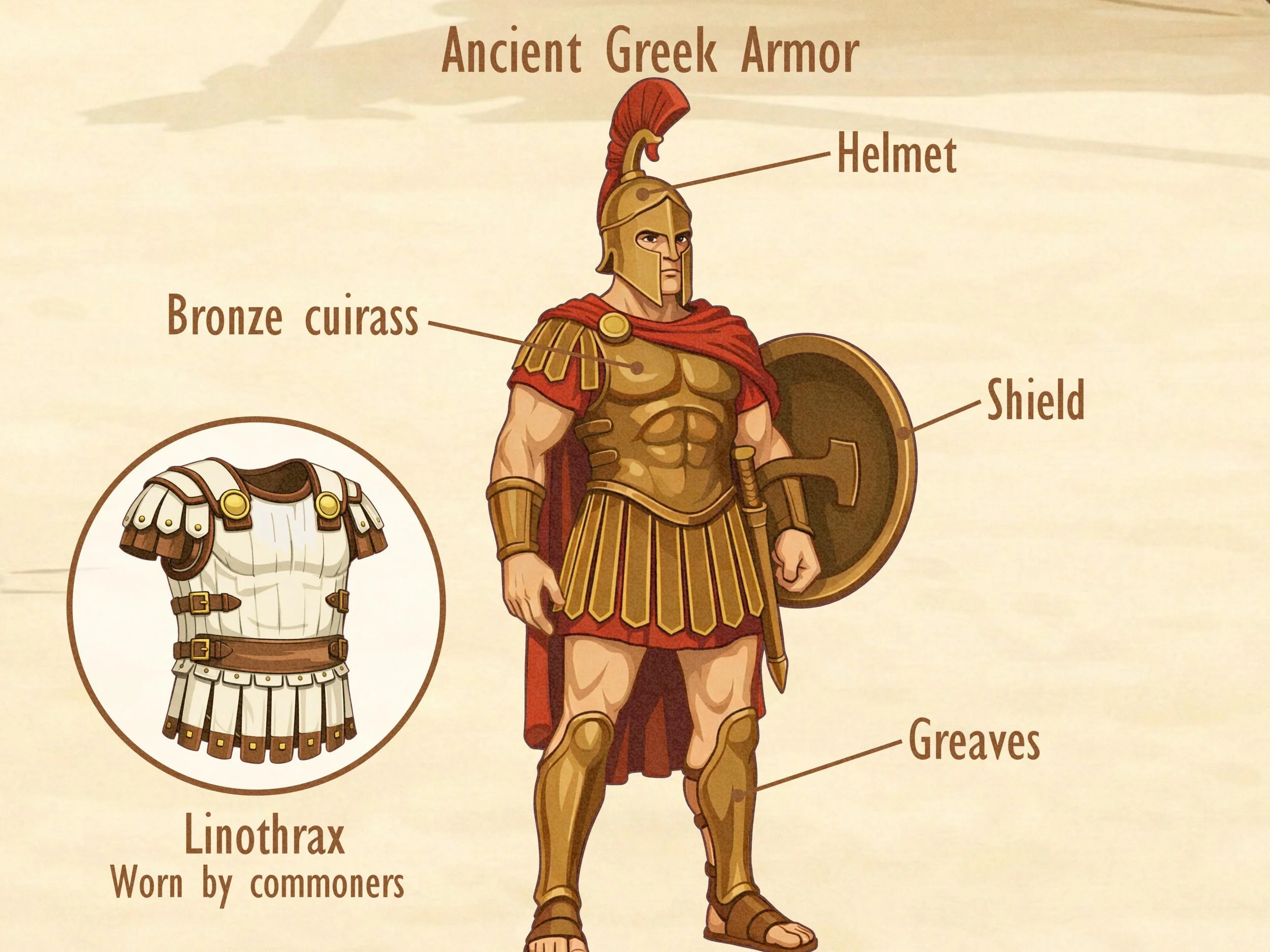
Ancient Greek weapons and armor were the products of highly developed craftsmanship. Greek warriors depended on equipment that needed to survive repeated physical stress while remaining practical enough to carry into battle. A sword that broke easily was useless. Armor that was too heavy could exhaust its wearer. A helmet that blocked too much vision could create danger despite offering strong protection.
Greek craftsmen therefore worked within a continuous balance between strength, weight, mobility, material availability, and cost.
The production of swords and armor also changed significantly across Greek history. Bronze Age weapons differed from those of the Archaic and Classical periods, while Hellenistic armies adopted increasingly diverse forms of military equipment. There was no single “Greek sword” or universal suit of Greek armor.
Instead, Greek military technology developed through experimentation, trade, warfare, and cultural exchange.
The Materials of Greek Warfare
Greek armorers worked primarily with materials such as:
bronze,
iron,
wood,
leather,
linen,
wool,
and other organic materials.
Each material had particular advantages.
Bronze was durable and could be cast or shaped.
Iron could produce strong blades but required specialized processing.
Wood formed the structural core of many shields.
Linen and leather could provide lighter forms of bodily protection.
The final equipment often combined several materials.
The Bronze Age Tradition
The earliest Greek civilizations of the Bronze Age produced sophisticated weapons.
Mycenaean warriors used bronze swords and other military equipment.
Bronze was an alloy created primarily from copper and tin.
Because tin was not equally available everywhere, bronze production depended on trade.
The existence of large-scale bronze industries demonstrates the economic complexity of ancient Mediterranean societies.
Making a Bronze Sword
A bronze sword could begin with the preparation of metal.
The basic process involved:
obtaining copper and tin;
melting the materials;
producing bronze of a suitable composition;
pouring molten metal into a mold;
removing the cooled object;
refining the blade;
sharpening and polishing;
attaching or shaping the handle.
Casting allowed craftsmen to create a basic sword form.
However, the finished weapon often required substantial additional work.
Casting Molds
Ancient metalworkers used molds to shape molten metal.
A mold could be made from materials capable of surviving high temperatures.
The design needed to create the intended shape while allowing the metal to flow.
A poorly designed mold could produce defects.
Successful casting therefore required experience and control.
Finishing the Blade
After casting, the weapon was not automatically ready for battle.
The blade could require:
hammering,
grinding,
sharpening,
polishing,
and correction of imperfections.
The edge needed to be thin enough to cut effectively but strong enough to avoid excessive damage.
The balance between sharpness and durability was essential.
The Transition Toward Iron
Over time, iron became increasingly important in Greek weapon production.
Iron was more widely available than tin, although producing useful iron required specialized knowledge.
Unlike bronze, ironworking involved heating ore and processing the resulting material.
The quality of iron could vary significantly.
Producing a reliable blade required control over heating and forging.
Forging an Iron Sword
An iron sword could be shaped through repeated cycles of heating and hammering.
A blacksmith would heat the metal until it became workable.
The material could then be hammered into the desired form.
This process could involve:
forming the blade;
narrowing the cutting edges;
shaping the tang;
refining the point;
and correcting irregularities.
Repeated heating allowed the metal to remain workable.
The Importance of Carbon
The properties of iron can be changed by the presence of carbon.
Iron with an appropriate carbon content can produce steel-like material with different hardness and strength.
Ancient metalworking techniques could produce varying qualities of iron and steel.
However, ancient Greek weapons should not all be imagined as identical high-quality steel blades.
The properties depended on the ore, technique, and skill of the smith.
Heat Treatment
Heating and cooling can change the structure and mechanical properties of iron and steel.
Ancient smiths developed practical methods for improving weapons through controlled heating and cooling.
They may not have understood the process through modern materials science, but generations of experience revealed that different treatments could affect:
hardness,
flexibility,
and durability.
The craft depended upon observation.
Types of Greek Swords
Greek warriors used several sword forms.
Two famous types include:
Xiphos
The xiphos was a relatively short double-edged sword.
It could be used for cutting and thrusting.
It became strongly associated with Greek hoplites.
Kopis
The kopis had a curved blade with a forward-weighted design.
Its shape made it effective for powerful cutting blows.
Different weapons reflected different fighting styles and military contexts.
The Sword as a Secondary Weapon
For many hoplites, the primary weapon was the spear.
The sword often served as a secondary weapon.
If the spear broke or became impractical, the warrior could draw the sword.
This influenced sword design.
A weapon carried as a backup needed to be compact and manageable.
Making the Handle
The blade needed a secure handle.
A poorly attached grip could cause the weapon to become dangerous to its own user.
Handles could involve materials such as:
wood,
bone,
ivory,
or other organic materials.
The grip needed to be shaped for control.
A pommel could help balance the weapon and secure components.
Bronze Armor
Bronze was also important for defensive equipment.
A skilled armorer could create:
helmets,
breastplates,
greaves,
and fittings.
Large pieces of bronze armor could be shaped through repeated hammering.
This required advanced knowledge of metalworking.
The Bronze Cuirass
A cuirass protected the torso.
Some Greek body armor was shaped to resemble the human body, producing the famous “muscle cuirass” appearance.
This design combined:
protection,
anatomical representation,
and artistic aesthetics.
The armor was not simply a flat sheet of metal.
It could be shaped to fit the body.
Hammering Bronze
Bronze can be shaped through repeated hammering.
As the metal is worked, it can become harder and less flexible.
Craftsmen could periodically heat it through annealing before continuing.
The production of a complex helmet or cuirass therefore involved repeated cycles of:
heating,
hammering,
shaping,
and refinement.
Linen Armor
Not all Greek armor was made from metal.
One important form of body protection was the linothorax, traditionally understood as armor made from linen layers, although the exact construction techniques remain debated among scholars.
Multiple layers of fabric could create a relatively light form of protection.
Such armor demonstrates that ancient military technology was not limited to metal.
Organic materials could also provide useful defense.
Leather and Organic Materials
Leather could be used in straps, fittings, and protective elements.
Organic materials had several advantages.
They could be:
lighter,
more flexible,
and sometimes less expensive than large quantities of bronze.
However, they generally do not survive as well archaeologically.
This means the archaeological record can create the misleading impression that ancient armies relied more heavily on metal than they actually did.
The Greek Shield
The large round shield associated with hoplite warfare was commonly called an aspis.
Its construction generally involved a wooden core combined with carefully designed grips and, in some cases, metal facing or reinforcement.
The shield needed to balance:
coverage,
weight,
strength,
and maneuverability.
A large shield could protect not only its owner but also contribute to the defense of the wider formation.
The Porpax and Antilabe
The Greek shield used a distinctive grip system.
The warrior placed the forearm through the porpax and held the antilabe near the rim.
This distributed the shield's weight and allowed greater control.
The system demonstrates how ancient military equipment could incorporate sophisticated ergonomic design.
Making a Greek Helmet
Helmets were often created from bronze.
The craftsperson shaped the metal through hammering and repeated heating.
Different styles developed according to military needs.
These included:
Corinthian helmets,
Illyrian helmets,
Chalcidian helmets,
and Attic forms.
Each offered a different balance between protection and awareness.
The Importance of Visibility and Hearing
A helmet that covered most of the face could provide strong protection.
However, it could also reduce:
peripheral vision,
hearing,
and comfort.
More open helmets provided greater awareness but less facial protection.
Greek armorers therefore had to make strategic design choices.
There was no perfect helmet for every situation.
Greaves
Greek warriors often wore greaves to protect the lower legs.
Bronze greaves could be shaped to fit around the calf and shin.
The natural springiness of the metal could help hold the greave in place.
A well-made piece required careful shaping because it needed to protect the leg without severely restricting movement.
Decoration and Identity
Weapons and armor could also be decorated.
A wealthy warrior might possess equipment with:
engraved patterns,
embossed designs,
elaborate crests,
or expensive materials.
Military equipment therefore had symbolic value.
It could communicate social status and identity as well as provide protection.
The Role of Specialized Workshops
Producing military equipment required specialized labor.
A complete set of armor could involve:
miners,
metal traders,
smelters,
blacksmiths,
bronze workers,
carpenters,
leatherworkers,
textile producers,
and weapon specialists.
The finished equipment represented an entire economic network.
Trade and Military Technology
Greek military production depended heavily on trade.
Copper, tin, iron, timber, leather, and other materials were not distributed equally across the Mediterranean.
Cities and craftsmen needed access to trade routes.
Military technology was therefore connected with economic power.
A state capable of acquiring large quantities of raw materials could equip more soldiers.
Repair and Recycling
Metal was valuable.
Damaged weapons and armor could often be repaired or melted down.
Bronze was particularly suitable for recycling.
This means that many ancient objects disappeared because their material was reused.
The archaeological record therefore represents only a fraction of the equipment originally produced.
Testing Equipment Through Experiment
Modern experimental archaeologists have recreated ancient weapons and armor.
By using historically appropriate materials and techniques, researchers can investigate:
weight,
mobility,
durability,
manufacturing time,
and combat effectiveness.
Such experiments help historians understand practical questions that written sources do not always answer.
However, modern reconstruction remains an interpretation rather than a perfect recreation of ancient experience.
The Balance Between Technology and Human Skill
Greek weapons were not produced by machines.
Every sword and piece of armor depended heavily on human skill.
A blacksmith needed to recognize the condition of heated metal.
A bronze worker needed to know when a sheet could be hammered safely.
A carpenter needed to shape wood without creating structural weaknesses.
Knowledge was preserved through experience and apprenticeship.
The Evolution of Greek Military Equipment
Greek military technology changed as warfare changed.
Developments in:
infantry tactics,
cavalry,
siege warfare,
and large professional armies
created new requirements.
The heavily armed citizen hoplite was not the only type of Greek warrior.
By the Hellenistic period, armies used increasingly diverse forms of equipment.
Military technology continued to evolve.
Conclusion
The Greeks created their swords and armor through a combination of metallurgy, woodworking, textile production, trade, and specialized craftsmanship.
Bronze swords could be cast and carefully finished. Iron blades were forged through repeated heating and hammering. Craftsmen shaped helmets and cuirasses through complex metalworking techniques, while shields combined wood, metal, and carefully designed grip systems.
Greek armor was not defined by a single material or design. Bronze, iron, linen, leather, and wood each contributed to military technology.
The greatest achievement of Greek armorers was their ability to balance competing needs.
Weapons needed to be strong but manageable.
Armor needed to protect without completely restricting movement.
Shields needed to cover the body without becoming impossible to control.
The finished equipment was therefore the result of careful design as well as craftsmanship.
Behind every Greek warrior stood an invisible network of miners, traders, smiths, carpenters, weavers, and artisans.
Their work transformed raw materials into the weapons and armor that helped shape the military history of the ancient Greek world.