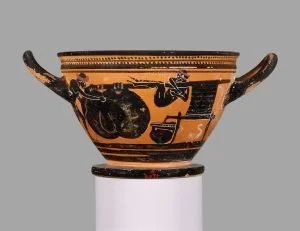
Perfume was an important part of personal care, religion, medicine, hospitality, and luxury in the ancient Greek world. Ancient Greek fragrance was not produced through modern industrial chemistry. Perfumers worked with natural materials obtained from plants, flowers, resins, spices, woods, seeds, and animal-derived substances.
The “secret ingredients” of ancient Greek perfume were therefore not mysterious synthetic chemicals. They were products of an extensive Mediterranean and Near Eastern trade network combined through skilled preparation.
Greek perfumers understood that a fragrance depended not only on the aromatic material itself but also on the substance used to carry and preserve its scent. Oils and fats played an essential role because many fragrant substances needed a medium capable of absorbing and retaining aromatic compounds.
The production of perfume was both an art and a technical craft.
Perfume in Ancient Greek Life
Fragrance appeared in many aspects of Greek society.
Perfumed substances could be used for:
personal grooming,
bathing,
athletic care,
religious offerings,
funerary rituals,
medical preparations,
and social display.
The use of fragrance was therefore not limited to luxury.
However, rare ingredients and complex preparations could make certain perfumes expensive and prestigious.
The Greek Word for Perfume
Ancient Greek texts use several terms connected with fragrances, oils, and ointments.
Perfumed oils were often important because olive oil provided an effective base.
Aromatic substances could be infused into the oil, producing a product that could be applied directly to the skin or hair.
Unlike many modern alcohol-based perfumes, ancient Greek fragrances were frequently oil-based.
Olive Oil as the Foundation
Olive oil was one of the most important ingredients in Greek life.
It served as:
food,
fuel,
a cosmetic substance,
a ritual material,
and a base for perfumes.
Its availability made it a practical carrier for fragrance.
The oil could absorb aromatic compounds and spread easily across the skin.
Perfumers could modify the oil through heating, filtering, and repeated infusion.
Almond Oil and Other Bases
Other oils could also be used depending on the desired preparation.
Ancient perfumery was not based on one universal formula.
Different ingredients had different properties.
A perfumer needed to consider:
scent,
texture,
stability,
availability,
and cost.
The choice of base could influence the final product.
Flowers in Ancient Greek Perfume
Flower-based fragrances were highly valued.
Possible aromatic plants included:
rose,
iris,
lily,
violet,
narcissus,
and other regional flowers.
These plants could be processed through soaking, pressing, heating, or infusion.
The resulting scents were often associated with beauty, youth, celebration, and luxury.
Rose Perfume
Rose was among the most important fragrance ingredients in the ancient Mediterranean.
Rose petals contain aromatic compounds that can be transferred into an oil or other medium.
Ancient rose perfumes could involve combinations of:
petals,
oil,
and additional aromatic substances.
The final product was more complex than simply placing flowers in a container.
Iris and Orris
Iris was another valuable source of fragrance.
The aromatic parts of the plant could be processed for use in perfumed preparations.
Iris-based scents were appreciated for their distinctive floral and earthy characteristics.
The preparation of plant materials often required drying and aging before the desired fragrance developed fully.
Myrrh
Myrrh was an important aromatic resin.
It came from trees and shrubs associated primarily with regions beyond mainland Greece and therefore depended on long-distance trade.
Myrrh possessed a strong, distinctive scent and could be used in:
perfume,
incense,
medicine,
and ritual.
Its value demonstrates that Greek perfumery was connected with international trade networks.
Frankincense
Frankincense was another important aromatic resin.
Like myrrh, it was valued for its fragrance and ritual associations.
Resins could be burned as incense or incorporated into other aromatic preparations.
Their use connected perfume with religious ceremony.
Cinnamon and Other Imported Spices
Some expensive perfumes included aromatic substances obtained through long-distance trade.
These could include materials such as:
cinnamon,
cassia,
and other spices.
Ancient trade routes connected the Mediterranean with regions of Africa and Asia through complex networks.
A luxurious perfume could therefore contain ingredients that had traveled enormous distances before reaching a Greek workshop.
Herbs and Leaves
Not all perfume ingredients were rare imports.
The Mediterranean environment provided many aromatic plants.
Possible materials included:
thyme,
rosemary,
marjoram,
mint,
sage,
and other herbs.
These could be used alone or combined with more expensive floral and resinous substances.
Herbal fragrances were practical because local plants were more accessible.
Aromatic Woods
Wood could also contribute fragrance.
Cedar and other aromatic woods were valued for their scent and preservation qualities.
Wood-derived materials could be used in storage, ritual, or aromatic preparations.
The fragrance of a finished perfume could therefore result from several different categories of ingredients.
Animal-Derived Ingredients
Some ancient perfumes and aromatic preparations used animal-derived substances.
These could serve as:
scent components,
stabilizing materials,
or ingredients in medical and cosmetic formulas.
Such materials were not necessarily used in every perfume.
Their inclusion depended upon the recipe and the availability of ingredients.
How Ancient Perfumers Extracted Fragrance
Modern perfume manufacturing often uses:
steam distillation,
solvent extraction,
molecular analysis,
and industrial blending.
Ancient Greek perfumers used more direct methods.
One common approach involved infusion.
Aromatic materials were placed into an oil or fat-based medium.
The mixture could be warmed or allowed to stand so that the base absorbed the fragrance.
The material could then be removed and replaced with fresh aromatic ingredients.
Repeated infusion could increase the strength of the scent.
Heating and Infusion
Heating had to be carefully controlled.
Too little heat might not effectively release desired aromatic compounds.
Too much heat could damage delicate ingredients.
Ancient perfumers therefore needed practical experience.
The process required attention to:
temperature,
duration,
ingredient ratios,
and filtration.
The work was both technical and sensory.
Grinding and Crushing
Some ingredients needed to be crushed before infusion.
Seeds, resins, bark, flowers, and herbs could release more fragrance when broken into smaller pieces.
Tools such as mortars and pestles allowed perfumers to process these materials.
Grinding also made it easier to combine different ingredients.
Mixing Fragrances
Ancient perfume was often a blended product.
A perfumer could combine:
a floral scent,
a resinous scent,
a spice,
and an oil base.
This allowed the creation of layered fragrances.
A perfume might contain an immediately recognizable aroma as well as deeper notes that developed over time.
The art of blending required knowledge of how different materials interacted.
Fixatives and Preservation
One challenge of perfume production is maintaining a fragrance.
Volatile aromatic compounds can disappear over time.
Oil-based preparations could help preserve certain scents.
Resins and other substances could also contribute longer-lasting aromatic qualities.
Ancient perfumers may not have described these functions using modern chemical terminology, but practical experience taught them which ingredients retained their fragrance.
Perfume and Athletics
Athletes were closely associated with oil.
Before exercise, they could apply oil to the body.
After training, they used a strigil to remove oil, sweat, and dirt.
Perfumed oils could add an element of grooming and luxury to bodily care.
The relationship between athletics and fragrance demonstrates that Greek perfume was connected with the physical body as well as elite fashion.
Perfume and Social Status
Rare ingredients could make perfume expensive.
A fragrance containing imported spices or resins represented access to trade networks and wealth.
The use of perfume could therefore communicate:
social status,
refinement,
wealth,
and participation in fashionable culture.
At the same time, simpler scented oils could be more accessible.
Ancient perfume existed across a range of economic levels.
Perfume and Gender
Both men and women could use scented products, although social expectations surrounding appearance changed according to period and community.
Greek authors sometimes expressed moral opinions about excessive luxury or cosmetic use.
These debates reveal that perfume could become associated with questions of:
self-control,
wealth,
gender expectations,
and foreign influence.
Fragrance was therefore not politically or morally neutral.
Perfume and Religion
Aromatic substances were important in religious life.
Fragrant oils and resins could be offered to the gods.
Incense produced smoke and scent within sacred spaces.
Perfume could also be associated with purification and ritual preparation.
The pleasant smell of aromatic materials could symbolize honor and devotion.
Perfume and Death
Fragrance also played a role in funerary practices.
Bodies could be washed, anointed, or treated with aromatic substances.
Perfume could therefore accompany major transitions in human life.
The same ingredients associated with beauty and celebration could also be associated with death and remembrance.
Perfume Containers
Ancient Greeks developed specialized containers for oils and perfumes.
Ceramic vessels could be designed to control the use and storage of valuable liquids.
Among the best-known forms is the aryballos, a small vessel often associated with athletes and perfumed oil.
Other vessel types were also used depending on the product and context.
Why Small Containers Were Useful
Perfume was valuable.
A small container reduced waste and made transportation easier.
A carefully designed opening could control the amount of oil poured out.
The container itself could also become an artistic object.
Painted and decorated perfume vessels demonstrate the connection between fragrance and visual culture.
Perfume Workshops
The production of perfume could involve specialized craftsmen.
A workshop required access to:
oils,
plant materials,
imported aromatics,
containers,
tools,
and trade networks.
The perfumer needed both practical skill and commercial knowledge.
Producing an attractive fragrance was not enough.
The ingredients had to be obtained, processed, stored, and sold.
The International Trade Behind a Single Bottle
A luxury Greek perfume could represent a remarkable chain of exchange.
Olive oil might be produced locally.
A flower could come from a nearby region.
A resin might arrive from Arabia or northeastern Africa.
A spice could reach the Mediterranean through multiple intermediaries.
The final product was therefore the result of an interconnected ancient economy.
Ancient Perfume Was Not Exactly Like Modern Perfume
Modern perfume is often alcohol-based and manufactured through precise chemical processes.
Ancient Greek perfume was commonly oil-based.
Its scent, texture, and method of application would therefore have been different.
A modern spray creates a fine mist.
An ancient perfumed oil was more likely applied directly to the skin or hair.
The experience of fragrance was therefore closely connected with touch.
Reconstructing Ancient Perfume
Modern historians and experimental archaeologists have attempted to recreate ancient perfumes based on:
written recipes,
archaeological residues,
ancient containers,
and knowledge of historical ingredients.
These reconstructions help researchers understand ancient manufacturing techniques.
However, the exact smell of every ancient perfume cannot always be recovered.
Organic materials change over time, and ancient recipes may be incomplete.
The “Secret” of Ancient Greek Perfume
The greatest secret was not one magical ingredient.
It was the combination of natural resources, technical knowledge, and skilled blending.
A successful perfumer understood:
which plants produced desirable scents;
how to prepare flowers and resins;
how to infuse aromatic materials into oil;
how to combine different fragrances;
and how to preserve the finished product.
Ancient perfume was therefore a form of applied knowledge.
Conclusion
The secret ingredients of ancient Greek perfume included an extraordinary variety of natural substances: olive oil, flowers, herbs, aromatic resins, spices, woods, and other carefully selected materials.
Rose, iris, myrrh, frankincense, cinnamon, herbs, and locally available plants could all contribute to the creation of fragrance. Some ingredients were gathered close to home, while others traveled across vast trade networks before reaching Greek workshops.
Ancient perfumers used techniques such as crushing, heating, soaking, infusion, filtering, and blending to transform raw materials into valuable scented oils.
Perfume was more than a cosmetic product. It was connected with athletics, religion, medicine, hospitality, social identity, and funerary customs.
Behind a small vessel of fragrant oil stood a sophisticated process involving agriculture, trade, craftsmanship, and sensory knowledge.
The true secret of ancient Greek perfume was therefore not hidden in a single rare ingredient.
It was hidden in the skill of the perfumer who knew how to transform the natural world into scent.