Ancient Greek civilization is often remembered for marble temples, bronze statues, painted pottery, and philosophical texts.
But one of the most important products of Greek society was far less likely to survive in the archaeological record:
Textiles.
Clothing, household fabrics, sails, blankets, ceremonial garments, and woven decorations were essential to everyday life. Yet because cloth decays easily, much of the ancient Greek textile tradition has disappeared.
What historians know comes from surviving textile fragments, loom weights, tools, literary sources, and images painted on pottery.
Together, these sources reveal that weaving was one of the most important technologies in the ancient Greek household.
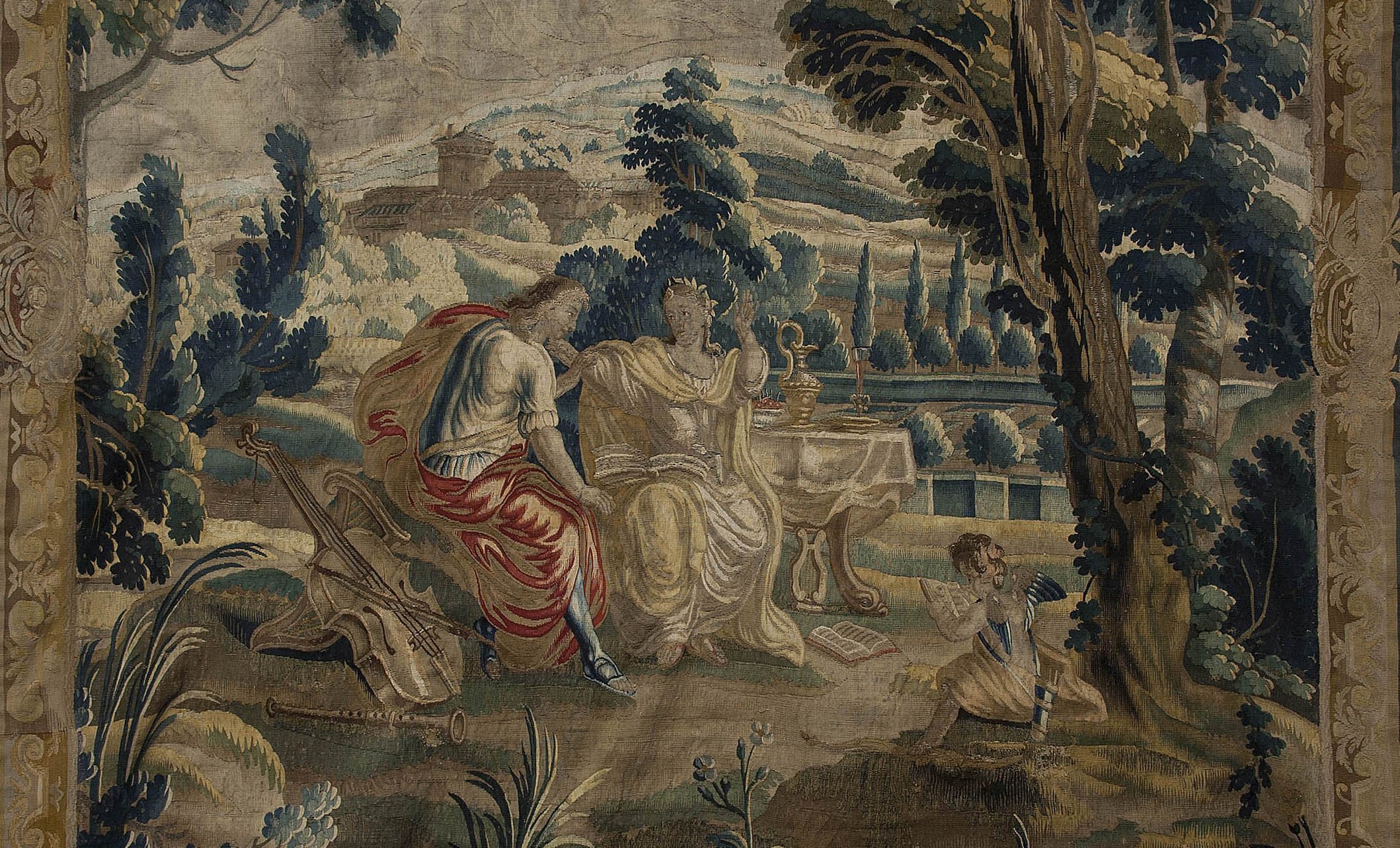
A Crucial Clarification: Did the Greeks Make "Tapestries"?
The word tapestry is often used loosely to describe ancient woven textiles.
However, the famous large-scale narrative tapestries associated with medieval and later European traditions should not simply be projected backward onto ancient Greece.
Greek textile production included woven garments, decorative fabrics, patterned textiles, embroidery, and elaborate ceremonial cloth.
The techniques and terminology varied.
Therefore, when discussing Greek "tapestries," it is more accurate to describe the broader world of Greek textile production and decorative weaving.
The First Step: Producing Fiber
Ancient Greek textiles could be made from several natural materials.
The most important included:
Wool
Linen
Other plant fibers
Later and more limited luxury materials acquired through trade
Wool was particularly important.
Sheep provided a renewable source of fiber that could be cleaned, processed, spun, dyed, and woven.
Linen came from flax and required a different production process.
Before weaving could begin, raw fibers needed significant preparation.
Cleaning and Preparing Wool
Freshly obtained wool could contain natural oils, dirt, and other impurities.
It had to be cleaned and prepared.
The fibers were then arranged and processed so they could be spun into yarn.
This stage required skill because the quality of the final textile depended heavily on the consistency of the thread.
Uneven yarn could produce uneven fabric.
Spinning: Turning Fiber Into Thread
One of the most common ancient tools was the spindle.
A spindle allowed fibers to be twisted into thread.
The process was physically simple in principle but required practice.
The spinner controlled the thickness and twist of the yarn.
A spindle whorl—a weighted object attached to the spindle—helped maintain rotation.
Archaeologists frequently discover spindle whorls because they survive much better than the wooden shafts and textile fibers associated with them.
These small objects are important evidence for the enormous scale of ancient textile production.
The Loom and the Warp-Weighted System
One of the most characteristic Greek weaving technologies was the warp-weighted loom.
The warp threads were arranged vertically.
Weights attached to the lower ends helped keep the threads under tension.
The weaver then passed the horizontal weft thread through the vertical warp.
By repeating this process, fabric gradually formed.
The loom weights discovered at archaeological sites provide evidence of ancient weaving even when the textiles themselves have completely decayed.
Weaving Was Labor-Intensive
Producing a single piece of cloth could require a remarkable amount of work.
The process included:
Obtaining raw fiber.
Cleaning and preparing the material.
Spinning fibers into thread.
Preparing the loom.
Weaving the fabric.
Dyeing or decorating the textile.
Cutting, arranging, or finishing the final garment.
In a society without industrial machines, textile production demanded time and human labor.
This is why clothing was economically valuable.
A fine garment represented not only material but also many hours of work.
Women and the Greek Household
Textile production was strongly associated with women's labor in many Greek communities, particularly within the idealized structure of the household, or oikos.
Ancient literature frequently connects respectable women with spinning and weaving.
The image was not accidental.
The ability to manage textile production represented domestic competence and economic contribution.
One of the most famous literary examples is Penelope in Homer's Odyssey.
She delays her suitors by claiming she must finish weaving a burial shroud.
During the day, she weaves.
At night, she secretly unravels her work.
The story demonstrates how deeply weaving was embedded in Greek cultural imagination.
Weaving as Mythology
The importance of textile production also appears in Greek mythology.
Athena was associated with wisdom, crafts, and weaving.
The myth of Arachne tells of a talented weaver who challenges Athena.
The story reflects both admiration for technical skill and anxiety surrounding human pride.
Weaving was therefore not merely a domestic activity.
It became a metaphor for intelligence, creativity, social order, and divine power.
Creating Color
Ancient textiles were not necessarily plain or colorless.
Greek artisans used dyes derived from plants, minerals, and other natural sources.
Different materials could produce different colors.
The process could involve:
Collecting dye-producing substances
Extracting color
Preparing the fibers
Using mordants or chemical agents to help fix color
Repeated dyeing to achieve deeper shades
Certain colors were more difficult and expensive to produce.
This made brightly colored or richly decorated textiles symbols of wealth and status.
Patterns and Decoration
Greek textile decoration could involve multiple methods.
Weavers could create patterns through changes in the arrangement of threads.
Additional decorative techniques could include embroidery and applied ornament.
Borders were particularly important.
A garment might include geometric patterns, repeated motifs, or symbolic designs.
Because most ancient Greek textiles have not survived, pottery paintings and sculpture are valuable sources for understanding the appearance of clothing.
Artists frequently depicted garments with folds, borders, and decorative patterns.
The Panathenaic Peplos
One of the most important ceremonial textiles in ancient Athens was the peplos associated with the Panathenaic festival.
A specially prepared garment was presented to Athena.
The production and presentation of this textile connected craftsmanship with civic identity and religion.
The cloth was not simply clothing.
It became an object of public ceremony.
Textile Production and the Greek Economy
Textiles were economically significant.
Households could produce cloth for their own use, but textiles also participated in trade and exchange.
Raw materials, dyes, and finished fabrics could move between regions.
Sails were essential to maritime activity.
Clothing was essential to daily life.
Ceremonial textiles carried religious importance.
Military equipment also depended on textile technologies, including garments, straps, padding, and other materials.
The ancient Greek world would have been impossible without fiber production.
The Forgotten Technology of Ancient Greece
Because marble statues and pottery survive more easily, textiles often receive less attention.
Yet the spinning wheel was not the only important technology of the ancient household—the spindle and loom were equally transformative.
Every piece of cloth represented accumulated knowledge about:
Animal husbandry
Plant cultivation
Fiber processing
Mechanical tension
Spinning
Dye chemistry
Pattern construction
Labor organization
Greek weaving was therefore a sophisticated technological tradition.
The next time we imagine ancient Greece, we should not picture only white marble and bronze.
The Greek world was also full of color, thread, wool, linen, patterned garments, dyed fabrics, and the constant sound of labor at the loom.