Few archaeological objects are as mysterious as the Phaistos Disc.
Discovered on the island of Crete, the small clay disc is covered with strange symbols arranged in a spiral. More than a century after its discovery, scholars still cannot agree on exactly what the symbols mean.
Is it an ancient language?
A religious text?
A hymn?
A magical formula?
A game?
A record of historical events?
Or could the entire object be something else entirely?
The Phaistos Disc remains one of the greatest undeciphered artifacts of the ancient Mediterranean.
The Discovery of the Phaistos Disc
The disc was discovered in 1908 at the archaeological site of Phaistos in southern Crete.
The excavation was conducted under the direction of the Italian archaeologist Luigi Pernier.
Phaistos was an important center of Minoan civilization, the Bronze Age culture that flourished on Crete long before classical Greek civilization.
The disc was found in a context associated with the broader archaeological remains of the Minoan world.
It immediately attracted attention because of its unusual writing.
What Does the Disc Look Like?
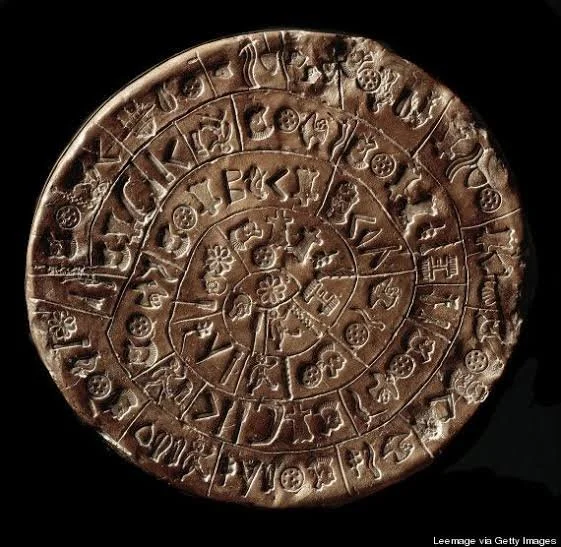
The Phaistos Disc is a roughly circular object made from clay.
Both sides contain symbols arranged in a spiral.
The signs include images resembling:
Human heads
Animals
Plants
Tools
Weapons
Other recognizable or semi-recognizable objects
The symbols are separated into groups by dividing marks.
This suggests that the signs may represent words, syllables, phrases, or another structured form of communication.
The problem is that no one knows for certain.
The Most Remarkable Detail: Was It an Early Form of Printing?
One of the most fascinating aspects of the Phaistos Disc is the way the symbols appear to have been impressed into the clay.
Rather than each sign being individually carved by hand after the clay was shaped, many scholars have argued that the symbols were stamped using pre-made sign tools.
If this interpretation is correct, the Phaistos Disc represents an extraordinary use of reusable symbols.
The same signs appear multiple times.
This has led people to describe the process as a kind of ancient precursor to movable-type printing.
However, this comparison must be used carefully.
The disc was not produced using modern printing technology. There is no evidence of mass production, printing presses, or an industrial system.
Nevertheless, the apparent use of reusable stamps is technologically fascinating.
How Many Symbols Are There?
The disc contains a limited number of distinct signs, repeated in different combinations.
The symbols are grouped into sequences.
This pattern strongly suggests intentional structure.
If the object contains writing, the signs may represent sounds or linguistic units.
But other possibilities exist.
The symbols could potentially represent:
A writing system
A religious formula
A mnemonic system
A coded message
A ceremonial text
A non-linguistic symbolic sequence
Without another text using the same system, determining the answer is extremely difficult.
Why Has Nobody Deciphered It?
The greatest problem is the lack of comparison.
Ancient scripts are usually deciphered more successfully when scholars possess a large number of examples.
The decipherment of Egyptian hieroglyphs, for example, was greatly assisted by the Rosetta Stone, which contained related texts in different scripts and languages.
The Phaistos Disc has no equivalent bilingual text.
It is also extremely short.
A short text provides limited statistical information.
Imagine trying to decode an unknown language using only a few sentences.
It would be extraordinarily difficult to determine:
Which direction the text should be read
Whether symbols represent sounds or words
What language is represented
Whether the object is even linguistic
How signs should be divided
Whether repeated patterns indicate grammar or simply decoration
Could It Be Related to Linear A?
The Phaistos Disc comes from Minoan Crete, where other writing systems are known.
One of the most important is Linear A, an undeciphered script used by the Minoans.
Later, the Mycenaean Greeks adapted a related system called Linear B.
Linear B was eventually deciphered and shown to represent an early form of Greek.
Linear A, however, remains undeciphered.
Some researchers have attempted to connect the Phaistos Disc to Linear A or other Aegean writing traditions.
The problem is that the symbols on the disc do not clearly match the signs of these scripts.
Any relationship remains uncertain.
Is the Disc Written in Greek?
There is currently no scholarly consensus that the Phaistos Disc contains Greek.
This is an important point.
The artifact predates classical Greek civilization and belongs to the complex cultural world of Bronze Age Crete.
Even if the signs represent language, that language may not be Greek.
It could represent a language associated with Minoan civilization, another population of the eastern Mediterranean, or something that scholars cannot currently identify.
Which Direction Should It Be Read?
Even determining where to begin can be debated.
The spiral creates an obvious visual structure, but the direction of reading must still be interpreted.
Did the writer begin at the outer edge and move inward?
Or begin at the center and move outward?
Small details associated with the signs have been used to argue for different possibilities.
The reading direction matters enormously because reversing the order of symbols changes every attempt at linguistic analysis.
The Hoax Theory
One of the most controversial possibilities is that the Phaistos Disc could be a modern forgery.
Some scholars have raised doubts because of its uniqueness.
No unquestionably identical system of writing has been discovered elsewhere.
The disc is unusual in its design, symbols, and apparent production technique.
Its uniqueness has encouraged suspicion.
However, proving that an archaeological object is a forgery is difficult, especially when the object was excavated more than a century ago.
The majority of scholarly discussion has generally treated the disc as an authentic ancient artifact, although questions and debates surrounding its authenticity have not completely disappeared.
The controversy itself demonstrates how unusual the object is.
Why the Mystery Continues
Every proposed decipherment faces the same problem.
A scholar may assign sounds or meanings to symbols and create an apparently convincing translation.
But without independent evidence, there is no reliable way to confirm that interpretation.
Many proposed translations have claimed that the disc contains:
A hymn
A prayer
A historical record
A legal document
A magical text
A military message
A calendar
A game
A poem
The sheer variety of proposed solutions demonstrates the danger.
When the underlying code is unknown, it is possible to construct interpretations that appear meaningful but cannot be independently verified.
What the Phaistos Disc Really Teaches Us
The greatest mystery may not be what the disc says.
It may be what the object reveals about the limits of human knowledge.
Modern archaeology has satellites, chemical analysis, digital imaging, databases, artificial intelligence, and advanced statistical methods.
Yet a small clay disc discovered in 1908 can still resist every attempt at explanation.
The Phaistos Disc is a reminder that the ancient world has not surrendered all of its secrets.
Some civilizations left behind buildings that can be excavated, statues that can be studied, and languages that can be translated.
Others left behind fragments.
A symbol.
A mark.
A spiral.
And a message that humanity may have been trying to read for more than a hundred years.
Perhaps the most fascinating possibility is that the Phaistos Disc is not mysterious because the ancient world failed to explain it but because we are still trying to learn how to ask the right question.