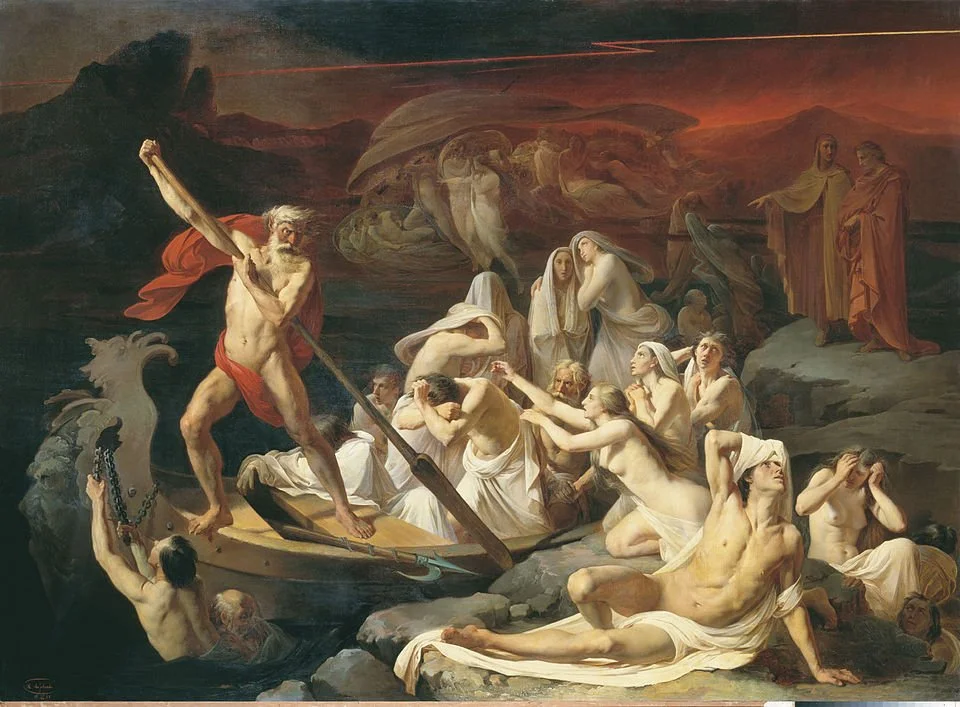
Among the many features of Greek mythology, few are as enduring and mysterious as the River Styx. Frequently imagined as a dark river separating the world of the living from the realm of the dead, the Styx has become one of the most recognizable symbols of the Greek Underworld. Yet the ancient conception of the Styx was considerably more complex than the popular image of a single river that every dead soul had to cross. In early Greek literature, the Styx was simultaneously a geographical feature of the Underworld, a divine being, and the sacred foundation upon which the gods themselves swore their most binding oaths.
The importance of the Styx can be traced particularly clearly through the works attributed to Homer and Hesiod. Hesiod's Theogony, one of the earliest surviving Greek accounts of divine genealogy, identifies Styx as an Oceanid, the daughter of Oceanus and Tethys. She is therefore not merely a body of water but a divine personality within the cosmic structure of Greek mythology. Hesiod also associates Styx with an extraordinary group of children: Zelos (Zeal), Nike (Victory), Kratos (Strength or Power), and Bia (Force). These figures became closely associated with Zeus and the authority of the Olympian order.
Styx as a Divine Being
The personification of the Styx reflects an important feature of ancient Greek religion: natural phenomena could possess divine identities. Rivers, springs, mountains, winds, and celestial bodies could all be understood as manifestations of divine powers. Consequently, Styx was not simply a river in a physical sense. She possessed ancestry, agency, and a place within divine society.
According to Hesiod, Styx played a significant role during the conflict between Zeus and the Titans. When Zeus called upon the gods to join his side in the war, Styx was among the first to respond. She came to Olympus with her children, demonstrating her allegiance to Zeus. In return, Zeus honored Styx and established her as the great witness of divine oaths.
This association explains why an oath sworn by the Styx carried extraordinary authority. The river represented something beyond ordinary promises: it was connected to the fundamental order of the cosmos and to Zeus's sovereignty over the gods.
The Most Sacred Oath of the Gods
In Greek mythology, even the Olympian gods could lie, deceive, quarrel, and betray one another. However, an oath sworn upon the Styx was treated as exceptionally serious.
Hesiod describes the waters of Styx as the substance brought to Olympus when a dispute arose among the immortals. Iris, the divine messenger, could be sent to obtain the sacred water so that a god could swear upon it. The water itself therefore functioned as a supernatural guarantor of truth.
Homer provides one of the clearest examples in the Iliad. When Hera attempts to convince Zeus that she had not influenced Poseidon to intervene in the Trojan War, she invokes the waters of the Styx as part of her oath. The oath is presented as the most solemn form of testimony available to the gods.
This is important because it reveals that the Styx was not primarily frightening merely because it belonged to the Underworld. Its deeper significance was irreversibility. A promise made through Styx could not casually be withdrawn.
Ancient Greek mythology therefore connects the Styx with an idea that remains powerful today: some promises carry consequences precisely because they cannot be undone.
Styx and the Underworld
The popular image of the Styx as the principal entrance to the Underworld comes from a combination of different ancient traditions that developed over time.
Hesiod places Styx within the geography of Hades. She dwells in a remote and terrible region associated with the realm of the dead. Her house is described as surrounded by immense rocks and supported by silver pillars, creating an image of a place that is both magnificent and terrifying.
However, it is important not to assume that every ancient Greek author imagined the Underworld in exactly the same way.
The Greek Underworld had several rivers associated with it, including Acheron, Cocytus, Phlegethon, Lethe, and Styx. Their individual roles and geographical relationships vary across literary traditions.
This is one reason why the modern statement that "all souls crossed the River Styx" is somewhat misleading. The later popular tradition frequently combines several different descriptions of the Underworld into one standardized landscape.
The River Acheron and Charon
Another important distinction concerns Charon, the famous ferryman of the dead.
Modern representations often depict Charon as transporting souls across the Styx. However, ancient sources also associate Charon with the Acheron, another river of the Underworld. The tradition concerning Charon developed over time, and he does not appear in the same role in the earliest surviving Homeric and Hesiodic descriptions.
This distinction demonstrates an important principle when studying mythology academically: Greek mythology was not a single standardized storybook.
Different poets, cities, religious traditions, and historical periods could emphasize different aspects of the same mythological world.
Thus, the familiar image of a dead soul approaching a dark river, paying Charon, and crossing into Hades represents a later synthesis of traditions rather than a complete description found identically in the earliest Greek literature.
Styx as a Symbol of Death
The connection between Styx and death nevertheless became extremely powerful.
Water traditionally represents boundaries and transition in mythology. A river can separate one territory from another, and in the case of Styx, that boundary becomes metaphysical: it separates mortal existence from the realm of the dead.
Crossing a river therefore becomes an appropriate symbol for death.
The individual leaves behind the familiar world and enters an unfamiliar domain governed by different rules. The river is not simply an obstacle; it represents a point of no return.
This symbolism is particularly significant because Greek mythology often portrays death as an irreversible transformation. Heroes can occasionally escape the Underworld—Heracles, Orpheus, and others demonstrate that extraordinary exceptions exist—but ordinary mortals do not simply return to their previous lives.
Styx and Achilles
The Styx also became connected with one of Greek mythology's most famous heroes: Achilles.
A later tradition claims that Achilles' mother, Thetis, attempted to make her son invulnerable by dipping him into the waters of the Styx. Because she held him by the heel, that part of his body remained vulnerable, producing the famous expression "Achilles' heel."
However, this story should be treated carefully.
The earliest surviving accounts of Achilles, particularly Homer's Iliad, do not present the Styx-dipping episode as the explanation for his vulnerability. The famous version belongs to later mythological traditions.
This is another example of how Greek mythology evolved over centuries. A story can become culturally dominant even though it does not originate in the earliest surviving version of the myth.
The Meaning of the Styx
The Styx ultimately represents several interconnected ideas:
death and the boundary between life and death;
divine authority;
irreversible promises;
cosmic law;
fear of the unknown;
and the consequences of crossing a point of no return.
Its power comes from this combination of meanings.
The Styx is simultaneously a river, a goddess, a sacred institution, and a symbol of mortality.
Perhaps this is why its image has survived for thousands of years. The idea of a river separating two worlds is universally understandable. Every human being eventually confronts some form of boundary between what is known and what lies beyond it.
In Greek mythology, the Styx gives that boundary a name.
Historical and Literary Significance
The mythology surrounding the Styx demonstrates the richness of ancient Greek religious thought. Rather than presenting death as a simple destination, Greek mythology created an entire conceptual geography around it. Rivers, gates, ferrymen, judges, gods, monsters, and spirits all contributed to the image of the Underworld.
The Styx stands at the center of that imaginative geography—not necessarily because every Greek believed that it was literally the single river that every soul crossed, but because it became the ultimate symbol of an unbreakable boundary.
Its waters were sacred enough to bind gods, terrible enough to belong to the Underworld, and powerful enough to remain one of the most enduring symbols of death in Western mythology.