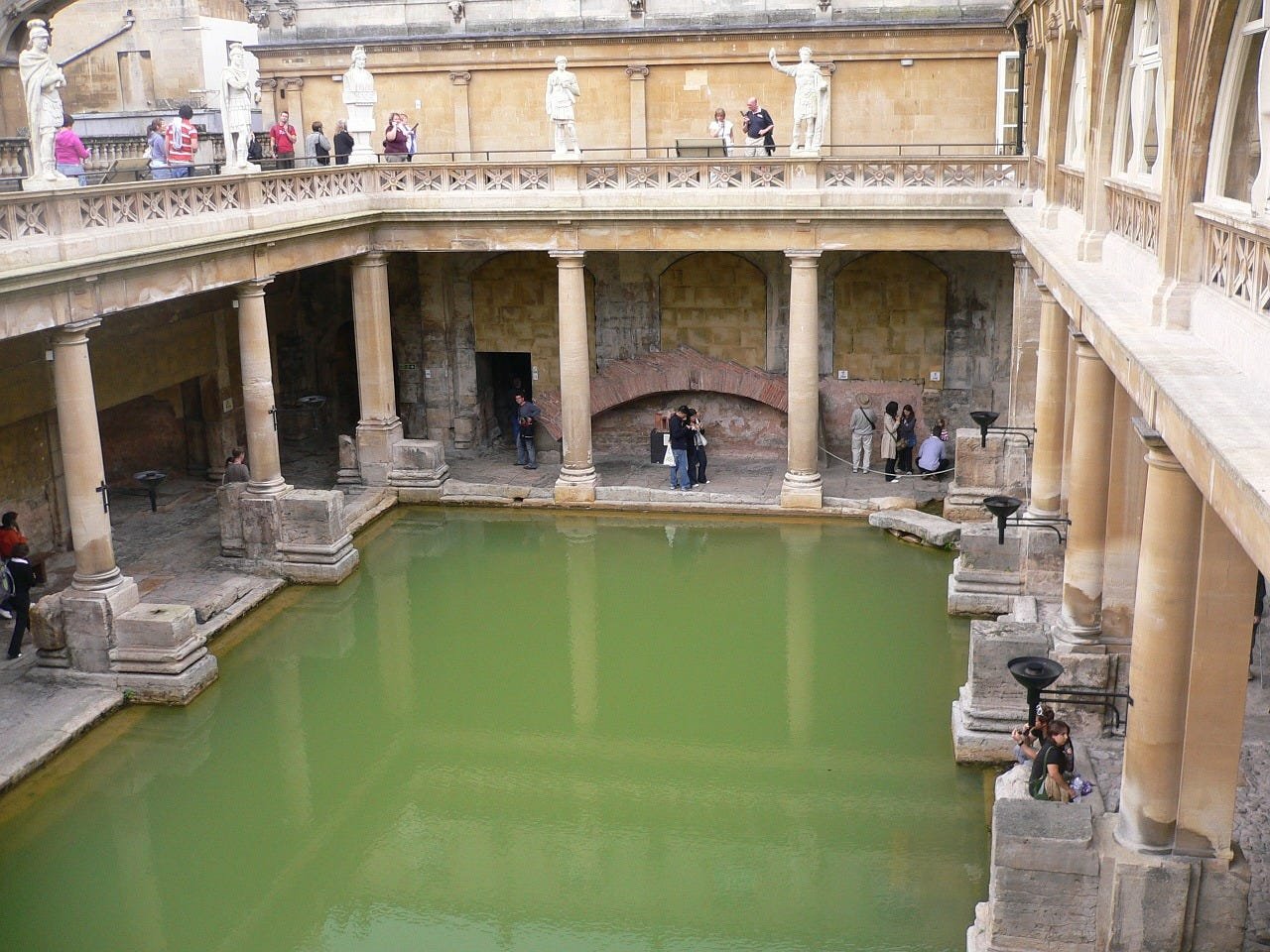
Bathing played an important role in ancient Greek life, but the idea of the “Greek bathhouse” requires careful explanation. Ancient Greek bathing practices were not identical to the enormous imperial bath complexes later associated with Rome. Greek bathing developed over a long period and included a mixture of domestic washing, public bathing facilities, athletic cleansing, therapeutic bathing, and social interaction.
Public bathing spaces existed in the Greek world, particularly in cities and sanctuaries, but their scale and organization varied according to place and period. By the Hellenistic era, more elaborate bathing facilities developed, while later Roman influence transformed bathing architecture throughout the Mediterranean.
For ancient Greeks, bathing could serve practical, medical, athletic, religious, and social purposes.
Bathing Before the Bathhouse
Personal cleanliness did not begin with monumental public buildings.
Early Greek communities relied upon:
rivers,
springs,
fountains,
basins,
portable vessels,
and household washing areas.
Water was essential for drinking, cooking, agriculture, and personal hygiene.
The availability of reliable water sources strongly influenced settlement patterns.
A natural spring could become an important community resource.
Water and Daily Life
Ancient Greek cities did not possess modern plumbing systems.
Access to water required infrastructure and labor.
Communities developed:
wells,
fountains,
cisterns,
aqueducts in some regions and periods,
and systems for collecting rainwater.
People often carried water from public sources.
This meant that washing and bathing depended upon the practical realities of supply.
The Development of Public Baths
Public bathing facilities gradually became more important in Greek communities.
These facilities allowed people to wash outside the household.
A bath complex could contain different types of spaces and equipment depending on its period and location.
Some included basins or tubs.
Others provided heated water.
The architecture of bathing became increasingly sophisticated during the Hellenistic period.
Athletic Bathing
One of the most important contexts for Greek bathing was athletics.
Greek athletes trained in spaces such as the gymnasium and palaestra.
Before exercise, athletes often applied oil to the body.
After training, the mixture of oil, sweat, and dirt could be removed with a curved metal tool called a strigil.
The athlete could then wash.
Bathing therefore became part of the regular athletic routine.
Oil and the Strigil
The use of oil may seem unusual from a modern perspective.
However, olive oil had practical and cultural importance.
It could be applied to the skin before physical activity.
After exercise, the strigil removed accumulated material from the body.
The process became closely associated with Greek athletic culture.
Images of athletes using strigils appear in ancient art.
The Gymnasium as a Social Institution
The gymnasium was not simply a sports center.
It could also function as a place for:
education,
conversation,
intellectual discussion,
physical training,
and social interaction.
Bathing facilities associated with athletic spaces therefore formed part of a wider social environment.
Physical and intellectual life could overlap.
Hot and Cold Bathing
Ancient Greek bathing included different approaches to water temperature.
Cold-water washing was common.
Over time, heated bathing also became increasingly important.
By the Hellenistic period, technological developments allowed more sophisticated systems for heating water and rooms.
These developments later contributed to the larger bathing traditions of the Roman world.
Heating Water
Before modern boilers, heating water required direct physical labor.
Water could be placed in containers and heated over fires.
More elaborate facilities could use furnaces and architectural systems to distribute heat.
Managing temperature required:
fuel,
labor,
water,
and maintenance.
A heated bath was therefore more resource-intensive than simple washing.
The Importance of the Hip Bath
Archaeological evidence from the Greek world includes various forms of bathing installations, including individual tubs.
Some were designed so that a person could sit while washing.
These installations demonstrate that bathing was not always a matter of entering a large communal pool.
Individual bathing spaces existed alongside more collective arrangements.
Bathhouses and Social Interaction
Public bathing created opportunities for social contact.
People could encounter:
friends,
athletes,
travelers,
and members of the local community.
However, it is important not to assume that Greek bathhouses functioned exactly like the famous Roman thermae.
Roman imperial baths often became enormous architectural complexes containing multiple recreational and social facilities.
Greek bathing traditions were generally more varied and, in many periods, less monumental.
Bathing and Hospitality
Bathing also had a role in hospitality.
A guest arriving after a journey might be offered water for washing.
The act of cleansing could mark a transition from travel into the household.
This practice appears in Greek literature and reflects the importance of washing as a social gesture.
Bathing in Homeric Society
Greek epic literature contains descriptions of washing and bathing.
Characters may be washed after travel, battle, or major events.
These literary scenes demonstrate that personal cleanliness and bodily care were culturally meaningful.
However, literary descriptions should not automatically be treated as exact historical records.
Epic poetry combines social observation with storytelling and idealization.
Bathing and Health
The Greeks were interested in the relationship between the body and health.
Medical writers and traditions considered:
exercise,
diet,
rest,
water,
and environmental conditions.
Bathing could therefore be associated with physical well-being.
Different temperatures and bathing practices were sometimes considered appropriate for different conditions.
Ancient medical theories differed greatly from modern medicine, but they reveal a serious interest in how lifestyle affected the body.
Therapeutic Springs
Natural springs could also become associated with healing.
Certain sanctuaries and locations attracted visitors because of their water.
People could travel to sites connected with religious healing or natural resources.
The distinction between medicine, religion, and bathing was not always as sharply separated as it is today.
Bathing and Religion
Water had ritual importance in Greek religion.
Purification could be required before certain religious activities.
People might wash before participating in rituals or entering sacred spaces.
This does not mean that every bathhouse was a religious institution.
Instead, it demonstrates that water had multiple meanings.
The same basic act of washing could serve:
hygienic,
athletic,
social,
medical,
and religious purposes.
Who Used Public Baths?
Access to bathing facilities depended upon social conditions.
Men and women did not necessarily use the same spaces or participate in the same forms of public bathing.
Practices varied across different Greek communities and historical periods.
Social class could also affect access to private bathing facilities.
Public baths could provide resources to people who lacked extensive washing spaces at home.
Gender and Bathing
Evidence indicates that bathing practices could be shaped by gender, local custom, and social expectations.
Some facilities may have been used at different times by different groups.
Other spaces may have been designed for particular users.
It would be inaccurate to imagine a single universal rule governing all Greek bathhouses.
The Greek world was culturally diverse.
Bathing and the Hellenistic World
The Hellenistic period saw significant changes in urban life.
Cities became larger and more cosmopolitan.
Architectural and engineering developments encouraged the construction of increasingly complex public facilities.
Bathing spaces could include more specialized rooms and heating systems.
The growing importance of communal facilities reflected changes in urban culture.
Greek Bathing and Roman Baths
The Romans inherited and transformed many bathing traditions from the Greek world.
Roman bath complexes became famous for specialized spaces such as:
the frigidarium,
tepidarium,
and caldarium.
Although these later Roman forms are often more familiar today, they should not be projected backward unchanged onto earlier Greek society.
Greek bathing traditions contributed to the wider Mediterranean history of public bathing, but the two systems were not identical.
The Architecture of a Bathing Facility
The design of a Greek bathhouse depended upon its resources and purpose.
Possible features included:
water basins,
tubs,
drainage systems,
changing areas,
furnaces,
and heated rooms.
A successful facility needed to manage one of the most difficult architectural problems: water.
Builders had to consider:
supply,
storage,
heating,
drainage,
and cleaning.
Drainage
Used water had to go somewhere.
Without effective drainage, a bathhouse could become unhygienic and structurally damaged.
Ancient engineers created channels and drains to guide water away from bathing areas.
This demonstrates the importance of infrastructure.
A bath was not simply a container filled with water.
It was part of a larger system.
The Economic Cost of Bathing
Water and fuel required resources.
A facility that heated large quantities of water required:
labor,
wood or other fuel,
maintenance,
and infrastructure.
Public bathing therefore depended upon economic organization.
Cities, private individuals, sanctuaries, or other institutions could support facilities depending on local circumstances.
Bathing as a Daily Routine
Not every ancient Greek necessarily visited a public bath every day.
The frequency of bathing depended upon:
occupation,
wealth,
access,
location,
and cultural practice.
Nevertheless, washing was an established part of bodily care.
For athletes, bathing could follow exercise.
For travelers, it could follow a journey.
For religious participants, it could be connected with purification.
For others, it could simply be part of ordinary cleanliness.
The Sensory Experience of Bathing
A public bathing environment involved more than water.
It included:
heat,
steam,
the smell of oils,
conversation,
movement,
and the sound of water.
The bathhouse was therefore a sensory and social environment.
It could provide a temporary separation from outdoor labor and daily responsibilities.
Bathhouses and Urban Life
Public facilities contribute to the development of urban communities.
A bathhouse created a shared space where people could perform similar routines.
The existence of such spaces reflects the growing complexity of city life.
A large population required infrastructure that extended beyond individual households.
Bathing facilities were part of this broader development.
Archaeological Evidence
Archaeologists study ancient bathing through:
surviving architecture,
water channels,
tubs,
furnaces,
drains,
ceramic vessels,
strigils,
and written references.
This evidence allows researchers to reconstruct how bathing spaces were used.
However, not every feature can be interpreted with complete certainty.
A room containing a basin may have served multiple purposes.
Archaeological interpretation therefore requires careful comparison.
Conclusion
Greek bathhouses played an important role in daily life, but their function extended far beyond simple cleanliness.
Bathing was connected with athletics, social interaction, hospitality, health, religion, and urban infrastructure.
Athletes used oil and strigils as part of their training routines. Travelers could wash after long journeys. Individuals participated in forms of ritual purification. Public facilities created opportunities for social interaction.
Greek bathing traditions also evolved over time. Early practices centered heavily on natural water sources and household washing, while later Hellenistic developments introduced more sophisticated communal facilities and heating systems.
The Greek bathhouse was therefore not simply a place to become clean.
It reflected a broader understanding of the body and its relationship with society.
Through water, exercise, conversation, ritual, and relaxation, bathing became part of the rhythm of everyday life in the ancient Greek world.