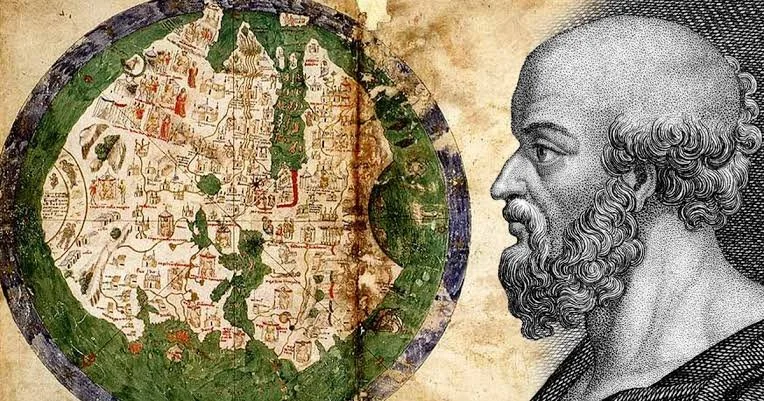
One of the greatest achievements of ancient Greek science was the realization that the Earth could be studied through observation and mathematics.
While modern technology allows scientists to measure the planet using satellites and advanced instruments, ancient scholars had only relatively simple tools.
Yet Greek thinkers developed methods capable of estimating the size of the Earth with remarkable sophistication.
The most famous calculation was performed by Eratosthenes, a Greek scholar who lived during the Hellenistic period.
His method became one of the greatest examples of scientific reasoning in the ancient world.
The Greek Understanding of a Spherical Earth
The idea that the Earth was spherical developed gradually.
Greek philosophers and astronomers observed several natural phenomena that supported this conclusion.
One important observation involved lunar eclipses.
During a lunar eclipse, the Earth casts a shadow on the Moon.
The shadow appears curved.
Greek thinkers recognized that a spherical object naturally produces such a shadow.
Another observation involved ships disappearing over the horizon.
As a ship moved away, the lower part of the vessel disappeared before the mast.
This suggested that the surface of the Earth was curved.
Eratosthenes and the Measurement of the Earth
Eratosthenes is famous for using shadows to estimate the Earth's circumference.
He knew that in the city of Syene, now associated with Aswan in Egypt, the Sun could appear nearly directly overhead at a particular time of year.
At approximately the same time, an object in Alexandria cast a shadow.
This difference was the key to his calculation.
Measuring the Angle
Eratosthenes measured the angle created by the shadow in Alexandria.
The angle represented a fraction of a complete circle.
If the angle was approximately one-fiftieth of a full circle, then the distance between the two locations represented approximately one-fiftieth of the Earth's circumference.
The calculation followed a simple principle:
If you know the angle between two points on a sphere and the distance between those points, you can estimate the size of the entire sphere.
The Mathematical Method
The basic calculation can be expressed as:
Earth's Circumference = Distance Between Locations × Number of Equivalent Angular Sections
If the measured angle represented approximately 1/50 of a complete 360-degree circle, Eratosthenes multiplied the estimated distance between the cities by 50.
The resulting figure was an estimate of the Earth's circumference.
Why the Method Was Revolutionary
The brilliance of Eratosthenes' experiment was not simply the answer.
It was the method.
He used:
observation,
measurement,
geometry,
comparison,
and logical reasoning.
He transformed something as simple as a shadow into evidence about the size of the entire planet.
The Limitations of the Measurement
The calculation was not perfect.
Several assumptions were involved.
The cities were not located exactly on the same north-south line, and measuring long distances accurately in the ancient world was difficult.
The precise length of the ancient unit known as the stade is also debated.
Despite these limitations, the calculation demonstrated extraordinary scientific reasoning.
Greek Geography and Mathematics
Greek scholars were interested in the size and shape of the world.
Their studies contributed to:
geography,
astronomy,
navigation,
mathematics,
and cartography.
The work of Eratosthenes demonstrated that the natural world could be investigated through evidence rather than speculation alone.
The Legacy of Greek Earth Measurement
The ancient calculation of the Earth's circumference remains an important symbol of scientific thought.
It demonstrates that major discoveries do not always require advanced technology.
A vertical object, sunlight, careful observation, and geometry were enough to investigate the size of the planet.
The work of Eratosthenes remains one of the greatest examples of the power of scientific reasoning in the ancient world.