Before Theseus Entered the Labyrinth, He Had to Defeat Six Deadly Killers Along the Road to Athens
Theseus is best known for entering the Labyrinth and defeating the Minotaur.
But that was not the beginning of his heroic career.
Before reaching Athens, Theseus traveled along the dangerous road from Troezen to Athens.
According to the traditional mythology, he confronted a series of criminals and monsters.
These encounters function as his own version of the heroic labors associated with Heracles.
Theseus the Young Hero
Theseus was the son of Aegeus, king of Athens, according to one major tradition.
He was raised away from Athens.
When he became old enough, he decided to travel to the city and reveal his identity.
His journey became a test.
Why Not Travel by Sea?
Aegeus had advised Theseus to travel safely.
Instead, Theseus chose the dangerous land route.
This decision allowed him to prove his courage.
Periphetes, the Club Bearer
The first major opponent was Periphetes.
He attacked travelers with a club.
Theseus defeated him.
The hero then took the club for himself.
This became one of his recognizable attributes.
Sinis, the Pine-Bender
Next came Sinis.
He was notorious for killing victims through a brutal method involving bent pine trees.
Theseus defeated Sinis using the same method against him.
This represents a recurring mythological theme:
the hero destroys the criminal through his own method.
The Crommyonian Sow
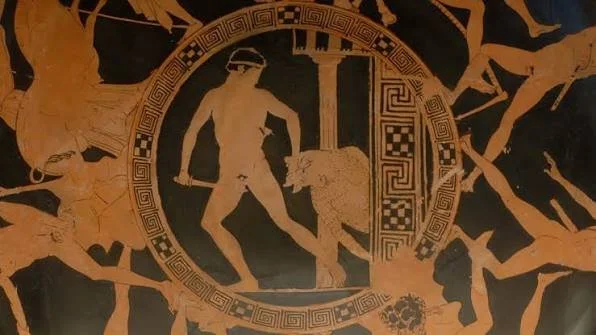
Theseus then encountered the Crommyonian Sow, a dangerous monstrous animal.
Some versions associate the creature with a monstrous boar.
Theseus killed it.
The episode demonstrates that his journey involved both human criminals and supernatural threats.
Sciron
The criminal Sciron forced travelers to wash his feet near a cliff.
While they were vulnerable, he kicked them into the sea.
Theseus defeated him.
The story again emphasizes the reversal of violence.
Cercyon
Cercyon was a powerful wrestler.
He challenged travelers to wrestling matches and killed those he defeated.
Theseus defeated Cercyon through superior skill.
This is important because Theseus does not always win through brute strength.
He uses technique.
Procrustes
The final major criminal was Procrustes.
He offered travelers a bed.
But if they were too tall, he cut them down.
If they were too short, he stretched them.
Theseus subjected Procrustes to his own method of punishment.
The story became one of the most famous examples of mythological justice.
Why Theseus's Journey Matters
These encounters establish Theseus as a hero before the Minotaur story.
Each opponent represents disorder.
The road to Athens is dangerous.
Theseus transforms it.
He eliminates criminals.
The hero effectively makes the route safer for everyone who follows.
The Connection With Heracles
Theseus was sometimes portrayed as a younger counterpart to Heracles.
Both heroes defeat:
Monsters.
Criminals.
Supernatural threats.
But their personalities differ.
Heracles is often defined by extraordinary physical strength.
Theseus is frequently associated with:
Intelligence.
Political leadership.
Strategy.
Theseus Arrives in Athens
After completing the journey, Theseus reached Athens.
He eventually revealed his identity to Aegeus.
His arrival began the next stage of his legendary career.
The Minotaur Awaits
Theseus's greatest adventure remained ahead.
Athens was forced to send young men and women to Crete as tribute.
The victims were sent into the Labyrinth.
Theseus volunteered to go.
He intended to kill the Minotaur.
The journey through the Labyrinth would become the defining myth of his life.
Why the Six Labors Matter
Without the road to Athens, Theseus would appear as a hero who suddenly defeats one monster.
The earlier labors provide a narrative progression.
He proves himself repeatedly.
He defeats injustice.
He survives danger.
He earns the right to become one of Greece's great legendary heroes.