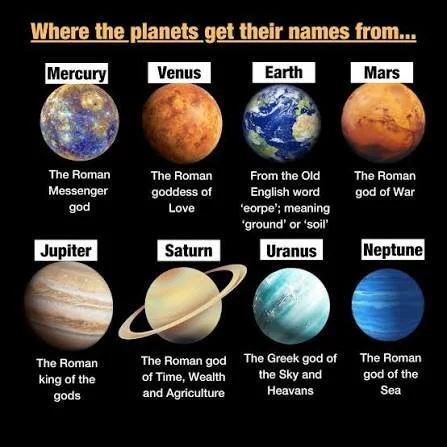
When modern people say Mercury, Venus, Mars, Jupiter, and Saturn, they are using names inherited primarily from the Roman world.
But many of the concepts behind these names have much older Greek roots.
The ancient Greeks observed the planets long before modern astronomy existed.
They noticed that several points of light moved differently from the fixed stars.
These wandering objects became associated with gods, mythology, mathematics, calendars, and eventually scientific astronomy.
The story of planetary names therefore reveals something fascinating about the development of language.
It also demonstrates how Greek intellectual traditions were transmitted into Roman and later European culture.
The "Wandering Stars"
The Greek word planētēs means "wanderer."
This became the root of the modern word planet.
Ancient observers noticed that most stars maintained fixed positions relative to one another.
But a small number of bright objects moved across the sky.
These were the planets.
The ancient Greeks therefore understood the heavens through a distinction between fixed stars and wandering stars.
The Five Visible Planets
Without telescopes, ancient observers could see five planets with the naked eye:
Mercury;
Venus;
Mars;
Jupiter;
Saturn.
The Sun and Moon were also visible celestial bodies, but they were treated separately in ancient astronomical systems.
The five planets could be followed over long periods.
Their movements were complicated but predictable.
Greek Names for the Planets
The Greeks gave planetary bodies names associated with their gods.
Mercury was associated with Hermes.
Venus was associated with Aphrodite.
Mars was associated with Ares.
Jupiter was associated with Zeus.
Saturn was associated with Cronus.
The Roman system later substituted Roman divine names:
Hermes → Mercury
Aphrodite → Venus
Ares → Mars
Zeus → Jupiter
Cronus → Saturn
This is why modern English uses Roman names for planets whose mythological identities have Greek equivalents.
Hermes and Mercury
Mercury moves relatively quickly across the sky.
The Greeks associated the planet with Hermes, the messenger god.
The Romans associated it with Mercury, their corresponding deity.
The connection makes intuitive sense within the mythological system.
Hermes was associated with speed, travel, communication, and movement.
The planet seemed to move rapidly relative to the background stars.
Aphrodite and Venus
Venus is exceptionally bright.
It can appear as either a morning or evening object depending on its position relative to the Sun.
Its brightness led many ancient cultures to associate it with beauty.
The Greeks connected the planet with Aphrodite, goddess of love and beauty.
The Romans connected it with Venus.
The name survived through Latin and became the English "Venus."
Ares and Mars
Mars has a distinctive reddish appearance.
Ancient observers noticed its unusual color.
The Greeks associated the planet with Ares, god of war.
The Romans associated it with Mars.
The reddish appearance could naturally encourage associations with blood and warfare.
Zeus and Jupiter
Jupiter is the largest planet in the Solar System and appears extremely bright from Earth.
The Greeks associated it with Zeus, the supreme Olympian god.
The Romans called the planet Jupiter.
The English name therefore comes through the Roman tradition.
Cronus and Saturn
Saturn is slower-moving than the other naked-eye planets.
The Greeks associated it with Cronus.
The Romans called the planet Saturn.
The name survived into modern astronomical terminology.
Greek Astronomy Before the Hellenistic Period
Greek interest in the heavens developed over many centuries.
Early philosophers attempted to explain the cosmos using natural principles.
Thales, Anaximander, Anaximenes, Pythagorean thinkers, Plato, Aristotle, and others proposed different models of the universe.
They did not all agree.
Some believed the heavens were composed of perfect circular motions.
Others developed more mathematical approaches.
The Pythagorean Tradition
Pythagorean thinkers were particularly interested in numerical relationships.
They explored mathematical patterns in music and cosmology.
Later traditions associated the Pythagoreans with ideas about celestial harmony.
Not every idea attributed to Pythagoras can be securely traced to him personally.
Nevertheless, Pythagorean thought contributed to the long Greek tradition of understanding nature mathematically.
Plato and the Heavens
Plato regarded astronomy as an important field of philosophical education.
The movement of celestial bodies appeared to provide an example of mathematical order.
Plato's approach influenced later thinkers who sought geometrical explanations for planetary movement.
Aristotle's Cosmos
Aristotle developed a geocentric model of the universe.
Earth occupied the center.
The heavens consisted of concentric spheres carrying celestial bodies.
The planets were understood as moving within this ordered cosmic system.
Aristotle's model became enormously influential.
It was later challenged by new astronomical observations and mathematical theories.
Hipparchus
The Greek astronomer Hipparchus made major contributions to observational astronomy.
He worked with careful measurements of celestial positions.
His work helped develop mathematical models for astronomical motion.
He also contributed to the development of trigonometry and star cataloging.
Ptolemy
The most influential ancient Greek astronomical system was developed by Claudius Ptolemy in Roman-era Alexandria.
His work, the Almagest, synthesized centuries of Greek astronomical thinking.
Ptolemy's model explained planetary movements using combinations of circles.
It remained influential for many centuries.
Greek Became the Language of Science
Greek became an important language for scientific and philosophical writing throughout the Hellenistic and Roman worlds.
Even when political power shifted to Rome, Greek remained widely used in intellectual communities.
This is one reason Greek terminology survived.
Latin Borrowed Greek Concepts
Roman intellectuals adopted enormous amounts of Greek terminology.
Sometimes they translated words.
Sometimes they replaced Greek gods with Roman equivalents.
Planetary names were therefore transformed linguistically.
The scientific concepts remained connected to Greek intellectual traditions even when the names became Latin.
Greek Influence on Modern Astronomy
Modern scientific terminology still contains enormous amounts of Greek.
Examples include:
astronomy;
planet;
galaxy;
cosmos;
geology;
biology;
physics.
Greek roots became embedded in the language of science.
Why Planet Names Survived
Planetary names are particularly durable because they were transmitted through multiple civilizations.
Greek astronomers studied the heavens.
Roman scholars adopted Greek astronomy.
Medieval Islamic scholars preserved and developed Greek astronomical traditions.
European scholars later recovered and expanded ancient astronomical texts.
The vocabulary traveled with the knowledge.
Greek Mythology in Modern Space Exploration
Modern astronomy continues to use mythological names.
Planets have Roman names, while many moons carry names from Greek and Roman mythology.
For example:
Jupiter's moons include Io, Europa, Ganymede, and Callisto;
Saturn's moons include Rhea, Dione, and Iapetus;
Neptune's moons include Triton and Nereid.
The mythological vocabulary has therefore expanded far beyond the five visible planets.
The Difference Between Myth and Science
It is important not to confuse ancient mythology with modern astronomy.
The Greeks did not discover that planets were orbiting other worlds using modern telescopes.
Their observations were limited by the technology available to them.
Yet their careful observations, mathematical reasoning, and conceptual vocabulary became part of the intellectual foundation of later astronomy.
Conclusion
The names of the planets tell a story of cultural transmission.
Greek observers called the planets wandering stars.
They associated them with Hermes, Aphrodite, Ares, Zeus, and Cronus.
Roman culture translated those identities into Mercury, Venus, Mars, Jupiter, and Saturn.
Those Roman names eventually entered modern European languages.
At the same time, the Greek word planētēs gave modern science the word planet itself.
Every time we say "planet," we are using a word whose history reaches back to ancient Greek observations of the night sky.