Ancient Greek religion was far more complicated than the familiar stories of Zeus, Athena, Apollo, and the other Olympian gods might suggest.
Religion was woven into nearly every aspect of Greek life.
People prayed before journeys, sacrificed animals before festivals, consulted oracles before important decisions, dedicated objects to gods, performed funerary rituals, celebrated agricultural festivals, and participated in ceremonies intended to maintain relationships between humans and the divine.
Some of these practices seem familiar to modern readers.
Others can appear extraordinarily strange.
Ancient Greek religious rituals could involve unusual foods, symbolic objects, sacred animals, blood sacrifices, ritual purity, ecstatic behavior, nighttime ceremonies, and elaborate festivals.
However, calling them "weird" is a modern judgment. To the people who performed them, these practices could be completely meaningful and logical within their religious worldview.
Understanding the stranger rituals therefore requires looking at what they meant rather than simply describing how unusual they appear today.
Why Did the Greeks Sacrifice?
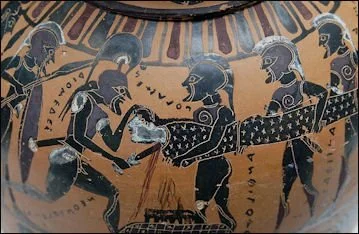
Sacrifice was one of the central practices of ancient Greek religion.
The most common form involved offering an animal to a deity.
Animals such as cattle, sheep, goats, and pigs could be sacrificed.
The ritual was not simply about killing an animal.
It involved a carefully organized sequence of actions.
Participants might:
prepare the animal;
lead it toward the altar;
perform prayers;
pour liquid offerings;
kill the animal;
divide the body;
burn selected portions for the gods;
distribute or consume the remaining meat.
The ritual created a relationship between humans and the divine.
The Gods Did Not Literally "Eat" the Sacrifice
Ancient Greek religion generally did not imagine the gods consuming food in the same physical way humans did.
The gods received particular portions through burning.
The smoke and aroma rose toward heaven.
Humans consumed much of the remaining meat.
This created a ritual relationship between divine and human communities.
Sacrifice was therefore simultaneously religious, social, and communal.
The Strange Case of Black Animals
Animal color could matter.
Some rituals involved animals of particular colors depending on the deity or ritual context.
Dark or black animals were sometimes associated with underworld or chthonic powers.
White animals were more commonly associated with celestial gods in some ritual contexts.
These distinctions were not universal rules for every sacrifice.
Greek religion was decentralized, and practices varied from one city and sanctuary to another.
Nevertheless, the symbolism demonstrates that even the appearance of an animal could carry ritual meaning.
Sacrifices to the Underworld Gods
Sacrifices directed toward underworld deities could differ from ordinary Olympian sacrifices.
Instead of sharing the meat communally, certain rituals involved burning or burying the entire animal.
The ritual was directed downward rather than upward.
This reflects a fundamental distinction in Greek religious thinking between gods associated with the sky and powers associated with the earth and underworld.
The difference was not simply geographical.
It represented different relationships between humans, gods, death, and the earth.
The Ancient Greeks Sacrificed Puppies
One of the more disturbing practices associated with ancient Greek religion involved the sacrifice of dogs in certain contexts.
Dogs were sacrificed in some rituals associated with Hecate and other deities.
Dogs could have complicated symbolic associations.
They could represent protection and guardianship, but they could also be connected with liminal spaces, death, and the boundaries between worlds.
Hecate's association with crossroads and the night helps explain why dogs could appear within her ritual traditions.
However, dog sacrifice was never an ordinary part of everyday Greek religious practice.
It belonged to particular rituals and locations.
Horse Sacrifices
Horses were also sacrificed in some ancient Greek contexts.
Because horses were expensive and prestigious animals, sacrificing one represented a substantial offering.
Horses were particularly associated with gods and heroes connected with warfare, travel, and the sea.
Poseidon, for example, had strong associations with horses.
The famous epithet Hippios means "of horses."
Horse sacrifice therefore had symbolic and economic significance.
Human Sacrifice: Myth Versus Evidence
This is one of the most controversial subjects in ancient Greek religion.
Greek mythology contains stories of human sacrifice.
The most famous include Iphigenia, who was said to have been sacrificed or nearly sacrificed by her father Agamemnon.
Other myths involve human offerings to various powers.
But mythology does not automatically provide evidence that widespread human sacrifice actually occurred.
Archaeological evidence is difficult to interpret.
There are isolated cases that have been proposed as evidence of ritual killing, but scholars continue to debate their interpretation.
The archaeological and literary evidence does not support the idea that routine human sacrifice was a normal feature of Classical Greek religion.
The Myth of Iphigenia
According to one tradition, Agamemnon angered Artemis.
The Greek fleet was unable to sail toward Troy because of unfavorable winds.
Agamemnon was told that his daughter Iphigenia had to be sacrificed.
In some versions, she was killed.
In others, Artemis rescued her at the last moment and substituted an animal.
The existence of multiple versions is important.
Greek mythology was not a single standardized storybook.
Different authors, cities, and periods preserved different traditions.
Animal Substitution
The idea of replacing a human with an animal appears repeatedly in Greek religious mythology.
This may reflect a broader cultural understanding of sacrifice.
The story of Iphigenia, for example, ultimately becomes a narrative about substitution.
The human sacrifice is transformed into an animal sacrifice.
Whether this reflects an actual historical transition in ritual practice is uncertain.
Ritual Purity
Ancient Greek religion placed considerable emphasis on purity.
People could become ritually polluted through circumstances such as:
death;
childbirth;
bloodshed;
sexual activity;
certain illnesses;
contact with corpses.
Purification could involve washing, changing clothing, avoiding particular activities, or performing religious rites.
The concept of purity was not identical to modern ideas of hygiene.
A person could be physically clean while still being ritually impure.
Sacred Animals
Certain animals were associated with particular gods.
Owls were associated with Athena.
Dolphins and horses could be associated with Poseidon.
Peacocks became associated with Hera in later artistic traditions.
Snakes had complex religious associations.
Animals could appear in temples, sacrifices, myths, and artistic representations.
Their symbolic significance depended on context.
Sacred Snakes
Snakes were particularly fascinating.
They could represent danger, regeneration, the earth, and the dead.
At healing sanctuaries associated with Asklepios, sacred snakes were part of the religious environment.
Patients could sleep within the sanctuary and participate in rituals seeking divine healing.
Snakes therefore were not simply symbols of evil.
Their meaning depended on the religious tradition involved.
Dream Incubation
One of the most fascinating healing rituals was incubation.
At sanctuaries dedicated to Asklepios, visitors could sleep in sacred spaces in the hope that the god would appear in a dream.
The dream might provide guidance or indicate treatment.
The sanctuary of Epidaurus is famous for inscriptions recording miraculous cures attributed to Asklepios.
From a modern perspective, the practice looks unusual.
For ancient worshippers, however, dreams could be legitimate channels of divine communication.
Oracles
Oracles provided another unusual religious practice.
The most famous was Delphi.
People traveled long distances to ask questions about:
war;
colonization;
politics;
marriage;
religion;
personal problems.
The oracle's answers were often ambiguous.
Interpretation was therefore essential.
The oracle did not necessarily provide a simple yes-or-no answer.
The Delphic Pythia
At Delphi, the priestess known as the Pythia served as the central prophetic figure.
Ancient accounts describe her entering an altered ritual state before delivering responses.
Later writers associated this state with vapors rising from the ground, although the exact physiological explanation remains debated.
What matters historically is that the ritual was embedded within a highly organized sanctuary system.
Mystery Religions
Some Greek religious traditions were described as mysteries because important rituals were restricted to initiates.
The Eleusinian Mysteries are the most famous example.
Participants underwent ceremonies associated with Demeter and Persephone.
Initiates were forbidden from revealing what happened during the rites.
Because of this secrecy, historians cannot reconstruct every detail.
The mystery itself was part of the religious experience.
The Eleusinian Mysteries
The Eleusinian Mysteries were connected with the agricultural cycle and the myth of Persephone.
The story described Persephone's descent into the underworld and eventual return.
The religious ceremonies may have provided participants with hope concerning death and the afterlife.
The exact content of the initiation remains uncertain.
Ancient participants deliberately maintained secrecy.
Dionysian Rituals
The worship of Dionysus could involve ecstatic behavior.
Music, dancing, wine, masks, processions, and altered states were associated with some Dionysian traditions.
The famous Maenads of mythology represent women participating in ecstatic worship.
Literary descriptions can exaggerate or dramatize these rituals.
Not every Greek worshipper of Dionysus participated in violent or uncontrolled behavior.
The reality varied by cult, location, and period.
Processions and Strange Costumes
Greek festivals could involve elaborate costumes and symbolic performances.
Participants might wear masks, animal skins, crowns, or special garments.
Religious processions could include musicians, animals, sacred objects, priests, and large groups of citizens.
The spectacle itself was part of religious communication.
Why Were These Rituals Important?
The rituals served multiple purposes.
They could:
honor gods;
request protection;
seek healing;
mark transitions;
reinforce community identity;
maintain social order;
commemorate myths;
deal with death;
establish relationships between humans and divine powers.
Religion was therefore not simply something Greeks practiced privately.
It helped organize society.
Conclusion
Ancient Greek sacrifices and rituals could appear strange, frightening, or even disturbing to modern observers.
Dogs were sacrificed in certain contexts.
Horses could be offered to gods.
Animals were carefully selected according to ritual requirements.
People sought healing through sacred dreams.
Mystery initiations were protected by secrecy.
Dionysian festivals could involve ecstatic behavior.
Oracles were consulted about major political decisions.
And stories of human sacrifice occupied an important place in Greek mythology, even though the historical evidence for widespread human sacrifice is much weaker.
The most important lesson is that these practices should not simply be dismissed as "weird."
They reveal how ancient Greeks understood relationships between humans, gods, nature, death, disease, and society.
To understand the ritual, we must first understand the worldview that made the ritual meaningful.