Introduction
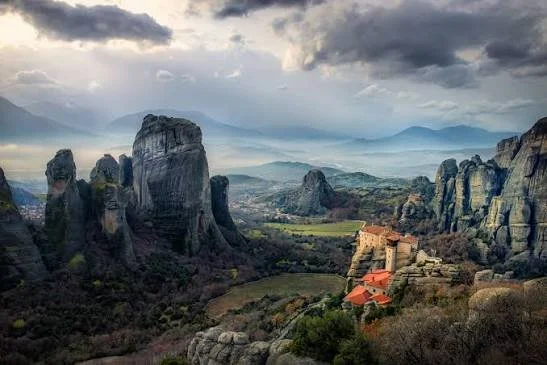
Meteora, in central Greece, is internationally known for its dramatic rock pillars and monasteries built on elevated sandstone formations. The landscape combines geological processes that operated over millions of years with a more recent history of religious settlement, architecture, and cultural preservation.
The title Petrified Forests Under Meteora Monastic Cliffs evokes the possibility of ancient forests preserved beneath the region's cliffs. Although fossil wood and ancient plant remains can occur in suitable geological environments, a specific petrified forest beneath Meteora's monastic formations should not be treated as a documented discovery without geological evidence.
The subject nevertheless provides an opportunity to examine the difference between fossilization, sedimentary rock formation, and the cultural history of a remarkable landscape.
The Geological Formation of Meteora
Meteora's towering formations consist primarily of sedimentary rocks shaped by the long-term accumulation and consolidation of sediments, followed by uplift, erosion, and weathering.
Water, wind, gravity, and changes in climate gradually sculpted the landscape. Erosion removed weaker material and exposed resistant rock masses, creating the pillars and cliffs that dominate the region today.
The exact geological history involves several stages rather than one sudden event. The age of a rock formation must also be distinguished from the age of any fossil found within it. A sedimentary layer can be much older than the monastery built on top of it, while a fossil's age depends on its geological context.
What Is a Petrified Forest?
A petrified forest is a deposit containing fossilized wood or other remains of trees that were buried and preserved through geological processes.
When wood is rapidly buried by sediment, oxygen availability may decrease and decomposition can slow. Under suitable conditions, mineral-rich groundwater may enter the wood's cellular structure. Minerals can fill spaces or replace parts of the original organic material, preserving details of the wood.
This process is commonly described as permineralization or mineral replacement, depending on the precise mechanism.
Not every buried forest becomes petrified. Preservation depends on environmental conditions, sediment chemistry, burial history, and the availability of minerals.
How Fossil Wood Is Identified
Fossil wood can sometimes be identified through microscopic examination of its cellular structure. Thin sections reveal features that may help researchers determine the type of tree or its broader botanical group.
Geologists also examine the surrounding rock layers, mineral composition, and depositional environment. These clues help establish whether the wood was buried in place or transported from another location.
A single piece of fossilized wood does not necessarily indicate a forest at the discovery site. It may have been carried by rivers or redeposited in younger sediments.
Could Fossil Forests Exist Near Meteora?
The presence of sedimentary rocks in a region does not automatically establish the existence of a petrified forest. To confirm such a feature near Meteora, researchers would need documented fossil wood deposits, geological mapping, and evidence that the remains belong to a coherent ancient environment.
The title's reference to a forest "under" monastic cliffs should also be interpreted cautiously. A fossil-bearing geological layer might lie beneath a cliff in a broad stratigraphic sense, but that is different from a hidden forest directly underneath a monastery.
No specific deposit should be claimed without a published geological record or verified field observations.
Fossils and Ancient Environments
Where fossil wood is found, it can help reconstruct past environments. Tree species may indicate whether an area once supported forests, woodland, or vegetation adapted to particular climatic conditions.
Associated fossils can provide additional information about ancient ecosystems. Pollen, leaves, seeds, and other plant remains may reveal changes in vegetation through time.
Geologists must consider the age of the fossils, the sedimentary environment, and the possibility that material was transported before burial.
The Monasteries and the Geological Landscape
Meteora's monasteries were constructed on naturally elevated rock formations. Their location offered isolation, visibility, and a challenging approach that influenced religious life.
The monasteries became important centers of Orthodox Christian spirituality and cultural heritage. Their architecture demonstrates how human communities adapted to an unusual geological environment.
The relationship between the monasteries and the rocks is therefore real and well documented, even though a specific petrified forest beneath the cliffs would require separate verification.
Conservation Challenges
Meteora faces the challenge of protecting geological features, historic buildings, wildlife, and the surrounding landscape while accommodating visitors.
Foot traffic, construction, weathering, and changes in drainage can affect fragile environments. Scientific research must also avoid damaging fossil deposits or archaeological material.
If fossil wood were identified in the area, its conservation would require careful documentation and protection from unauthorized collecting.
Responsible Geological Interpretation
Popular descriptions of unusual landscapes sometimes combine genuine geological facts with speculative hidden features. Such stories can attract interest, but they may confuse visitors about what researchers have actually established.
Reliable interpretation should distinguish between confirmed rock formations, documented fossils, and hypothetical deposits that have not been verified.
This approach does not make Meteora less extraordinary. Its geological history and monastic heritage are already remarkable.
Conclusion
The idea of petrified forests beneath Meteora's monastic cliffs invites a fascinating investigation into fossilization, sedimentary geology, and the deep history of central Greece. However, the existence of a specific petrified forest in this location requires geological confirmation. By separating established features of Meteora's landscape from unverified fossil claims, researchers can better explain how ancient environments are preserved in rock and how human communities later built sacred places within those geological settings.