Introduction
The Messara Plain in southern Crete is one of the island's important agricultural landscapes. Its fertile land has supported settlement and farming across many historical periods, while the wider region contains archaeological remains associated with ancient Cretan societies.
The idea of salt caverns beneath the Messara Plain invites an investigation into evaporite geology, groundwater, and the underground structures that can develop in certain rock formations. However, a salt cavern is a specific geological feature, and its existence beneath a particular agricultural plain must be confirmed through geological surveys.
The region's archaeological and agricultural importance should not be used as evidence for a hidden salt-cavern system.
How Salt Deposits Form
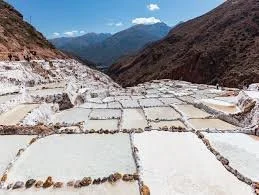
Rock salt, primarily composed of the mineral halite, forms when saline water evaporates and leaves dissolved salts behind.
This process can occur in restricted marine basins, salt lakes, or other environments where evaporation exceeds the replenishment of water.
Over geological time, repeated cycles of evaporation and sedimentation can produce thick deposits of salt and other evaporite minerals.
These deposits may later be buried beneath younger sedimentary layers.
How Salt Caverns Develop
Salt is soluble in water. When groundwater circulates through a salt deposit, it can dissolve the mineral and enlarge underground openings.
Natural cavities may develop under suitable geological conditions, although the process depends on the structure of the deposit, the movement of water, and the surrounding rock.
Large underground salt caverns can also be created through industrial solution mining, in which water is injected into a salt formation and the resulting brine is removed.
A natural salt cavity and an engineered salt cavern are therefore different features and should not be confused.
Crete's Geological Setting
Crete has a complex geological history involving tectonic movement, uplift, sedimentation, and the development of different rock formations.
The island contains limestone, other sedimentary rocks, and numerous karst features. Limestone can dissolve to form caves, sinkholes, and underground drainage systems.
However, limestone caves are not salt caverns. Their formation involves different minerals and geological processes.
The existence of caves somewhere on Crete does not establish the presence of rock-salt deposits beneath the Messara Plain.
Groundwater and Agricultural Landscapes
Groundwater is important to agriculture in Mediterranean regions, especially where summers are dry and rainfall is seasonal.
Water can move through permeable sediment, fractured rock, or karst systems. Its availability depends on recharge, geological structure, extraction, and climate.
Salt deposits can affect groundwater chemistry where saline water dissolves and enters an aquifer. Elevated salinity can also result from seawater intrusion, evaporation, or irrigation practices.
These processes require careful monitoring because saline groundwater can reduce soil productivity and damage crops.
How Geologists Investigate Underground Salt
Researchers use geological maps, borehole records, geophysical surveys, and chemical analysis to identify possible evaporite deposits.
Electrical resistivity and seismic methods may help reveal underground structures, although results must be interpreted alongside direct geological information.
Boreholes can provide samples that establish the type and depth of rock layers.
Water chemistry can also reveal whether groundwater has interacted with salt-bearing formations, but salinity alone does not prove that a cavern exists.
Natural Caverns and Human Activity
If a salt cavern is present, its significance depends on its size, stability, water movement, and relationship with the surface.
Underground cavities can create hazards when their roofs weaken or collapse. Changes in groundwater flow may accelerate dissolution and alter the stability of surrounding material.
Agricultural development should therefore be based on reliable geological information rather than assumptions about underground spaces.
Archaeology and the Messara Plain
The Messara region is important for the study of ancient Crete, including settlements and archaeological sites associated with Minoan civilization and later periods.
Its agricultural productivity contributed to the development of communities and the movement of goods.
Salt was valuable in many ancient societies because it could be used for food preservation, animal husbandry, and other purposes. However, the historical importance of salt does not establish that the Messara Plain contained a natural salt cavern or an ancient underground salt mine.
Claims about historical extraction require archaeological and documentary evidence.
Environmental Considerations
Underground salt formations can affect the quality of groundwater and the stability of the landscape.
If a salt-bearing layer is exposed to fresh water, dissolution may alter local water chemistry. Human extraction can also change underground conditions.
Any proposed excavation or industrial development should therefore include appropriate geological, hydrological, and environmental assessments.
Conclusion
Salt caverns beneath the Messara Plain are an intriguing geological theme, but their existence should not be treated as confirmed without direct evidence. Rock salt forms through the evaporation of saline water, while underground cavities can develop through dissolution or industrial extraction. The geological structure of southern Crete must be examined carefully to determine whether salt-bearing formations occur beneath the plain. Geological mapping, borehole sampling, and groundwater analysis can distinguish actual evaporite deposits from ordinary limestone caves and other underground features, helping protect both the agricultural landscape and its archaeological heritage.