Introduction
The Gulf of Volos lies along the coast of Thessaly in central Greece. Its coastal waters connect urban settlements, ports, river systems, wetlands, and marine habitats.
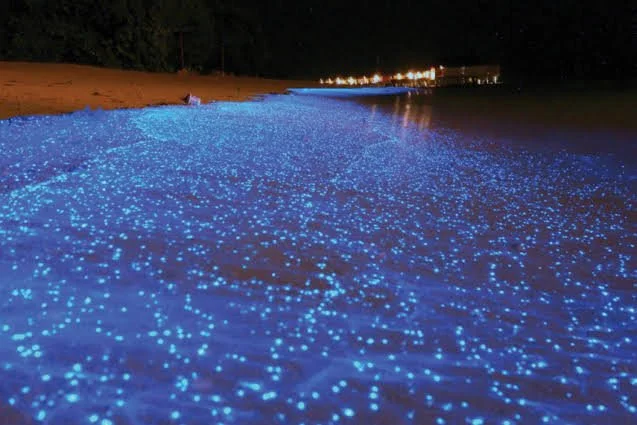
At night, the sea can sometimes appear to glow when certain microscopic organisms produce bioluminescence. Such displays are among the most striking natural phenomena in marine environments, but they depend on the species present, water conditions, and the intensity of the bloom.
The idea of plankton blooms in the Gulf of Volos at night invites an investigation into bioluminescence, marine ecology, and water quality. However, a recurring or unusually bright phenomenon at a specific location should be confirmed through local observations and scientific sampling.
What Is Plankton?
Plankton consists of organisms that drift in water and are unable to swim effectively against currents over substantial distances.
Phytoplankton includes microscopic organisms that use sunlight for photosynthesis. Zooplankton includes small animals and other organisms that feed on phytoplankton or other members of the plankton community.
Plankton forms the foundation of many marine food webs. It supports fish larvae, shellfish, and numerous other organisms.
Its abundance can change rapidly in response to temperature, nutrients, light, currents, and grazing pressure.
How Plankton Blooms Develop
A plankton bloom occurs when the abundance of certain organisms increases substantially over a relatively short period.
Blooms may develop when nutrient availability, sunlight, water temperature, and circulation create favorable conditions.
Some blooms are harmless, while others can affect water quality, marine organisms, or human activities.
A bloom's impact depends on the species involved, its density, and the environmental conditions. The term "plankton bloom" therefore does not automatically indicate pollution or ecological danger.
Bioluminescence
Bioluminescence is the production of light through a chemical reaction within a living organism.
In marine environments, certain dinoflagellates and other organisms can emit light when mechanically disturbed. Waves, paddles, swimming animals, or moving water may stimulate a brief flash.
The light is often blue or blue-green because these wavelengths travel efficiently through seawater.
Not all plankton is bioluminescent, and not every bloom produces visible light.
Why the Sea May Glow at Night
When bioluminescent organisms become abundant near the surface, their combined light can become visible to the human eye.
Small disturbances may create glowing streaks, sparks, or patches in the water.
The intensity depends on organism density, species, darkness, water clarity, and the amount of movement.
Moonlight, artificial lighting, cloud cover, and coastal development can affect whether the glow is noticeable.
The Gulf of Volos Environment
The Gulf of Volos is a semi-enclosed marine environment influenced by coastal settlements, freshwater inputs, maritime activity, and seasonal conditions.
Such environments can experience changes in nutrient concentrations and water circulation.
Freshwater inflows may transport nutrients into coastal waters, while currents and temperature changes influence how those nutrients are distributed.
However, the presence of a semi-enclosed gulf does not establish that a particular bioluminescent bloom occurs regularly. That question requires local ecological monitoring.
How Scientists Study Blooms
Marine biologists can collect water samples and examine them under microscopes to identify organisms.
Measurements of chlorophyll, temperature, salinity, dissolved oxygen, and nutrients help explain the conditions associated with a bloom.
Satellite observations can sometimes identify large surface changes in chlorophyll, although they may not detect every species or a brief nighttime event.
Nighttime observations and repeated sampling can help establish whether a glowing event is linked to a specific organism.
Are Bioluminescent Blooms Dangerous?
Bioluminescence alone does not establish that a bloom is harmful.
Some bioluminescent organisms can occur in harmless concentrations. Other species may produce harmful substances or contribute to oxygen depletion when large blooms decay.
Scientists must identify the organisms before assessing risk.
People should avoid assuming that glowing water is safe to drink or that contact is harmless in every circumstance. If authorities issue a local warning about a bloom, their guidance should be followed.
Climate and Seasonal Variation
Water temperature, rainfall, sunlight, and circulation influence plankton communities.
Climate change may alter bloom timing and the distribution of some marine species, but the effects vary by region and organism.
Long-term monitoring is needed to distinguish natural seasonal variability from a persistent ecological change.
Responsible Wildlife Observation
People hoping to see bioluminescence should avoid adding chemicals, disturbing wildlife, or entering unsafe water.
Photography can also be challenging because the light may be faint and brief. Long-exposure images can exaggerate the apparent brightness of a phenomenon, so photographs should not be treated as direct measurements of intensity.
Scientific documentation benefits from recording the date, location, weather, water conditions, and any available laboratory results.
Conclusion
Plankton blooms can create spectacular nighttime displays when bioluminescent organisms are abundant in coastal waters. The Gulf of Volos offers an interesting environment for studying the relationship between plankton, nutrients, circulation, and coastal ecology. However, specific glowing blooms must be verified through local observations and biological sampling. Combining marine monitoring with responsible public observation can help distinguish ordinary seasonal events from unusual blooms that warrant further investigation.