Introduction
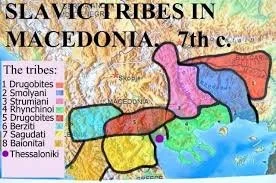
The seventh century was a period of significant political and demographic change in the Balkans. The eastern Roman, or Byzantine, Empire faced military pressures, shifting settlement patterns, and the arrival or expansion of Slavic-speaking groups in many parts of southeastern Europe.
The region historically known as Macedonia became part of this wider transformation. Archaeological evidence from settlements, burial grounds, ceramics, and changes in regional occupation can help researchers investigate how communities adapted to new political circumstances.
The phrase "Slavic tribes" is useful as a broad historical label, but it should not imply that every community shared one political organization, culture, or migration history.
The Balkans in the Seventh Century
The seventh century followed decades of conflict affecting the Byzantine Balkans. Imperial military and administrative control weakened in several regions, while Slavic-speaking groups established communities across parts of the peninsula.
Written sources, particularly Byzantine texts, describe these developments from the perspective of imperial authorities. Such accounts often emphasize raids, warfare, and threats to imperial territory.
Archaeology adds a different perspective by examining settlement, production, burial practices, and everyday material culture.
Who Were the Slavic Groups?
The term "Slavic" refers primarily to linguistic and cultural connections rather than a single unified people. Early Slavic-speaking populations likely consisted of multiple communities with different leaders, local traditions, and relationships with neighboring groups.
Some groups moved into new areas, while others developed relationships with existing inhabitants. Intermarriage, exchange, conflict, and cultural adaptation could all contribute to changing identities.
It is therefore misleading to imagine the region's transformation as a simple replacement of one population by another.
Archaeological Evidence
Archaeologists investigate early medieval settlement through several kinds of evidence:
pottery and household objects
settlement plans
agricultural tools
burial customs
metal objects
fortifications
changes in the distribution of inhabited sites
Ceramic styles can be useful, but pottery alone rarely identifies ethnicity with certainty. Similar objects may circulate through trade or be adopted by neighboring communities.
Likewise, changes in settlement patterns may reflect insecurity, economic transformation, environmental factors, or political reorganization rather than migration alone.
Settlements and Rural Life
Many early medieval communities depended on agriculture, livestock, woodland resources, and local exchange. Their settlements could consist of relatively small groups of houses, storage structures, and working areas.
Archaeologists can study the organization of these settlements through postholes, hearths, pits, animal bones, botanical remains, and the distribution of artifacts.
Such evidence reveals how communities produced food and organized domestic life during periods of political uncertainty.
Continuity and Cultural Change
One of the most important questions is how Slavic-speaking newcomers interacted with populations already living in Macedonia and neighboring regions.
Some towns experienced decline or transformation, while other areas maintained forms of local occupation. Christian institutions, imperial administration, and urban life did not develop uniformly across the Balkans.
Cultural change could occur through the adoption of new languages, technologies, social practices, and political affiliations.
These processes unfolded over generations rather than through one single event.
Written Sources and Archaeology
Byzantine texts provide valuable information about military campaigns and political developments, but they have limitations. Authors often focused on imperial interests and may have used broad labels for groups whose internal organization was poorly understood.
Archaeological evidence can test parts of these narratives, although it also requires careful interpretation.
The strongest reconstructions combine historical texts, securely dated material remains, settlement archaeology, and regional comparisons.
Conclusion
The archaeological study of Slavic-speaking communities in seventh-century Macedonia reveals a period of major transformation in the Balkans. Migration, political disruption, settlement change, and cultural interaction all contributed to the region's development. Rather than viewing these events as a simple replacement of one people by another, researchers increasingly examine the varied experiences of communities that adapted to changing political and social conditions.