Introduction
Stymphalos, located in the mountainous region of northeastern Arcadia, is known for its ancient settlement and its association with the surrounding lake and fertile basin. The area's geographical position connected communities across the central Peloponnese.
The Geometric period of Greek history, generally dated from approximately 900 to 700 BCE, witnessed important changes in settlement patterns, burial customs, artistic production, and social organization.
Warrior graves from this period can provide evidence of weapons, military identity, social distinction, and the ways communities remembered individuals. Investigating such burials near Stymphalos would help place the region within the wider archaeological history of early Greek society.
Stymphalos and Its Ancient Landscape
Ancient Stymphalos developed near the lake of the same name, surrounded by mountains and agricultural land.
The region's natural geography influenced settlement, transportation, and access to resources.
The lake and its surrounding wetlands provided environmental resources, while nearby routes connected communities with other parts of Arcadia and the northeastern Peloponnese.
These conditions supported a landscape in which farming, animal husbandry, and regional exchange could develop.
The Geometric Period
The Geometric period takes its name from the characteristic decoration of pottery produced during this era.
Vessels were commonly decorated with patterns such as meanders, zigzags, triangles, and repeated horizontal bands.
During the later part of the period, human and animal figures became increasingly prominent in some artistic traditions.
The period also witnessed changes in burial customs and the emergence of increasingly visible forms of social distinction.
Understanding Warrior Graves
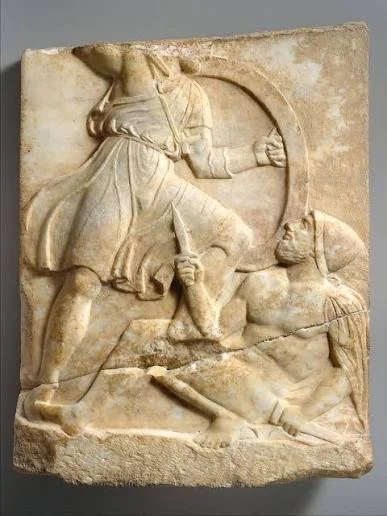
A warrior grave is generally identified through the presence of weapons and other objects associated with military activity.
Burials might contain swords, spearheads, knives, shields, or defensive equipment, depending on the period and local customs.
However, the presence of a weapon does not automatically prove that the deceased was a professional soldier.
Weapons could also represent social identity, inherited status, personal wealth, or ceremonial symbolism.
Archaeologists therefore interpret burial assemblages as a whole rather than assigning military occupations based on a single object.
Weapons and Geometric Funerary Customs
Weapons found in Geometric graves can reveal changes in technology and social organization.
Iron gradually became increasingly important in weapon production during the early first millennium BCE, although bronze objects continued to be used in certain contexts.
Spearheads, swords, and knives varied in shape and manufacturing technique.
Their placement within a grave may provide clues about how the deceased was represented during burial ceremonies.
In some cases, weapons were deliberately damaged or arranged in symbolic ways, although such interpretations require careful evidence.
Pottery and Burial Chronology
Geometric pottery is essential for dating graves from this period.
Vessels were often placed in burials as containers for offerings or as objects associated with funerary ceremonies.
Their decorative styles and shapes changed over time, allowing archaeologists to establish chronological sequences.
Pottery may also reveal relationships between local communities and wider Greek artistic traditions.
A securely dated grave assemblage containing both weapons and pottery can provide a stronger basis for interpreting social and cultural practices.
Social Status and Warrior Identity
Weapon burials are often interpreted in relation to the development of elite identities in early Greek society.
The possession of weapons could communicate a person's ability to participate in warfare and defend the community.
However, burial wealth did not necessarily correspond directly to political power or military achievement.
The treatment of the deceased, the construction of the grave, and the range of accompanying objects all contribute to understanding social distinctions.
Comparisons with other Geometric cemeteries can help identify regional patterns.
Stymphalos and Regional Connections
Arcadia was not isolated from the wider Peloponnese.
Its communities maintained connections with neighboring regions through movement, trade, and shared cultural traditions.
The study of weapon types and pottery styles near Stymphalos could reveal whether local burial customs followed broader Peloponnesian patterns or developed distinctive characteristics.
Material analysis may also help identify whether weapons were manufactured locally or obtained through exchange.
Excavation and Preservation
Burials are especially vulnerable to disturbance because they may be affected by agricultural activity, construction, looting, and erosion.
Once a grave is opened, its spatial relationships must be recorded carefully.
The position of weapons, pottery, skeletal remains, and other objects can reveal important information about funerary rituals.
Scientific methods such as osteological examination, radiocarbon dating, and metallurgical analysis may provide additional evidence.
Conclusion
Geometric warrior graves near Stymphalos would offer valuable evidence for understanding burial practices, weapon technology, and social identity in early Greek Arcadia.
Their study could help explain how communities represented military roles and social distinction during a period of significant cultural change.
However, the specific claim of a documented group of warrior graves near Stymphalos requires archaeological verification. Secure burial contexts and associated dating evidence are essential for establishing their chronology and interpretation.