Introduction
Patras, located on the northern coast of the Peloponnese, was one of the most important cities in Roman Greece. Its position near the entrance to the Gulf of Corinth connected it with maritime routes linking Italy, the western Mediterranean, and the eastern provinces of the Roman Empire.
The city's Roman theater remains provide evidence of its cultural and architectural development. Theaters were important public buildings where performances, festivals, and civic gatherings took place.
The possibility of Roman theatrical backdrops in the suburbs of Patras raises questions about stage design, theatrical architecture, and the spread of urban entertainment beyond the central city. However, the identification of particular backdrop structures requires archaeological evidence.
Patras During Roman Rule
Patras became an important Roman colony following the settlement of veterans under Emperor Augustus.
Its location supported commercial activity and communication between Italy and Greece. The city developed public buildings, streets, religious institutions, and entertainment facilities.
Roman Patras was part of a wider network of provincial cities that adopted Roman architectural and civic traditions while maintaining local cultural characteristics.
Its archaeological remains provide evidence of how Roman urban planning developed in western Greece.
Roman Theater Architecture
Roman theaters were designed to accommodate audiences and provide a controlled setting for dramatic performances.
A typical theater included a seating area, an orchestra, and a stage building known as the scaenae frons.
The stage building could contain architectural decoration, columns, niches, statues, and entrances used by performers.
Unlike many earlier Greek theaters, Roman examples often incorporated more extensive architectural structures behind the stage.
These elements helped create a visually impressive setting for theatrical performances.
The Function of Theatrical Backdrops
The term backdrop can refer to decorative scenery or architectural elements placed behind the performance area.
In Roman theaters, the stage building itself often served as a permanent architectural background.
Painted scenery and temporary decorative elements could also be used for particular performances, although their survival in the archaeological record is limited.
The stage environment helped establish the setting and visual atmosphere of a performance.
Architectural decoration could also communicate civic identity, religious associations, and imperial loyalty.
Materials and Decorative Techniques
Roman theatrical architecture used a variety of materials, including stone, marble, brick, mortar, and plaster.
Columns, capitals, entablatures, and sculptural elements created the appearance of monumental architecture.
Painted plaster could imitate expensive materials or add color to interior surfaces.
Some theaters incorporated marble statues and decorative reliefs that reinforced the prestige of the building.
The combination of permanent architecture and temporary stage elements allowed performances to take place within an elaborate visual environment.
The Roman Theater of Patras
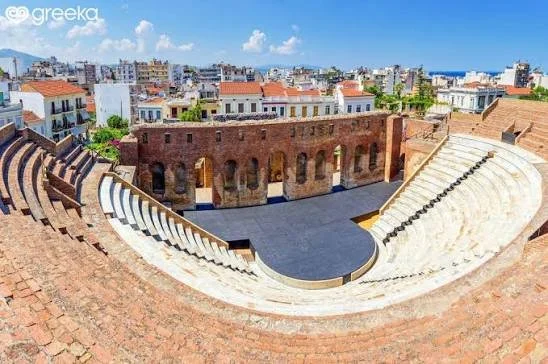
Patras preserves an important Roman-era theater in its historic urban landscape.
Its archaeological remains contribute to understanding the city's entertainment culture and public architecture.
The theater should be distinguished from any proposed theatrical structures in the surrounding suburbs. A building outside the central performance complex might have served as a workshop, storage facility, residential structure, or another public function.
The presence of architectural fragments near a theater does not automatically establish that they belonged to its stage backdrop.
Theater and Urban Life
Roman theaters served multiple social purposes.
They provided venues for dramatic performances, musical events, public celebrations, and other forms of entertainment.
Attendance could bring together different sections of the urban population, although seating arrangements often reflected distinctions in status and civic position.
Theaters also functioned as displays of civic prestige. Their monumental architecture demonstrated the resources and ambitions of the communities that constructed them.
In a major Roman city such as Patras, theatrical facilities formed part of a broader network of public institutions.
Investigating the Suburbs
The suburbs of ancient Patras may contain archaeological remains associated with roads, workshops, residences, burial areas, and other urban activities.
A proposed theater-related structure would need to be investigated through excavation and architectural survey.
Researchers would examine foundations, decorative fragments, plaster remains, and the relationship between the building and known urban routes.
Geophysical survey could help identify buried walls or other structures before excavation.
The dating of associated pottery and construction materials would be essential for determining whether a structure belonged to the Roman period.
The Problem of Preserved Scenery
Temporary theatrical backdrops were generally made from materials that were less durable than stone architecture.
Painted timber panels, fabrics, and movable decorations could disappear through decay, fire, or later reuse.
As a result, archaeologists often reconstruct Roman stage design through architectural remains, wall paintings, literary descriptions, and surviving examples from other theaters.
Fragments of painted plaster may provide evidence of decorative schemes, but they do not always reveal whether a surface belonged to a theater or another type of building.
Conservation and Research
Roman theatrical structures require careful conservation because exposed masonry and decorative surfaces are vulnerable to weathering.
Excavation can reveal fragile painted plaster, carved stone, and architectural fragments that need immediate stabilization.
Digital reconstruction can help researchers visualize how a stage building may have appeared, provided that reconstructed elements are clearly distinguished from surviving evidence.
Comparisons with other Roman theaters can provide useful context without assuming that every theater followed the same design.
Conclusion
Roman theatrical backdrops associated with the suburbs of Patras would offer an interesting opportunity to investigate the city's entertainment culture and architectural development.
The study of stage structures, painted surfaces, and decorative fragments could reveal how Roman performance spaces were designed and how theatrical traditions influenced urban life.
However, the specific claim of Roman theater backdrops in Patras' suburbs requires archaeological verification. The city's known Roman theater provides an important historical foundation, but individual suburban structures must be identified through secure architectural and chronological evidence.