Introduction
Phigalia, also known as Phigaleia, was an ancient city in southwestern Arcadia, near the mountainous borderlands of the Peloponnese.
The region is particularly associated with the sanctuary of Apollo Epikourios at Bassae, but its wider archaeological landscape contains evidence of ancient settlement and religious activity.
The title Archaic Gold Seals from Phigalia Rural Tombs suggests the discovery of gold objects used as seals or markers in burials dating to the Archaic period.
Such a discovery would be archaeologically significant, but the existence of a specific collection of gold seals from rural Phigalian tombs should not be treated as confirmed without excavation records or published evidence.
The subject nevertheless provides an opportunity to explore Archaic burial customs, ancient goldworking, personal identity, and the archaeological study of elite objects.
Phigalia in the Ancient Peloponnese
Phigalia was situated in a mountainous part of Arcadia.
Its location connected the settlement with neighboring communities and routes across the western Peloponnese.
The surrounding landscape included agricultural areas, river valleys, and difficult mountain terrain.
Ancient communities in this region participated in religious, political, and economic networks that extended beyond their immediate settlements.
The Archaic Period
The Greek Archaic period is generally dated from approximately the eighth to the early fifth century BCE.
During this period, Greek communities experienced major political and cultural developments.
City-states expanded, sanctuaries became important centers of worship, and artistic production developed distinctive regional styles.
Trade and contact with the eastern Mediterranean influenced Greek craftsmanship and decorative design.
Gold in Ancient Greek Society
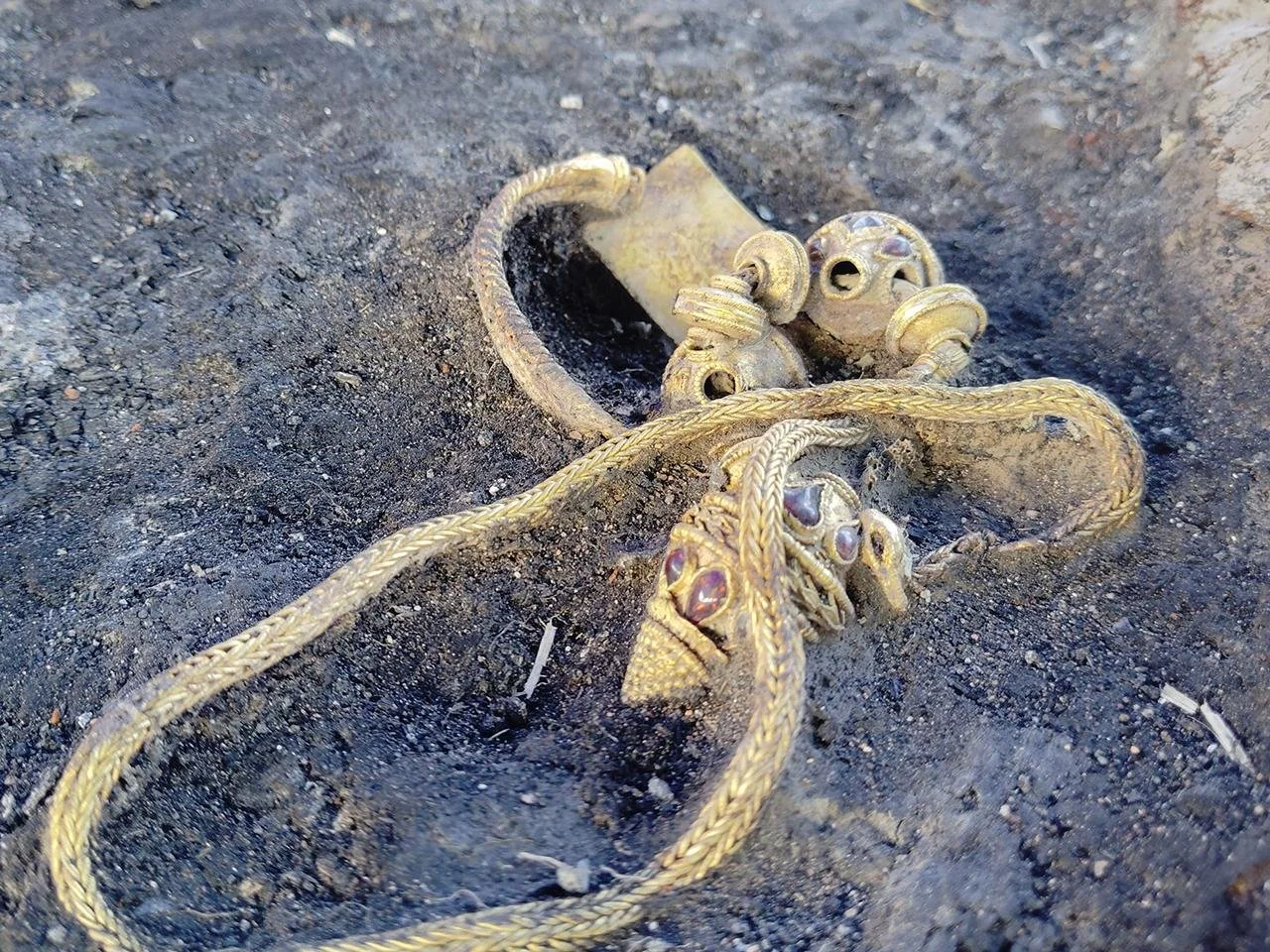
Gold was a valuable material used for personal ornaments, religious objects, decorative elements, and prestige goods.
Its rarity and appearance made it particularly suitable for objects associated with wealth and status.
Gold jewelry could include earrings, pendants, rings, decorative plaques, and other objects.
The presence of gold in a burial may indicate the social position of the deceased, although burial wealth does not provide a complete picture of an individual's status.
What Is a Gold Seal?
A seal is an object or device used to authenticate, identify, or mark something.
In the ancient world, seals could be made from stone, metal, or other durable materials.
They might carry engraved symbols, patterns, or inscriptions.
A gold object found in a tomb should not automatically be called a seal. Its shape, engraved surface, wear patterns, and archaeological context would need to be examined to determine its function.
Some objects may have been jewelry, decorative fittings, or symbolic burial offerings rather than practical sealing devices.
Burial Customs in the Archaic Period
Archaic Greek burial practices varied across regions and communities.
Graves could contain pottery, weapons, personal ornaments, vessels, and objects associated with daily life.
The placement of grave goods may reflect beliefs about death, identity, social status, and remembrance.
Rural cemeteries are particularly valuable because they can reveal how communities outside major urban centers organized their burial traditions.
Goldworking Techniques
Ancient goldsmiths used a variety of techniques.
These included hammering, casting, engraving, granulation, and joining separate components.
Granulation involved attaching tiny gold spheres to a surface to create decorative patterns.
Engraving could produce symbols or designs on a metal object.
Scientific examination of a gold artifact can reveal manufacturing techniques and sometimes provide clues about workshop traditions.
Archaeological Context and Provenance
The context in which an object is discovered is essential.
A gold object recovered from a documented burial can be studied alongside pottery, human remains, grave architecture, and other associated material.
An object without a secure archaeological context is more difficult to interpret.
Researchers must also distinguish between an ancient object found in the region and an object demonstrably produced or used by the local community.
Scientific Analysis
Modern techniques can help researchers investigate ancient gold objects.
Microscopy can reveal manufacturing marks and surface details.
X-ray fluorescence can provide information about elemental composition.
Other analytical methods may help identify metalworking techniques and compare objects from different archaeological contexts.
However, chemical composition alone rarely establishes a precise workshop or geographical origin.
It must be combined with archaeological and stylistic evidence.
Why Rural Tombs Matter
Burial sites outside major cities can challenge assumptions that artistic wealth and specialized craftsmanship were concentrated only in major political centers.
A rural tomb containing finely made objects could indicate connections with wider trade networks or the presence of locally influential families.
It could also reveal how regional communities adapted artistic styles circulating across the Greek world.
Conclusion
Archaic Gold Seals from Phigalia Rural Tombs present an intriguing archaeological possibility involving precious-metal craftsmanship and burial traditions in ancient Arcadia.
The specific discovery of gold seals from rural Phigalian tombs requires documentary confirmation and should not be presented as established fact.
Nevertheless, the wider study of gold objects in Archaic Greek burials can reveal valuable information about technology, social identity, trade, and regional artistic traditions.
If securely documented examples were identified in the Phigalian landscape, they could contribute to a deeper understanding of how communities in the mountainous Peloponnese participated in the cultural and economic world of Archaic Greece.