Introduction
The Myrtoan Sea lies between the Peloponnese and the Cyclades, forming part of the wider Aegean maritime region. Its deep waters, exposed coastlines, and strong regional winds make it an interesting area to consider when examining Greece's offshore renewable-energy potential.
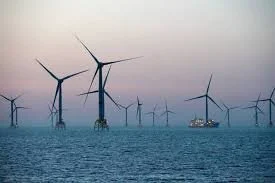
The concept of Offshore Wind Arrays in Myrtoan Sea Depths explores the possibility of installing wind turbines at sea to generate electricity for mainland and island communities.
Although Greece has significant offshore wind potential, a specific large-scale wind array in the Myrtoan Sea should not be presented as an established project without official confirmation. The region's depth, environmental conditions, shipping routes, and competing maritime uses would all influence its suitability.
The Geography of the Myrtoan Sea
The Myrtoan Sea occupies a section of the Aegean between the Peloponnese and the Cyclades.
It is characterized by exposed maritime conditions and considerable variations in water depth.
Its location connects important shipping routes between the eastern Mediterranean, the Aegean, and ports in southern Greece.
These geographical characteristics create both opportunities and engineering challenges for offshore energy development.
How Offshore Wind Farms Work
Offshore wind turbines convert the kinetic energy of moving air into electricity.
Wind turns the turbine blades, which rotate a generator housed within the turbine structure.
Electricity travels through cables to an offshore substation and then through transmission infrastructure toward the mainland grid.
Offshore installations can benefit from stronger and more consistent winds than some land-based locations.
However, their construction and maintenance are generally more expensive.
Fixed-Bottom and Floating Turbines
Water depth is one of the most important factors in offshore wind engineering.
Fixed-bottom turbines are attached to foundations anchored to the seabed. They are generally more practical in relatively shallow waters.
Floating turbines are supported by floating platforms connected to the seabed through mooring systems.
Floating technology could make deeper sections of the Myrtoan Sea more accessible.
Nevertheless, deep-water development introduces additional engineering demands involving platform stability, mooring systems, cable connections, and maintenance.
Wind Conditions and Energy Potential
Before an offshore wind farm can be developed, researchers need detailed information about local wind conditions.
Measurements may come from meteorological buoys, floating LiDAR systems, satellite observations, and atmospheric models.
Long-term measurements help determine average wind speeds, seasonal variation, turbulence, and extreme weather conditions.
A location with strong winds is not automatically suitable. Developers must also consider turbine spacing, seabed geology, water depth, and connection to the electrical grid.
Connecting Wind Power to Greek Islands
An offshore wind installation could potentially supply electricity to mainland Greece or nearby islands.
Subsea transmission cables could connect offshore substations to suitable coastal grid connections.
Such infrastructure would require coordination with existing telecommunications cables, shipping lanes, fishing areas, and marine conservation zones.
Energy storage and connections with other renewable sources could also help manage variations in wind production.
Marine Ecology and Environmental Protection
Offshore wind projects can affect marine environments during construction and operation.
Underwater noise, seabed disturbance, vessel activity, and changes to marine habitats require careful assessment.
The Myrtoan Sea supports marine ecosystems and migratory species.
Environmental studies would need to examine impacts on fish, marine mammals, seabirds, and sensitive seabed habitats.
Construction schedules and turbine placement could be adjusted to reduce ecological disturbance.
Shipping, Fishing, and Maritime Safety
The Myrtoan Sea is part of an active maritime region.
Offshore turbines would need to be positioned with consideration for commercial shipping, fishing activity, navigation, and emergency access.
Safety zones and maritime coordination would be essential.
The economic interests of coastal communities would also need to be considered before selecting development sites.
Greece's Offshore Wind Opportunity
Greece has been examining offshore wind as part of its broader energy transition.
Floating wind technology is particularly relevant because much of the country's offshore environment becomes deep relatively close to shore.
However, turning technical potential into operating wind farms requires marine surveys, environmental approvals, grid planning, investment, and clear regulatory procedures.
Conclusion
Offshore Wind Arrays in Myrtoan Sea Depths represent a possible direction for expanding renewable-energy production in Greece.
The region's maritime exposure and deep-water conditions make floating wind technology an interesting subject for investigation.
However, a viable project would require detailed wind measurements, seabed surveys, environmental assessments, and careful planning around shipping and fishing.
If these challenges can be addressed, offshore wind could eventually contribute to a more diversified and resilient Greek electricity system.