Introduction
Quantum science is one of the most important areas of modern physics and engineering. It examines the behavior of matter and energy at extremely small scales, where particles can display properties that differ significantly from the objects encountered in everyday life.
Research in quantum technologies has expanded beyond theoretical physics into computing, communications, sensing, and materials science.
The title Quantum Labs in Patras University Complex explores the potential role of university-based research facilities in developing these technologies.
The University of Patras has an established scientific and engineering research environment. However, the existence, scale, and specific capabilities of any dedicated quantum laboratory should be verified through institutional documentation rather than inferred from the university's general research reputation.
What Is Quantum Technology?
Quantum technology uses principles of quantum mechanics to develop new scientific and engineering applications.
Quantum mechanics describes the behavior of particles and systems at microscopic scales.
Important concepts include superposition, entanglement, quantum measurement, and tunneling.
These effects can be used in specialized devices that may offer capabilities beyond conventional technologies.
Quantum research is commonly divided into several interconnected areas, including quantum computing, quantum communication, quantum sensing, and quantum materials.
Quantum Computing
Quantum computers use quantum bits, commonly called qubits.
Unlike classical bits, which represent information as either zero or one, qubits can be prepared in quantum states that involve combinations of these possibilities.
Quantum algorithms use these properties to perform certain calculations in ways that differ from conventional computing.
This does not mean quantum computers are faster at every task.
Their potential advantage applies to specific classes of problems, and many practical applications remain limited by hardware stability, error correction, and system scale.
Quantum Communication
Quantum communication investigates how quantum states can be used to transmit or protect information.
One important application is quantum key distribution.
This approach uses quantum principles to help establish secure encryption keys.
If an unauthorized observer attempts to measure certain quantum states, the measurement can disturb the system in detectable ways.
However, practical quantum communication systems still face engineering challenges involving distance, equipment reliability, network integration, and cost.
Quantum Sensing
Quantum sensing uses sensitive quantum systems to measure physical quantities.
These may include magnetic fields, electric fields, acceleration, time, and gravitational effects.
Quantum sensors can potentially provide extremely precise measurements.
Applications may include medical research, geological surveys, navigation, materials testing, and environmental monitoring.
Universities with strong physics and engineering departments may contribute to this field through experimental research and instrument development.
Why Patras Could Be Relevant
The University of Patras is a major Greek higher-education institution with research activity across science, engineering, technology, and medicine.
Its academic environment provides opportunities for collaboration between physicists, electrical engineers, computer scientists, mathematicians, and materials researchers.
Quantum research is inherently interdisciplinary.
A functioning research program may require expertise in cryogenics, laser systems, nanofabrication, electronics, advanced materials, software, and precision measurement.
Universities can support this work by bringing together specialists from different departments.
What a Quantum Laboratory Requires
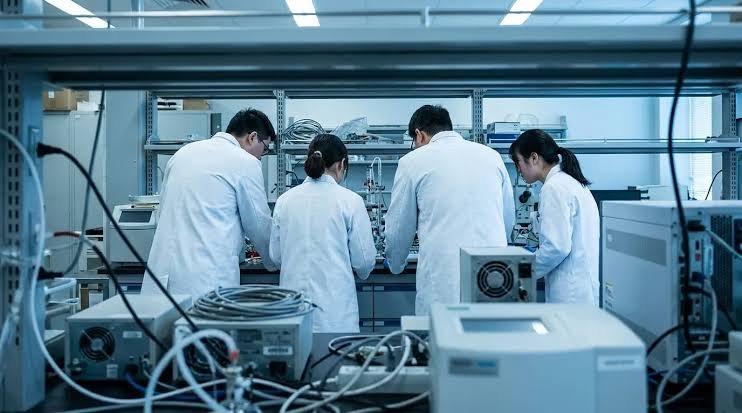
A quantum laboratory may need specialized equipment depending on its research focus.
A facility studying superconducting qubits could require cryogenic systems capable of reaching extremely low temperatures.
Research involving trapped ions may require vacuum chambers, precision lasers, and sophisticated control electronics.
Photonics laboratories may use optical tables, lasers, single-photon detectors, and carefully controlled environments.
Quantum materials research may require advanced microscopy, spectroscopy, and materials-characterization equipment.
There is no single universal design for a quantum laboratory.
Its infrastructure must match the experiments being conducted.
Collaboration and Research Funding
Quantum research often requires substantial financial support.
Funding may come from national research programs, European initiatives, universities, industry partnerships, and international scientific collaborations.
European research programs have increasingly supported quantum technologies through coordinated research and innovation projects.
For a university in Patras, collaboration with European laboratories could provide access to equipment, expertise, training, and shared research infrastructure.
Joint projects can also help graduate students and early-career researchers participate in international scientific networks.
Education and Workforce Development
Quantum technology requires specialized knowledge.
Students need strong foundations in mathematics, physics, computer science, and engineering.
Universities can introduce quantum topics through undergraduate courses, postgraduate programs, research seminars, and laboratory training.
Interdisciplinary education is particularly important because quantum technologies combine theoretical principles with complex engineering requirements.
Developing local expertise could help Greece participate in emerging quantum industries.
Potential Applications in Greece
Quantum research could eventually contribute to several areas relevant to Greece.
Quantum sensing may support geological and environmental measurements.
Advanced materials research could contribute to electronics and energy technologies.
Quantum communication could be relevant to secure communications infrastructure.
Quantum computing research may support investigations into complex simulations, optimization, and materials design.
These are potential areas of application rather than guaranteed commercial outcomes.
Challenges and Scientific Limitations
Quantum systems are often extremely sensitive to environmental disturbances.
Interactions with the surrounding environment can cause decoherence, which disrupts the quantum behavior required for many applications.
Researchers must develop methods to isolate, control, and measure quantum systems.
Scaling experimental systems into reliable commercial products is another major challenge.
Many quantum technologies remain in the research and development stage, and claims about immediate industrial transformation should be treated cautiously.
Conclusion
The Quantum Labs in Patras University Complex topic highlights the potential role of Greek universities in the expanding field of quantum science.
The University of Patras provides an academic environment where physics, engineering, computing, and materials research can intersect.
A dedicated quantum laboratory would require specialized equipment, trained researchers, sustained funding, and collaboration with national and international institutions.
The existence and capabilities of a specific facility should be confirmed through official university records.
Regardless of the current scale of local infrastructure, developing quantum expertise could strengthen Greece's participation in future scientific and technological research.