The Master of Mockery: Aristophanes and the Birth of Political Satire
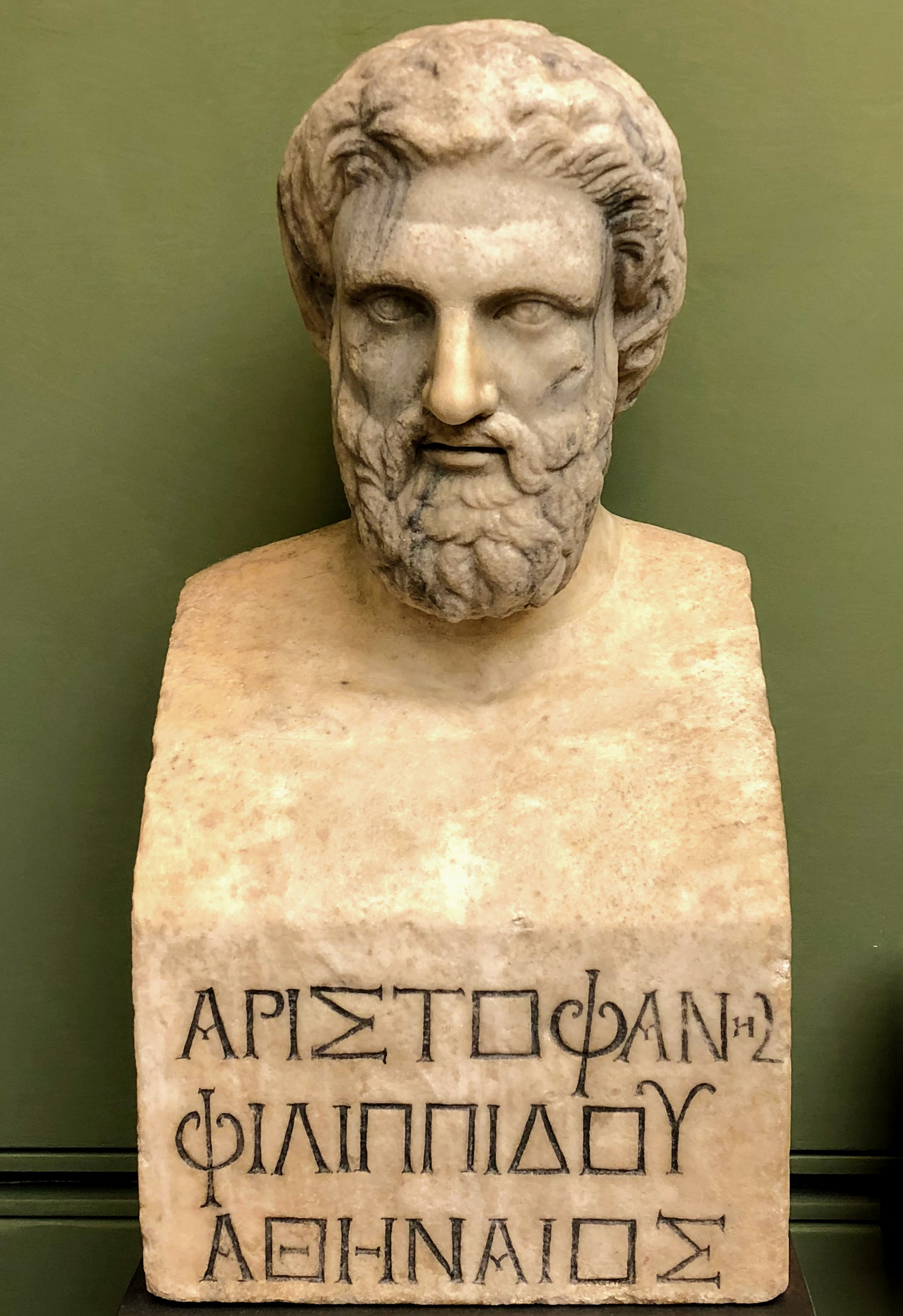
While the great tragedians were busy contemplating the crushing weight of fate, Aristophanes (c. 446–386 BCE) was in the theater of Dionysus making fun of them. Known as the "Father of Comedy," he is the only representative of Old Comedy whose work survives in complete form. His plays were the "Saturday Night Live" of ancient Athens—brilliant, crude, and fearlessly political.
1. The Mechanics of Old Comedy
Old Comedy was fundamentally different from the "sitcom" style of later Greek and Roman plays. It was characterized by high-energy performances, fantastic plots, and the Parabasis—a moment where the actors leave the stage and the Chorus addresses the audience directly, often to deliver the playwright’s own political opinions.
Structure and Style
Aristophanes used a combination of:
Slapstick & Scatology: Low-brow humor and physical gags.
Lyrical Beauty: Exquisite poetry in the choral odes.
The Agon: A formal debate between two characters representing opposing views (e.g., "Just" vs. "Unjust" speech).
2. The Fearless Satirist: Punching Up
Aristophanes lived through the Peloponnesian War, a brutal conflict between Athens and Sparta. He used his stage as a weapon against the powerful, frequently targeting:
Cleon the Demagogue: In The Knights, he portrayed the powerful Athenian leader as a corrupt slave who manipulates his "master" (the People). He was actually sued for libel for his portrayals, yet he continued to attack Cleon even after the lawsuit.
Socrates and the Sophists: In The Clouds, he famously parodied Socrates as a bumbling pseudo-intellectual who lives in a "Thinkery" and teaches students how to argue their way out of debts. This play was so influential that Socrates later blamed it for poisoning the jury's mind against him during his trial.
Euripides: In The Frogs, he depicts the god Dionysus traveling to the underworld to bring back a great poet. He stages a hilarious "poetry slam" between Aeschylus and Euripides, ultimately siding with the old-fashioned dignity of Aeschylus over the "modernist" Euripides.
3. Masterpieces of Subversion
Three of his works stand out for their radical creativity and enduring social commentary:
Lysistrata: The First Sex Strike
In his most famous play, the women of Greece, led by Lysistrata, decide to end the Peloponnesian War by refusing to have sex with their husbands until a peace treaty is signed. It is a brilliant exploration of gender power dynamics and remains one of the most performed comedies in the world today.
The Birds: Building a Cloud Cuckoo Land
Tired of the litigation-heavy life in Athens, two men convince the birds to build a giant city in the sky (Nephelokokkygia). This play is a masterpiece of escapism and a sharp critique of Athenian imperialism.
The Wasps: Mocking the Legal System
Aristophanes turned his sights on the Athenian obsession with law courts. He portrayed a man so addicted to jury duty that his son has to lock him in the house to keep him from the courts.
4. The Transition: From Old to Middle Comedy
As Athens lost the Peloponnesian War and fell under the rule of the "Thirty Tyrants," the freedom to mock political leaders vanished. Aristophanes’ later works, like Wealth, show a shift toward Middle Comedy, which relied less on specific political attacks and more on social types and domestic situations.Aristophanes reminds us that comedy is not just about laughter—it is a vital democratic check on power. By making the audience laugh at the absurdity of war, the vanity of philosophers, and the corruption of politicians, he ensured that no one in Athens was above being brought down a peg or two. His legacy lives on in every comedian who believes that truth is best served with a punchline