The story of Leander and Hero is one of the most poignant tales of doomed love in classical literature. Unlike the myths of gods and monsters, this is a human tragedy—a stark exploration of passion, the isolation of the individual, and the relentless power of the natural elements.
I. The Star-Crossed Lovers
The story is centered on the Hellespont (the Dardanelles strait separating Europe and Asia).
Hero was a beautiful priestess of the goddess Aphrodite, living in a tower in the city of Sestos on the European shore. Because of her service to the goddess, she lived in seclusion.
Leander was a young man from the city of Abydos on the opposite Asian shore.
The two met during a festival of Aphrodite, where Leander was instantly smitten. Despite the distance and the danger of the turbulent waters, they fell into an intense, secret love.
II. The nightly Vigil
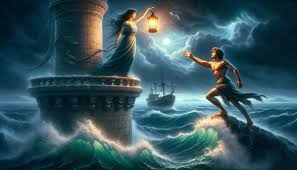
Since they could not be together openly, they devised a desperate plan. Each night, Hero would light a beacon-fire at the top of her tower. Guided by this flickering light, Leander would dive into the icy, treacherous Hellespont and swim across the dangerous currents to reach her.
For a long time, the ritual held. Leander would swim the miles across the strait, guided by his lover's light, and Hero would wait in the tower, her heart heavy with the fear of the sea but filled with the hope of his arrival.
III. The Fatal Night
The tragedy occurred during the onset of winter. As a violent storm began to rage, the winds whipped the sea into a frenzy.
The Extinguished Flame: Hero, anxious for her lover's safety, kept the beacon burning. However, in the height of the storm, a powerful gust of wind blew out the flame.
The Loss of Direction: Without the beacon to guide him, Leander was left lost in the dark, churning waters. The currents—which he had navigated so many times before—overcame his exhausted body. He struggled, but without the light to orient him, he eventually succumbed to the sea and drowned.
IV. The Final Sacrifice
The next morning, at dawn, Hero stood on the balcony of her tower, scanning the horizon for Leander. As the morning light washed over the shore, she saw his lifeless body washed up on the rocks below.
Overcome by grief, Hero could not bear to live in a world without him. She threw herself from the top of the tower into the sea, joining Leander in death.
V. Themes and Literary Legacy
The story is famously immortalized in the poem Hero and Leander, written by the 5th-century poet Musaeus Grammaticus. It was later a major inspiration for poets and writers, including Marlowe, Shakespeare, and Byron.
Love vs. Nature: The myth is a classic example of human passion pitted against the uncaring forces of the natural world. The sea—the Hellespont—is not an active villain; it is simply indifferent. The tragedy arises because the lovers ignore the boundaries of nature in their pursuit of one another.
The Symbol of the Beacon: The light is a powerful, dual-natured symbol. It represents the guiding force of love and hope, but it is also fragile—entirely dependent on the whims of the elements. It serves as a reminder that human efforts to connect are always vulnerable to external chaos.
The "Hellespontine" Connection: The story also carries a geographic resonance, echoing the mythical connection of the Hellespont (famously linked to the myth of Phrixus and Helle, who also perished in these waters). It cements the strait's place in classical literature as a site of crossing, transition, and, frequently, death.
The story of Leander and Hero is a meditation on the cost of devotion. It highlights the classical Greek and Roman fascination with "limitless" love—a passion that acknowledges no boundaries, even those of life and death, but ultimately pays the price for its own intensity.