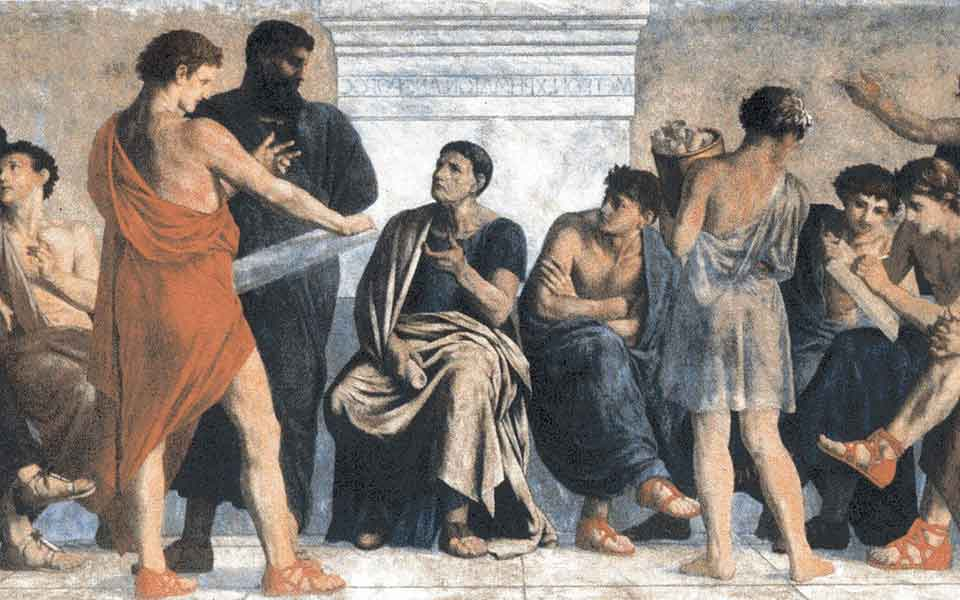
The Athenian Approach: The Pursuit of Paideia
Athenian education was fundamentally about individual cultivation. It was a private, family-funded endeavor that sought to produce a "well-rounded" citizen.
Holistic Growth: The goal was to balance the mind and the body. By learning to read, write, play the lyre, and wrestle, an Athenian boy was expected to gain the poise and intelligence required to navigate the public life of the agora and the democratic assembly.
The Role of the Family: Because it was private, education was deeply connected to the home. Parents took responsibility for hiring tutors and purchasing the time of a pedagogue (the slave who guided their son’s development).
Democratic Readiness: The ultimate aim was to create a man who could reason, speak persuasively, and contribute to the civic life of the city. For Athenians, excellence (arete) was found in the ability to excel in both war and the intellectual arts.
The Spartan Approach: The Rigor of the Agoge
In sharp contrast, Spartan education was a state-mandated totalizing experience. There was no "private" education in Sparta; from the age of seven, the individual ceased to belong to his family and became the property of the state.
Military Supremacy: The agoge was essentially a brutal, lifelong initiation into a warrior brotherhood. The curriculum prioritized endurance, survival, and combat. Boys were kept underfed and under-clothed to build mental and physical toughness.
The Power of the State: By removing boys from their homes, the Spartan state effectively destroyed the "private" sphere. By forcing them to eat in communal mess halls and live in barracks, they ensured that the individual's primary identity was tied to the unit, not the family.
Social Control: The training was not just about war; it was about maintaining control over their subject population (the Helots). The Crypteia—a secret service program for elite youths—was a grim example of how education was used to reinforce the social hierarchy through state-sponsored violence.
A Note on the Women of Greece
It is also worth noting how these philosophies extended to women. In Athens, girls remained within the domestic walls, taught by their mothers the arts of weaving, household management, and religious observance. In Sparta, the philosophy of "strength for the state" applied to women as well. Spartan girls underwent public physical training—wrestling and running—with the firm belief that a physically powerful mother would produce a stronger warrior son.
While the Athenian system fostered an environment where critical thinking and eloquent speech could thrive, the Spartan system produced a society of unmatched military stability and collective cohesion. Both systems were reflections of what these two cities feared most: Athens feared the loss of individual and democratic freedom, while Sparta feared the loss of their military dominance and their social order.