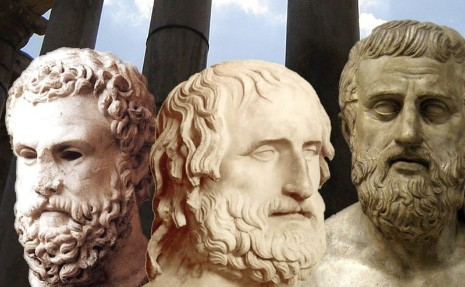
Aeschylus, Sophocles, and Euripides: The Great Tragedians
The Architects of Agony: Comparing the Three Great Masters of Athenian Tragedy
In the span of a single century, the city of Athens produced three playwrights who would define the theatrical medium for the next two millennia. While they all competed in the same religious festivals (the City Dionysia), Aeschylus, Sophocles, and Euripides each brought a distinct philosophical and structural evolution to the stage. They took the raw materials of myth and transformed them into a sophisticated examination of law, fate, and human psychology.
1. Aeschylus: The Father of Tragedy and the Moral Cosmos
Aeschylus (c. 525–456 BCE) is the earliest of the three. Before him, tragedy consisted of a single actor and a large chorus. Aeschylus’s most significant technical innovation was the introduction of the second actor, which allowed for true dialogue and conflict between characters independent of the chorus.
The Grandeur of Justice
Aeschylus’s plays are massive in scale and moral concern. His only surviving trilogy, the Oresteia, tracks the transition from primitive "blood feuds" to the "rule of law."
Style: High, archaic, and deeply religious.
Key Work: Agamemnon.
Philosophy: He believed that "suffering leads to wisdom" (pathei mathos). In his world, the gods are stern but represent a coherent moral order. Humans suffer because they violate the laws of the universe, and justice, though slow, is inevitable.
2. Sophocles: The Master of Irony and Character
Sophocles (c. 496–406 BCE) was the most successful of the trio, winning more first-place prizes than any other playwright. He introduced the third actor, which made the dramatic interactions far more complex and reduced the dominance of the chorus.
The Individual vs. Fate
Sophocles shifted the focus from the cosmic "laws" of Aeschylus to the individual character. He is the master of Tragic Irony, where the audience knows the hero's fate while the hero remains blind to it.
Style: Polished, balanced, and structurally perfect.
Key Work: Oedipus Rex.
Philosophy: His heroes are often isolated figures of immense integrity and stubbornness (like Antigone or Oedipus). They are trapped in a world where fate is invincible, yet their greatness is defined by how they face that fate once the "truth" is revealed.
3. Euripides: The Rebel and the Psychologist
Euripides (c. 480–406 BCE) was the most controversial and, during his lifetime, the least successful. He was the "modernist" of his day, frequently deconstructing traditional myths and portraying the gods as capricious or even cruel.
The Internal Storm
Euripides was interested in Psychological Realism. While Sophocles "drew men as they ought to be," Euripides "drew them as they are." He focused on marginalized voices—women, slaves, and the defeated—and explored the irrationality of human emotion.
Style: Plain, conversational, and often experimental.
Key Work: Medea or The Bacchae.
Philosophy: He was a skeptic. His plays often end with the Deus ex Machina (a god appearing via a crane to wrap up the plot), which many scholars interpret as a sarcastic critique of traditional religious resolutions. To Euripides, the real "gods" were the untamable passions within the human heart.