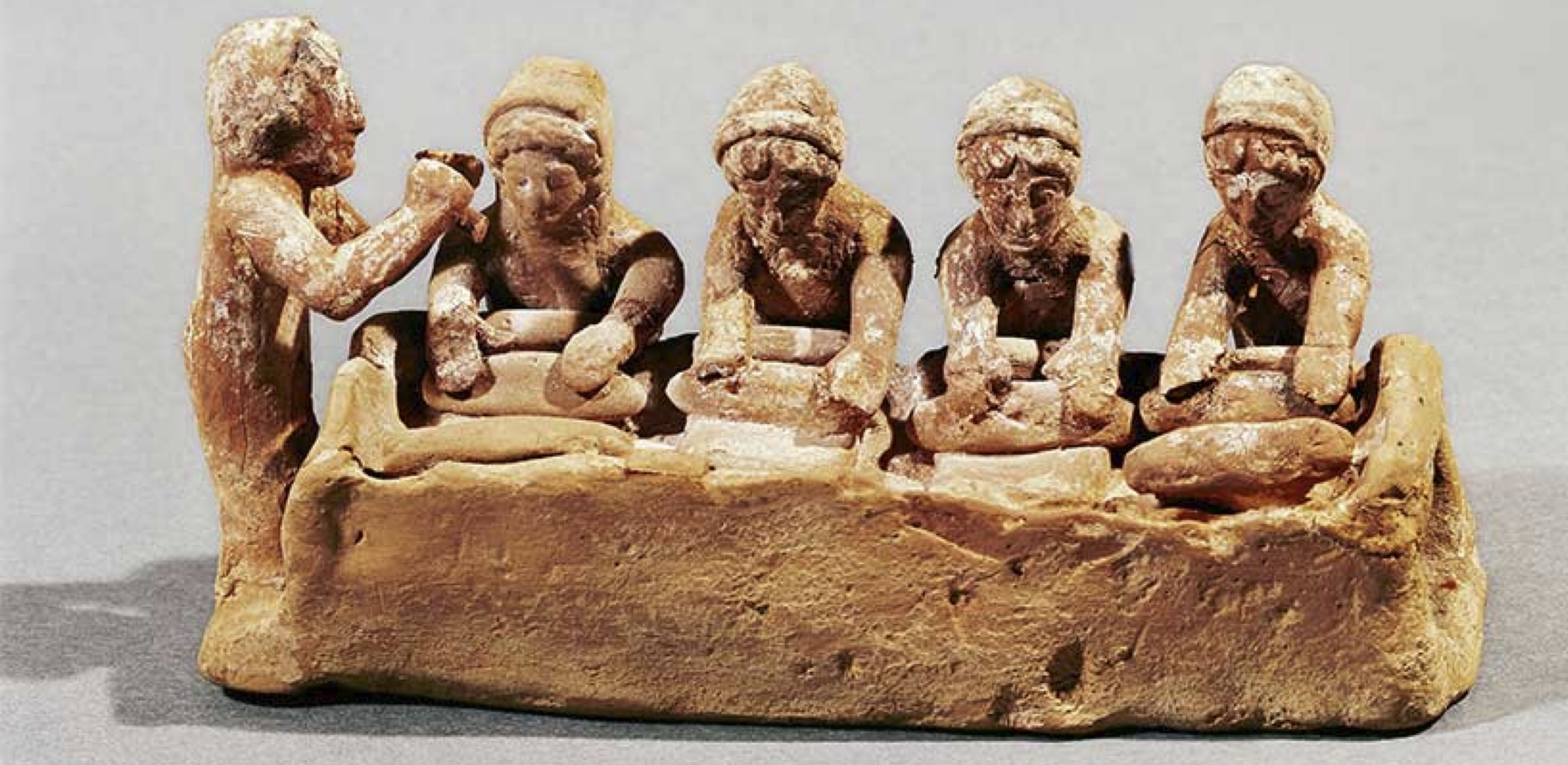
In the ancient Greek diet, bread was not a side dish or an optional accompaniment; it was the foundational substance of life. The Greeks categorized all food into two distinct groups: sitos (the primary grain staple, which comprised up to 70–80% of their daily caloric intake) and opson (anything eaten alongside the bread to make it palatable, such as olives, garlic, cheese, fish, or vegetables). To be human was to be a sitophagos—a "bread-eater." The production of bread was a labor-intensive, daily ritual that combined agricultural grit, mechanical sorting, and pyrotechnology.
The Grain Dilemma: Barley vs. Wheat
The geography of Greece heavily dictated the types of bread consumed across different social classes. The rocky, mountainous terrain and thin soil of the Greek peninsula were poorly suited for growing elite, demanding grains like naked wheat (pyros). Wheat required deep, fertile soil, which was largely restricted to regions like Thessaly, Sicily, or imports from the Black Sea. Consequently, fine wheat bread, known as artos, was a luxury item consumed by the wealthy or reserved for religious festival days.
The vast majority of Greeks relied on krithai (barley). Barley is an incredibly hardy grain capable of thriving in poor, arid soil. However, barley contains low levels of gluten-forming proteins, meaning it cannot rise into a fluffy, aerated loaf. Instead, barley flour was used to make maza, a dense, unleavened flatbread or paste. Maza was the fuel of the masses—the standard ration for rowers in the Athenian navy, farmers in the fields, and slaves in the silver mines.
The Grinding and Kneading Ritual
The conversion of raw grain into flour was a grueling domestic chore assigned almost exclusively to women or domestic slaves. The process followed a strict technological chain of operations:
Parching: Because barley hulls are tightly bound to the grain kernel, the grain was first lightly parched in shallow clay pans over an open fire to make the hulls brittle.
Milling: The parched grain was taken to a stone mill. In early periods, this was a simple saddle quern—a flat stone slab where a woman pushed a heavy cylindrical stone roller back and forth using her body weight. By the 5th century BCE, this was upscaled to the Olynthian hopper-mill, which used a lever mechanism to slide a slotted upper stone over a grooved lower stone, drastically increasing efficiency.
Sifting: The crushed grain was passed through sieves made of woven papyrus or horsehair to separate the fine flour (alphita) from the coarse bran.
Once the flour was secured, it was transferred to a large wooden or terracotta kneading trough (kardopos). To make artos, water, wild yeast starters (often derived from fermenting grape juice or leftover dough from the previous day), and a pinch of salt were added. The dough was systematically turned, punched, and stretched by hand until the gluten structure stabilized.
Pyrotechnology: The Evolution of the Oven
The cooking method depended entirely on domestic wealth. The simplest households cooked their maza directly in the hot ashes of a hearth fire or slapped the flat dough onto a heated terracotta tile covered by a clay dome (pnygeus).
The elite, however, utilized the clibanus ($\kappa\lambda\dot\iota\beta\alpha\nu o\varsigma$), a sophisticated, portable ceramic oven. The clibanus was a bell-shaped clay vessel with small ventilation holes. Hot charcoal was piled around the outside and on top of the dome, heating the interior walls. The dough was placed inside through a small door, creating a controlled, radiant heat chamber that allowed the wheat bread to rise into a light, golden loaf.
The Greeks took great pride in their baking arts; by the Hellenistic period, professional bakers in cities like Athens offered over 72 distinct varieties of bread, ranging from streptitai (twisted braided loaves) to daratos (flat unleavened unleavened griddle cakes), transforming a basic survival strategy into an art form.