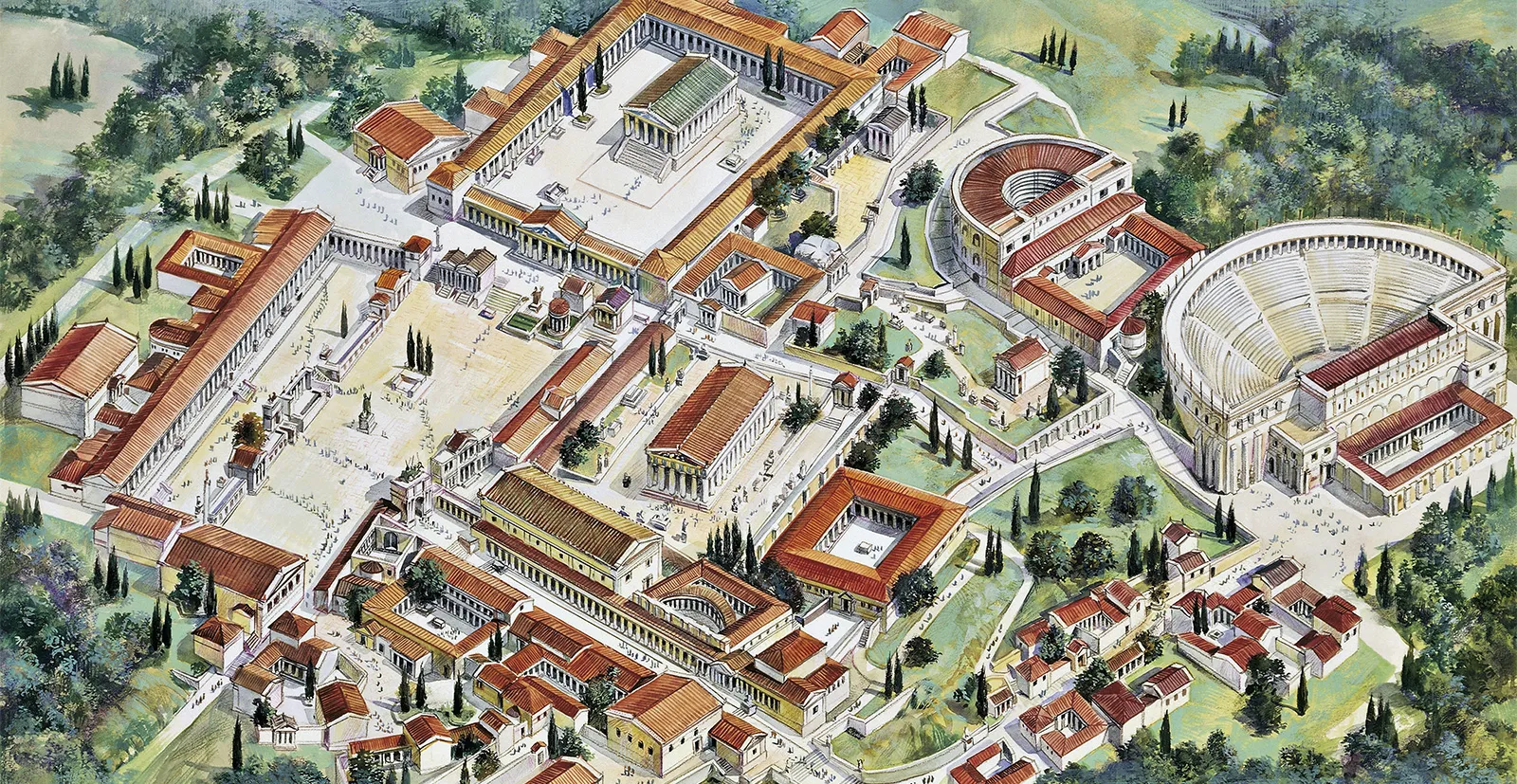
In the modern world, a city center is often divided into distinct zones: a financial district for banking, a shopping mall for commerce, a courthouse for law, and a park for socializing. To the ancient Greeks, however, all of these vital civic functions were compressed into a single, dynamic open space: the Agora ($\dot\alpha\gamma o\rho\dot\alpha$). Derived from the verb ageirein, meaning "to gather," the Agora was the undisputed physical, social, and political heart of the Greek city-state (polis).
                    [ THE MULTIDEPENDENT AGORA MATRIX ]
                                     │
         ┌───────────────────────────┼───────────────────────────┐
         ▼                           ▼                           ▼
[ THE CIVIC CORE ]          [ THE COMMERCIAL SPINE ]    [ THE PHILOSOPHICAL ENGINE ]
* Bouleuterion (Council)    * Kapeloi (Retail Stalls)   * Stoas (Shaded Porches)
* Heliaia (Public Courts)   * Metronomoi (Weights)      * Socratic Dialogue Circles
The Architecture of Democracy
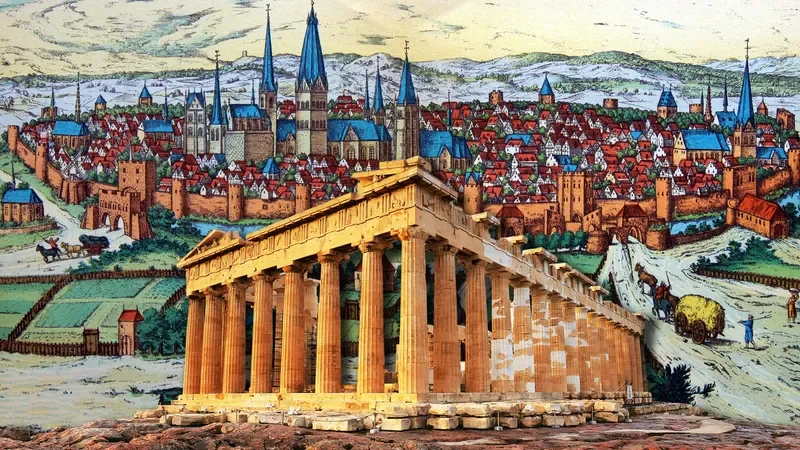
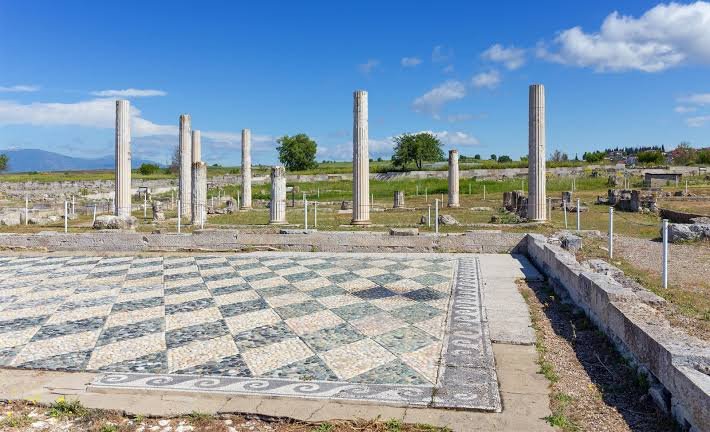
Physically, the Agora was a large, open square, typically situated in the center of the city or near its main harbors. It was carefully bordered by monumental public buildings that gave physical form to the concept of self-governance. The most prominent of these were the stoas—long, roofed colonnades that provided shade from the intense Mediterranean sun.
These stoas were not merely decorative; they were the multi-purpose civic complexes of the ancient world. Inside their shaded recesses, merchants set up shops, magistrates held informal hearings, and philosophers met with their students.
Surrounding the open square sat the permanent institutions of democracy. In the Athenian Agora, this included the Bouleuterion (the council house where the 500 citizens of the Boule met to draft legislation), the Tholos (the round headquarters of the executive committee), and the Heliaia (the massive public courts where juries numbering in the hundreds decided the legal fates of their peers).
To ensure the purity of this democratic space, the perimeter of the Agora was marked by marble boundary stones (horoi) inscribed with the words, "I am the boundary of the agora." Anyone who had committed a crime, failed to pay their taxes, or shirked their military duty was legally barred from crossing these markers, preserving the integrity of the civic heartland.
The Commercial Hub and Market Controls
Every morning, the quiet civic square transformed into a chaotic, loud marketplace. Temporary wooden stalls (skenai) were erected, organized into specific sectors based on the goods being sold. There was a section for fish, an alleyway for pottery, a corner for perfume, and a bustling livestock market. Retailers, known as kapeloi, screamed their prices to passing crowds, while bankers and money-changers sat at small tables (trapezai), exchanging foreign coins for local silver tetradrachms.
Because the Greeks viewed economic stability as an extension of moral and political health, the Agora was heavily regulated by elected public officials:
Metronomoi: Officials tasked with checking commercial scales, weights, and measures to ensure merchants were not cheating consumers.
Agoranomoi: Market police who monitored the quality of goods, settled disputes on the spot, and regulated prices for essential staples like grain and flour.
Sitophylakes: A specialized committee dedicated exclusively to monitoring the grain trade, ensuring that hoarding did not occur and that grain prices remained fair during times of drought.
The Intellectual and Social Crucible
Beyond politics and cash, the Agora was the supreme social crucible of the Greek world. It was the place where psychological citizenship was forged. For an Athenian man, staying home was a sign of anti-social behavior or a lack of civic virtue; a proper citizen spent his day in the Agora, engaging in lesche (casual gossip, political debate, and news-gathering).
It was within this dense, highly conversational environment that Western philosophy was born. Socrates did not teach in an isolated university classroom; he walked the Agora bare-footed, setting up camp near the cobbler's shop or inside the Stoa Basileios, cornering politicians, youth, and foreign visitors to dissect the nature of justice, virtue, and truth.
The Agora merged the sacred and the profane; it was surrounded by shrines to the gods, yet filled with the smell of roasting garlic and the shouting of slave traders. It was a space where every class of citizen collided daily, serving as the essential stage where the experiments of classical democracy, philosophy, and urban commerce were actively performed.