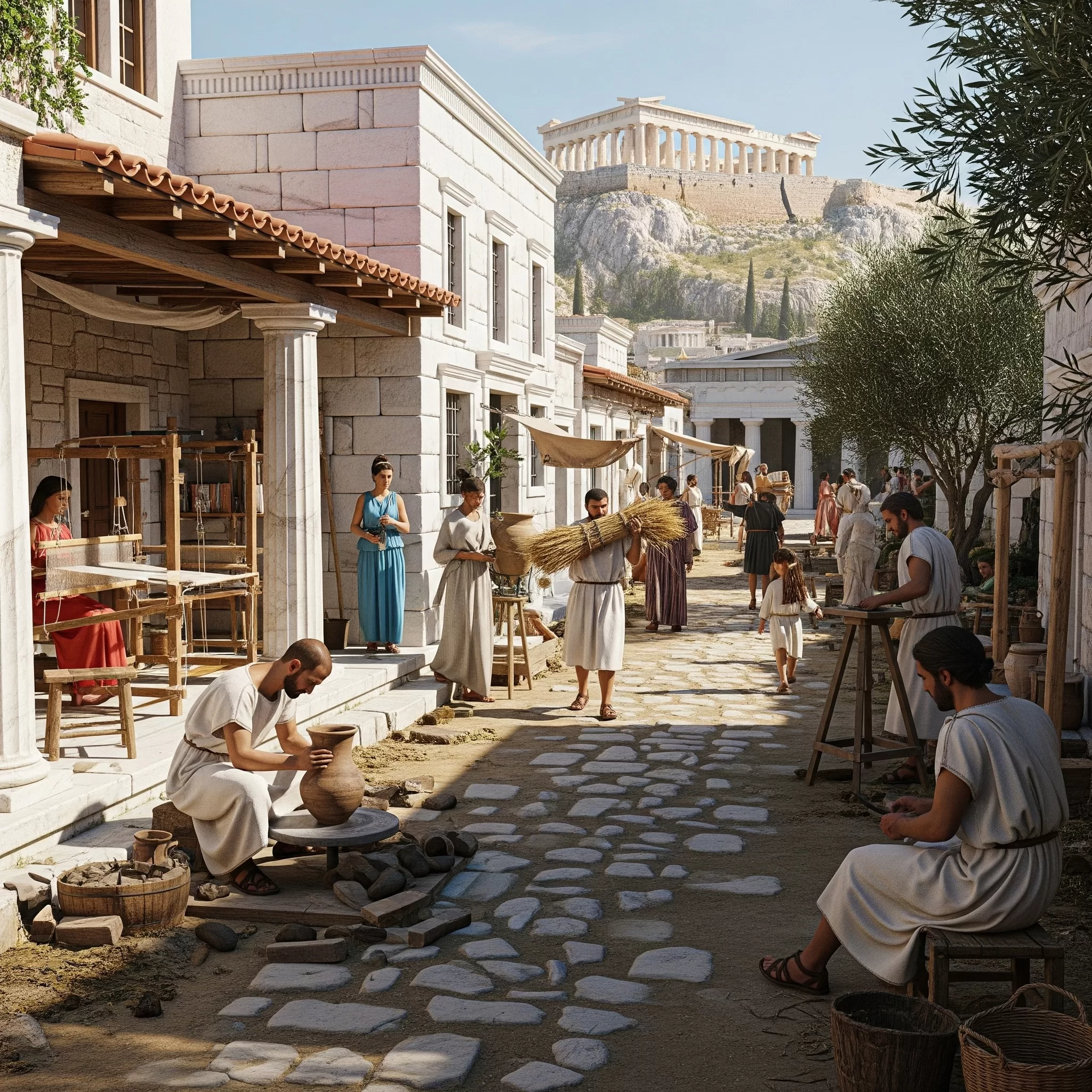
To fully comprehend the daily life of a free, adult male citizen in classical Athens (c. 5th century BCE), one must understand that his life was defined by an extreme separation of spheres. Manual labor was largely outsourced to a massive slave population, leaving the citizen with an ideological obligation to dedicate his time to the polis. His day was structured around civic duty, physical conditioning, and intense public socialization, all conducted under the open Mediterranean sky.
[ DAWN ] ────────────────► Light breakfast (akratismos) & domestic exit
                            │
[ MORNING ] ─────────────► Agora visitation: Political assemblies or legal trials
                            │
[ MIDDAY ] ──────────────► Light lunch (ariston) & thermal rest
                            │
[ AFTERNOON ] ───────────► Gymnasium training (Kynosarges / Academy)
                            │
[ SUNSET ] ──────────────► Return home / Preparation for the Symposium (Banquet)
Dawn: The Domestic Exit
The Athenian day began at the first crack of dawn (orthros). Because ancient homes lacked window glass, artificial lighting was limited to smoky, dim terracotta oil lamps burning olive oil. As soon as the sun rose, the domestic space became dark and unappealing. The citizen woke from his wooden couch, wrapped himself in a single piece of wool cloth known as a himation, and slipped on simple leather sandals.
Breakfast, known as akratismos, was a sparse, hurried affair. It consisted of a handful of dried figs, a few olives, and a piece of stale barley bread dipped directly into unwatered, dark wine to soften it.
With his breakfast concluded, the citizen immediately exited his home. The domestic sphere was the domain of his wife, children, and household slaves; a prominent man’s status was measured by how little time he spent inside his own walls.
Morning: The Civic Crucible
The entire morning was dedicated to public affairs. The citizen walked into the city center toward the Agora. If the Ekklesia (the citizens' assembly) was scheduled to meet, he would climb the rocky slopes of the Pnyx hill alongside 6,000 of his peers. For the next several hours, he would sit on the bare stone tiers, listening to orators debate foreign policy, war declarations, and grain taxes, raising his right hand to vote on historic decisions that altered the fate of the Mediterranean.
On non-assembly days, his morning might be spent serving as a juror (dikastes) in one of the city's massive public courts. Drawn by lot using a stone randomization machine called a kleroterion, he would sit on a jury of 501 or 1,001 citizens, listening to speeches and casting his bronze voting ballots into jars to decide complex criminal or property cases. If he had no official civic duties, the morning was spent wandering the marketplace stalls, conducting business, checking his agricultural accounts, and gathering political news.
Afternoon: The Cult of the Body
Around midday, the citizen took a brief pause for ariston, a light lunch consisting of fish, bread, cheese, and seasonal fruit, followed by a short rest during the peak heat of the day. By mid-afternoon, his attention shifted from the mind to the body. He walked outside the city walls to one of the state’s three great public academies: the Academy, the Lyceum, or Kynosarges.
These gymnasia were vast parklands featuring running tracks, wrestling pits (palaistrai), and bathhouses. Here, the citizen engaged in a ritualized athletic routine:
Stripping Down: He stripped completely naked (gymnos, the root of gymnasium).
Anointing: He coated his entire body in a thick layer of olive oil to protect his skin from dust and the sun.
Training: He spent hours practicing wrestling, the long jump with lead weights (halteres), javelin throwing, and sprinting.
Scraping: To clean himself, he used a curved bronze tool called a strigil to scrape the layer of oil, sweat, and dirt off his skin before plunging into a cold water pool.
This intense training was not for personal vanity; it was an essential military requirement. Every Athenian citizen was a soldier, liable for active hoplite infantry service until the age of 60.
Night: The Intellect of the Symposium
As the sun set, the citizen returned home to prepare for the social climax of his day: the symposium ($\sigma v \mu \pi \dot{o}\sigma \iota o\nu$), a ritualized all-male drinking banquet held in the andron (the dedicated men’s dining room of a private home). Reclining on cushioned couches arranged in a circle, the host and his guests would feast on roasted meats, eel, and wild game.
Once the food was cleared, the symposiarch (the leader of the feast) was chosen by a roll of the dice. The symposiarch determined the exact ratio of water to wine to be mixed in a giant bowl (krater), as drinking unwatered wine was viewed as a dangerous practice reserved for barbarians.
For the rest of the night, as the mixed wine was poured into shallow cups (kylikes), the citizens engaged in intellectual riddles, political debates, and philosophical discourses, accompanied by hired flute girls, dancers, and poetry recitations. The symposium merged intoxication with intellectual philosophy, sending the citizen to bed late at night, fully integrated into the tight-knit network of Athenian civic life.