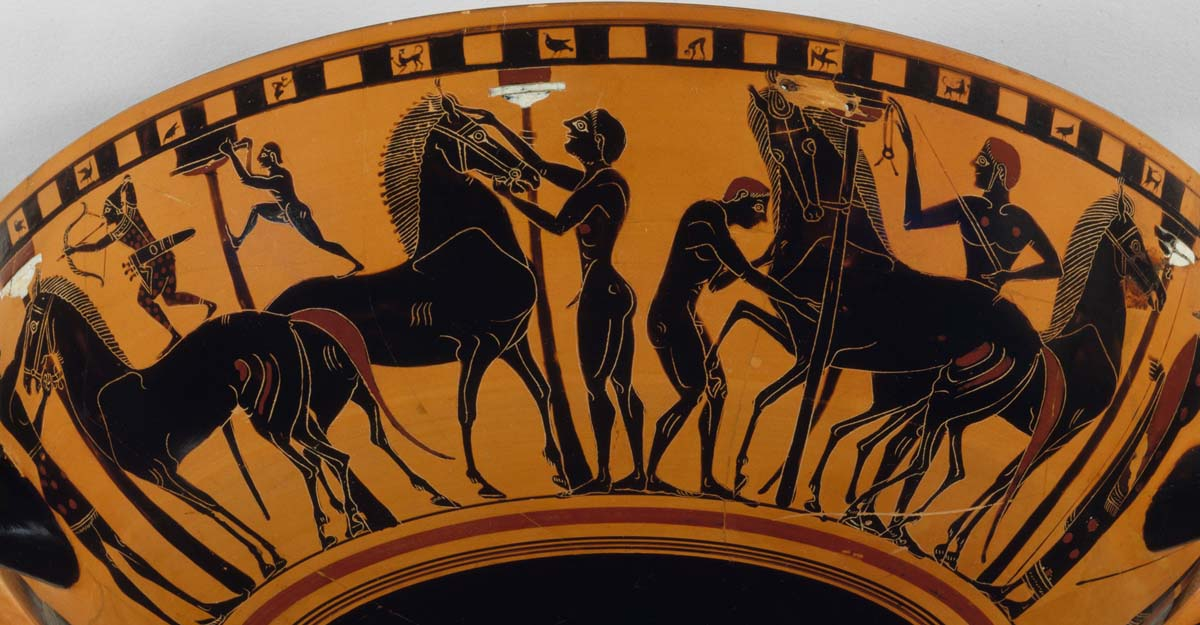
In ancient Greek society, the horse was the ultimate living symbol of aristocratic status, military power, and elite athletic victory. Owning, feeding, and breeding horses required an immense amount of land and wealth, turning horsemanship into a distinct class identity. However, unlike contemporary nomadic cultures that relied on brutal, mechanical force to break horses, the classical Greeks developed a highly sophisticated, psychologically grounded method of equestrian training that emphasized empathy, biomechanics, and clear communication.
                      [ THE XENOPHONIAN HORSE MANIFESTO ]
                                       │
         ┌─────────────────────────────┴─────────────────────────────┐
         ▼                                                           ▼
 [ THE PSYCHOLOGICAL APPROACH ]                             [ THE PHYSICAL RE-BALANCING ]
 * Total elimination of anger and fear                      * The Collection: Shifting weight to hindquarters
 * Positive reinforcement via rhythmic petting              * Loose rein communication via precision bit design
 * Understanding horse vision & prey psychology             * High-step high-action military gaits developed
Xenophon: The World’s First Natural Horse Master
The definitive guide to ancient equestrian methodology is Peri Hippikes (On Horsemanship), a treatise written around 360 BCE by the Athenian general, historian, and philosopher Xenophon. A student of Socrates, Xenophon applied philosophical discipline to horse training, creating a manual that remains a foundation of modern classical dressage.
Xenophon’s core philosophy was revolutionary for its time: the horse must never be broken through terror or violence. He explicitly wrote:
"For what a horse does under compulsion... is done without understanding; and there is no beauty in it either, any more than if one should whip and spur a dancer."
He argued that the trainer must master his own emotions, stating that orgé (anger) is the greatest sin in horsemanship, as it prevents a human from reading the animal's natural psychology. Xenophon taught that handlers must understand that a horse is a prey animal driven by vision and fear; therefore, any strange object or sound must be introduced slowly and paired with positive reinforcement, such as stroking the neck and offering food.
The Training Chain of Operations
The training of an elite Greek warhorse or chariot racer followed a strict, methodical timeline:
Foal Management: Xenophon advised that young foals should be housed in a bustling sector of the estate, ensuring they became desensitized to human voices, metallic noises, and crowded environments from birth.
The Professional Trainer: While an aristocrat would ride the horse in battle, the initial groundwork was handed over to a professional trainer (hippotropheus). The horse was taught to lead, tie, and accept the basic lunging line without panic.
The Soft Mouth Principle: The Greeks did not use heavy, bone-crushing metal bridles. Instead, they designed jointed bits (psalia) made of bronze or iron. The bit was engineered with small, rotating rings or disks that kept the horse's mouth active and salivating. The goal was to develop a "soft mouth," where the slightest twitch of the rider's pinky finger could communicate complex steering commands.
Biomechanics and the Art of Collection
Because the ancient Greeks rode without saddles, stirrups, or horseshoes, the rider's seat and balance were critical for survival on the battlefield. To prevent falling off during a heavy cavalry charge, the rider had to grip the horse’s bare back with his thighs. This required the horse to be trained in collection—the art of shifting its center of gravity backward.
The trainer used precision leg pressure and alternating tension on the reins to force the horse to tuck its hind legs deep beneath its body and lift its neck into a proud, arched frame. This posture took the load off the vulnerable front legs, allowing the horse to execute rapid, hair-pin turns, leap over battlefield obstacles, and execute high-stepping, theatrical military gaits.
Through this humane approach, the Greeks transformed horse training into a harmonious art form, viewing the warhorse not as a mechanical piece of military hardware, but as a noble, thinking partner in the pursuit of martial and civic glory.