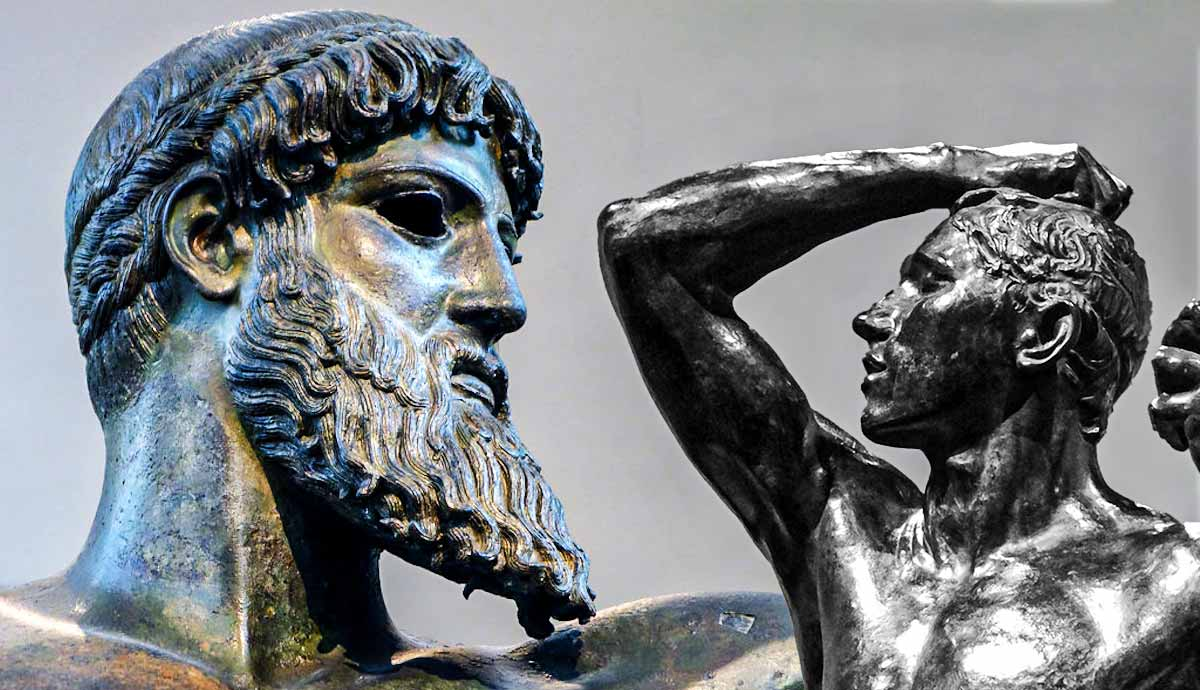
The evolution of ancient Greek sculpture is a journey from rigid, stylized block-carving to the absolute peak of dynamic, anatomical realism. This mastery was not merely the result of artistic genius; it was driven by revolutionary breakthroughs in geology, tool manufacturing, and mathematics. The Greeks transformed stone and metal into living tissue, creating a visual language that defined the canon of Western art.
   [ ARCHAIC PERIOD ] ──────────► Kouros: Rigid, Frontal, Egyptian Proportions
                                          │
                              (The Geometric Revolution)
                                          │
                                          ▼
   [ CLASSICAL / HELLENISTIC ] ◄─ Contrapposto: Dynamic, Weight-Shifted, Realism
The Marble Masters: Sourcing and Roughing
The journey of a marble sculpture began in the deep, dangerous quarries of the Aegean islands—most notably the fine, translucent white marble of Paros and the large-grained, brilliant stone of Mount Pentelicus near Athens.
Sculptors traveled directly to the quarries to select their blocks, often roughing out the basic dimensions of the statue on-site to reduce transportation weight.
The Grid System: In the Archaic period (c. 600–480 BCE), sculptors relied on a strict, two-dimensional Egyptian grid system. They drew the silhouette of the figure on the four flat faces of the stone block and carved inward at right angles, resulting in the rigid, blocky posture of the famous Kouros statues.
The Direct Carving Revolution: By the Classical era, artists abandoned the rigid grid for a fluid, three-dimensional approach, utilizing a technique called pointing. They created a primary clay or wax model, used callipers and plumb lines to measure deep spatial points, and transferred these coordinates directly onto the marble block.
The Toolkit of the Sculptor
To release the form from the stone, the sculptor utilized a specialized, progressive sequence of iron and steel tools:
The Pitching Tool: A heavy, broad-faced iron chisel used to strike off massive chunks of waste stone from the raw block.
The Punch (Subbia): A pointed iron rod struck with a heavy mallet to furrow deep grooves into the marble, gradually roughing out the torso and limbs.
The Claw Chisel (Gradina): A tool featuring a row of teeth that shaved down the ridges left by the punch, smoothing the contours and adding delicate surface texture.
The Flat Chisel: A razor-sharp straight blade used for fine anatomical detailing, slicing hair strands, and carving the deep, rhythmic folds of fabric drapery (himation).
The Bow Drill: A mechanical innovation that used a bow-string apparatus to rapidly spin a metal bit, allowing sculptors to bore deep, undercut channels into the stone to create the illusion of free-floating curls of hair and deep shadows within garments.
The Illusion of Life: Contrapposto and Polychromy
The ultimate aesthetic breakthrough occurred around 480 BCE with the invention of contrapposto (counter-pose). Foundational masterworks like Polykleitos' Doryphoros captured the natural mechanics of human weight-shifting.
By placing the figure's weight entirely on one "engaged" leg while leaving the other relaxed, the sculptor forced the hips, shoulders, and spine to tilt in opposing, harmonious angles, generating an internal energy and realism never before seen in stone.
Finally, the Greeks did not leave their marble white. The finished stone was subjected to ganosis, a process where the marble was painted with vibrant mineral pigments—such as Egyptian blue, cinnabar red, and yellow ochre—mixed with warm encaustic beeswax. The statue was then buffed with linen cloths until it shone, creating an incredibly lifelike, multi-colored skin finish that gleamed in the Mediterranean sun.