The ancient Greeks approached infrastructure differently than their Roman successors. While the Romans are legendary for their standardized, empire-wide network of paved, multi-layered roads and sophisticated arch bridges, Greek engineering was more localized, pragmatic, and heavily reliant on the natural geography of the region.
I. Road Construction: Functional and Localized
Unlike the Roman "highway" system designed for rapid military deployment, Greek roads were typically built to serve local needs—connecting cities to their sanctuaries, ports, or agricultural lands.
Materials and Design: Most Greek roads were not the multi-layered, paved thoroughfares associated with Rome. They were often leveled earth tracks, or where higher quality was needed, they were surfaced with gravel or local stone slabs.
The Diolkos (The Exception): The most famous example of Greek road engineering is the Diolkos at the Isthmus of Corinth (c. 600 BCE). This was a sophisticated, paved stone trackway designed to transport ships across the narrow strip of land between the Corinthian and Saronic Gulfs. It featured:
Limestone Pavement: A durable, hard-stone surface.
Parallel Grooves: Deep ruts carved into the stone that acted as rails to guide the wheeled carriages (holkos) carrying the ships.
Strategic Engineering: The road was designed with curves to navigate hills and included drainage systems to protect the stone from erosion, demonstrating a high level of technical planning.
II. Bridge Construction: Post-and-Lintel vs. Arches
The Greeks primarily utilized post-and-lintel construction—the same technique used in their temples, where vertical supports hold up horizontal beams. Arched bridges were relatively rare in classical Greek engineering compared to the Roman era.
Early Methods: In the Mycenaean period (as early as 13th century BCE), bridges were built using large, rough-hewn stone blocks. They often utilized a "corbelled" technique—where layers of stone were stacked and gradually stepped inward until they met at the top, forming a triangular or pseudo-arch opening to allow water to pass underneath.
Post-and-Lintel Bridges: For shorter gaps, the Greeks simply laid large wooden beams or stone slabs across stone piers or natural rock formations. These were sufficient for pedestrian traffic and light animal-drawn carts.
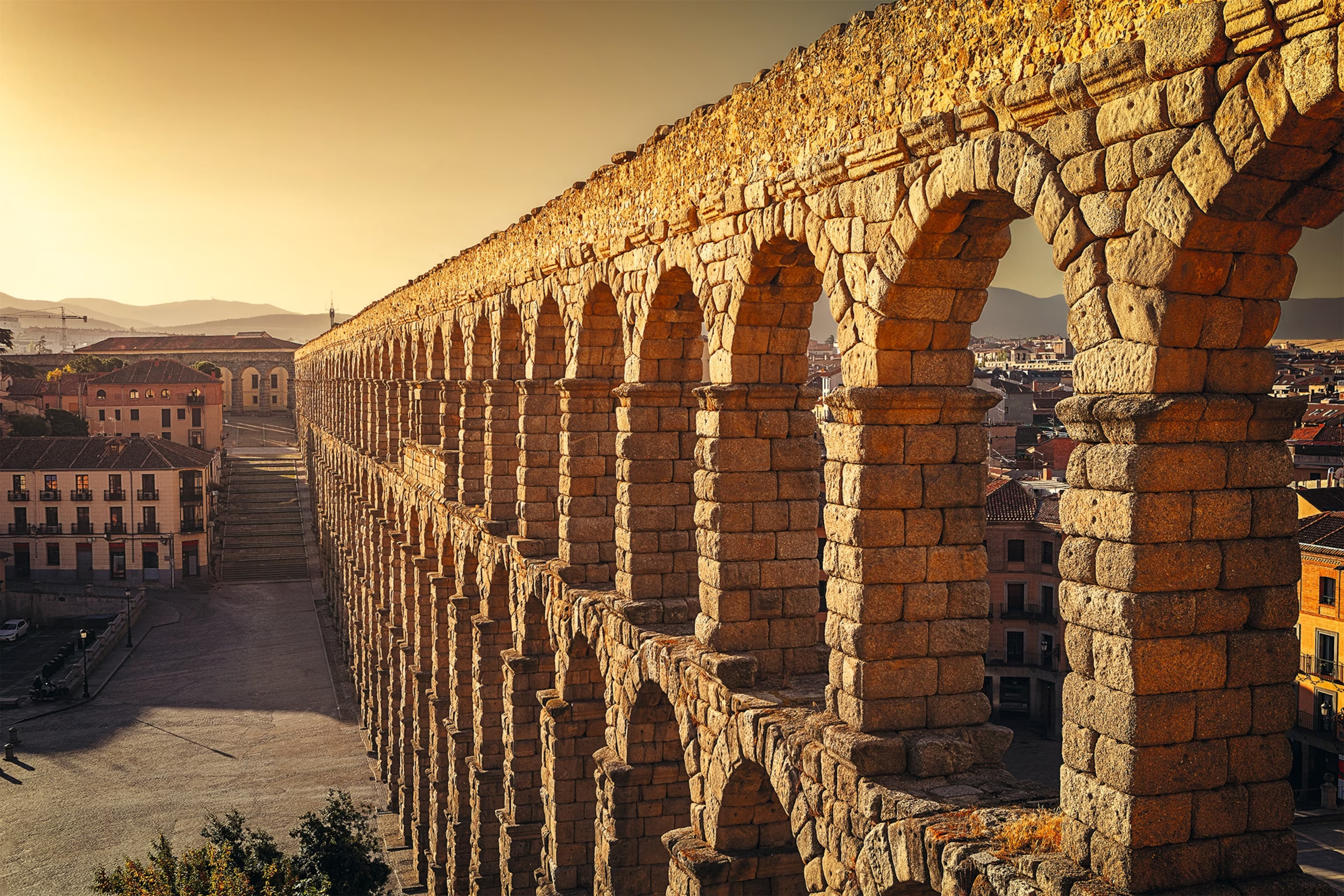
Limited Use of Arches: While the Greeks were aware of the arch—and occasionally used it in gates or smaller structures—they did not view it as the primary solution for spanning large distances. It was not until the later influence of Roman engineering (which perfected the semicircular arch and hydraulic concrete) that arched stone bridges became a standard feature of Mediterranean infrastructure.
III. The Engineering Philosophy
The fundamental difference between Greek and Roman infrastructure lies in their relationship with the landscape:
Greek Pragmatism: Greek builders often followed the natural contours of the land. They preferred to work with the terrain rather than imposing a perfectly straight path upon it. This often meant winding roads that avoided steep inclines, prioritizing stability and simplicity over the sheer scale and uniformity seen in Roman road building.
Local Craftsmanship: Because there was no centralized "state mandate" for a massive road network, bridge and road building were often localized projects, managed by individual city-states or wealthy sponsors. This resulted in a diverse variety of regional construction techniques that relied on local stone and traditional knowledge passed down through generations of masons.
While the ancient Greeks did not leave behind a monolithic network of highways, their infrastructure—especially specialized projects like the Diolkos—showed that they possessed the mathematical and mechanical understanding to solve complex transportation challenges when the need arose.