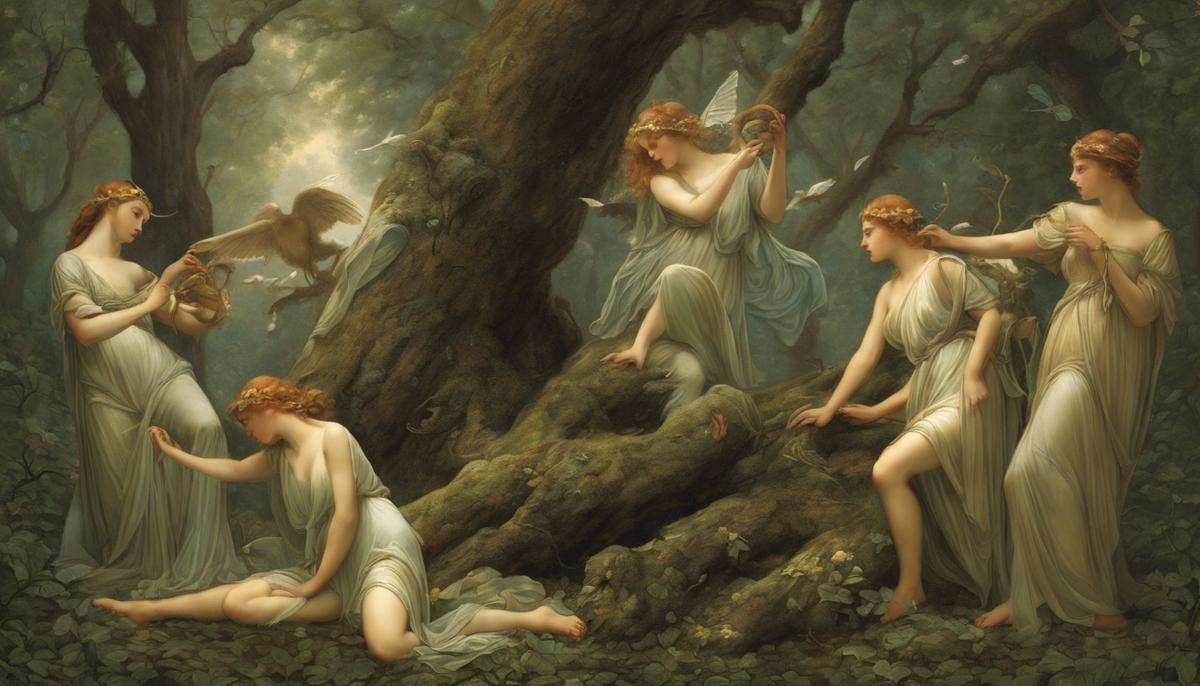
The Meliae (or Melian nymphs) hold a unique and somewhat unsettling place in the Greek pantheon. While many nymphs are portrayed as benign spirits of rivers or woods, the Meliae are explicitly connected to the violent, foundational forces of the cosmos, bridging the gap between the chaotic era of the Titans and the established reign of the Olympians.
I. A Primordial Origin
Their genesis is tied to the most visceral moment in Greek creation mythology. According to Hesiod’s Theogony, when the Titan Cronus castrated his father, Uranus (the Sky), the blood that spilled onto the earth (Gaia) gave birth to three distinct groups: the Erinyes (Furies), the Gigantes (Giants), and the Meliae.
Because they share this origin, the Meliae are "sisters" to the Furies, sharing an ancient, chthonic nature that predates the Olympian order. The name Meliae is derived from the Greek word melia, meaning the ash tree. This etymology is crucial, as it defines their dual nature as both vegetative spirits and entities inherently linked to the tools of war.
II. Guardians of the Divine
Despite their violent lineage, the Meliae are best known for their role as the nurses of the infant Zeus.
The Cretan Cave: When Rhea hid the infant Zeus in the caves of Crete to protect him from being devoured by Cronus, it was the Meliae who attended to him. They fed the god honey and the milk of the sacred goat, Amalthea.
The Martial Nursery: This role is deeply symbolic. By nurturing the future king of the gods with the products of the earth, the Meliae helped anchor the new divine order in the primordial power of the natural world. They served as the "bridge" between the savage, chaotic past and the structured, civilized future Zeus would eventually establish.
III. The Ash Tree and the "Bronze Age" of Man
The association with the ash tree provides a darker layer to their myth. In antiquity, the ash was the wood of choice for crafting spear shafts.
Progenitors of War: In Hesiod’s Works and Days, the "Bronze Race of men" is described as a violent, war-obsessed people. Many traditions link the Meliae to this race, implying that they provided the "ash" (the spears) that fueled this generation’s self-destruction.
Duality of Nature: This paints the Meliae as protectors of the divine (Zeus) but also as the symbolic providers of the weapons that defined human conflict. They embody the idea that the same earth that nurtures life also provides the materials required for death and destruction.
IV. Their Place in Ancient Belief
Unlike the dryads of the forest who were often seen as playful or elusive, the Meliae represented a more permanent, rigid power. They were considered "nymphs of the elder age"—entities that didn't just inhabit nature, but were an immutable part of the landscape’s fabric.
They reflect a Greek worldview where the natural environment was not a passive setting, but a powerful, sentient force that influenced the fates of both gods and mortals. They stand as a testament to the idea that the "civilized" world of the Olympians was built upon a foundation of wild, ancient, and potentially dangerous primal energy.
The Meliae remind us that in the Greek imagination, the transition from chaos to order was never entirely clean—the new gods always relied on the old, raw forces of the earth to survive and ascend.