The story of Erysichthon, most vividly told by the Roman poet Ovid in his Metamorphoses, is one of the most chilling myths regarding the consequences of hubris and the desecration of the sacred. It serves as a stark warning about the human tendency to disregard the natural world for the sake of greed.
I. The Desecration of the Grove
Erysichthon was a wealthy Thessalian king who cared nothing for the gods. One day, driven by an insatiable need for timber to construct a grand dining hall, he decided to cut down a magnificent, ancient grove of trees sacred to the goddess Demeter (Ceres).
The Sacred Tree: At the center of the grove stood a massive oak tree so large that it seemed like a forest in itself. Nymphs of the forest (the dryads) danced around it in celebration.
The Act of Defiance: When his servants refused to strike the tree, Erysichthon seized an axe himself. As he prepared to fell the oak, the tree bled, and a voice issued from within, predicting his doom. Ignoring the warning, he struck the tree down, killing the dryad who resided within it.
II. The Curse of Limos
Demeter was enraged by this sacrilege. To punish Erysichthon, she did not kill him outright; instead, she summoned Limos (the spirit of Famine) and commanded her to infect him with an insatiable hunger that could never be satisfied.
The Mechanic of the Curse: The more Erysichthon ate, the hungrier he became. His body was a hollow vessel; the food provided only temporary relief, making his appetite even more voracious.
The Devouring of Resources: He spent his entire fortune on banquets, yet he remained emaciated. He consumed every scrap of food in his kingdom, then turned to his livestock, and finally, his household pets.
III. The Final Degradation
As his wealth evaporated and his hunger intensified, Erysichthon’s actions became increasingly desperate and grotesque:
Selling his Daughter: In a final act of moral depravity, he sold his daughter, Mestra, into slavery repeatedly to raise money for food. (Mestra, however, had been granted the power of shape-shifting by her former lover, Poseidon, and would repeatedly escape her masters to return to her father, only for him to sell her again).
Self-Consumption: With no food, no wealth, and no one left to sell, the curse reached its horrific conclusion. In his madness, Erysichthon began to tear at his own flesh, devouring his own body until there was nothing left of him.
IV. Symbolism and Legacy
The story of Erysichthon acts as a powerful allegory for environmental and moral gluttony.
The Consumption of Nature: By destroying the sacred grove for personal comfort, Erysichthon effectively destroys the very source of life (Demeter, the goddess of the harvest). His hunger becomes a metaphor for the self-destructive nature of greed—it consumes the self as surely as it consumes the world.
A "Hungry" Society: In later literary history, Erysichthon has been interpreted as a symbol for those who exploit natural resources without regard for long-term survival. He represents the paradox of the "consumer": the more he takes, the less he is satisfied, eventually leading to the collapse of the society he sought to build.
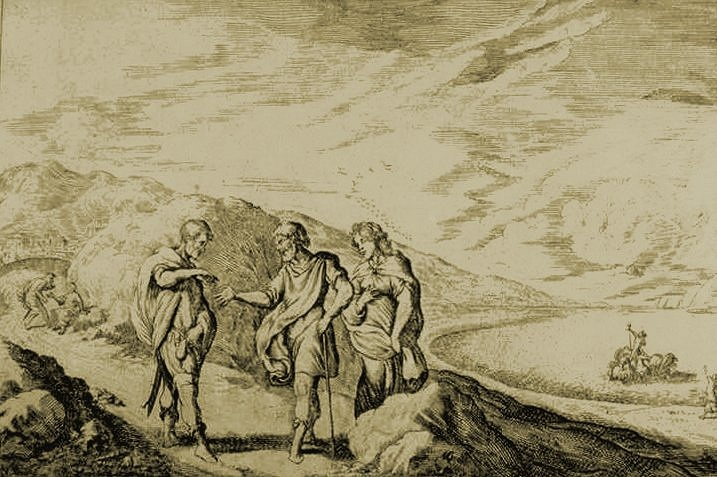
Erysichthon’s story is a dark counterpoint to the myth of Baucis and Philemon; while the latter were rewarded for their modest hospitality to the gods, Erysichthon was destroyed for his arrogant exploitation of the sacred.
Given your interest in how the Greeks and Romans used myth to comment on human behavior, would you be interested in exploring the cult of Demeter and the sacred groves as historical realities, or perhaps comparing this story of "divine punishment" to other mythological figures who suffered from eternal, physical torments?