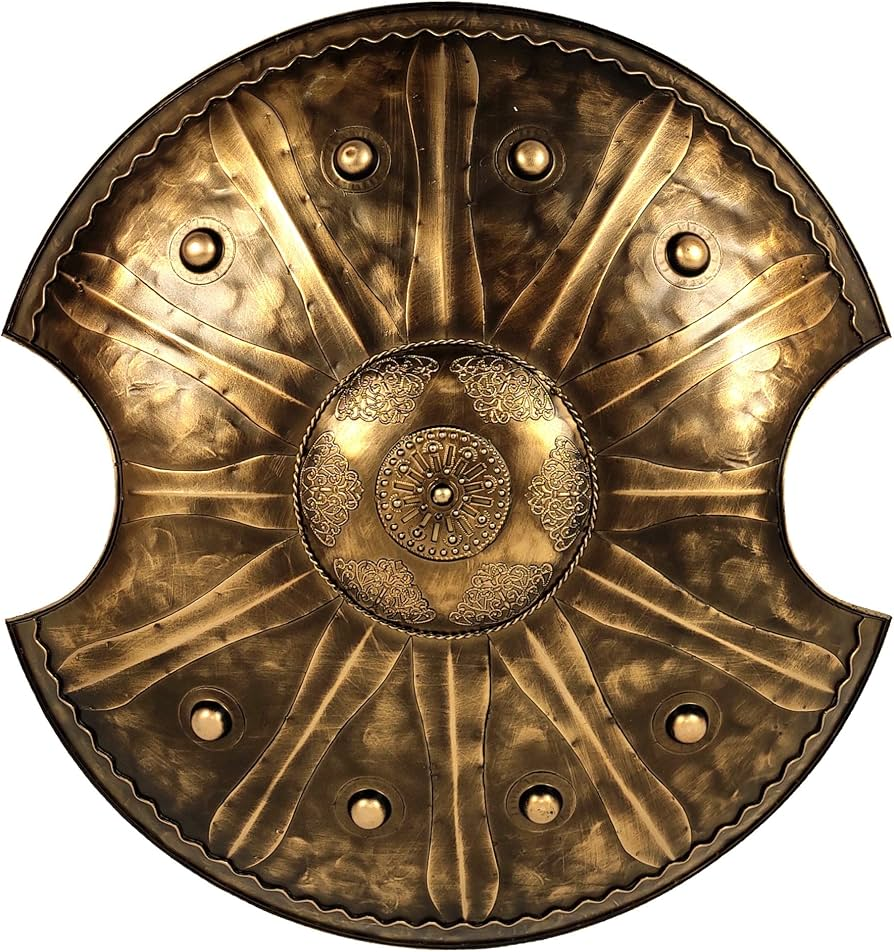
The hoplite shield—known as the aspis ($\alpha\sigma\pi\iota\varsigma$) or hoplon—was the literal and symbolic foundation of Greek military power. It was the weapon that gave the "hoplite" infantryman his name. Far from a simple sheet of metal, the aspis was a highly sophisticated, composite piece of defensive engineering designed to absorb the intense mechanical shocks of bronze spears and massed infantry collisions (othismos).
The Composite Wood Core
The manufacturing process began not with a blacksmith, but with a master woodworker. The core of the shield was constructed from lightweight, shock-absorbent woods—primarily poplar, willow, or soft walnut.
The Lathe Method: Craftsmen shaved down thin, curved wooden planks, joining them together using animal-glue tongue-and-groove joints to form a deep, bowl-shaped concave dome roughly 3 feet (90 cm) in diameter.
The Structural Elasticity: Wood was chosen over solid metal because a pure metal shield of that size would be impossibly heavy ($>30\text{ lbs}$), whereas a wooden core retained an elastic flexibility, capable of bending and absorbing the kinetic energy of a spear strike without fracturing.
The Metallurgic Canopy and Rim
Once the wooden core was sculpted, it was transferred to a bronze foundry. Blacksmiths took a thin sheet of bronze, roughly 0.5 millimeters thick, and meticulously cold-hammered it over a forming dye until it matched the exact convex contours of the wooden core. This bronze face was then pressed onto the wood and secured tightly around the edges using a heavy bronze rim.
The rim was a vital structural feature: it prevented the wooden core from splitting when struck by downward sword chops and ensured the shield retained its rigid, circular geometry under the crushing pressure of the phalanx.
The Revolutionary Ergonomic Revolution: Porpax and Antilabe
The true genius of the aspis lay in its revolutionary, twin-component interior suspension system, which fundamentally transformed ancient warfare:
  [ THE REVOLUTIONARY TWO-POINT GRIP ]

     ( Shield Edge ) ─────── ( Shield Center ) ─────── ( Shield Edge )
           │                         │                        │
     [ ANTILABE ] <──────────────────┴──────────────────> [ PORPAX ]
     (Leather Hand Grip)                             (Central Bronze Armband)
The Porpax: This was a wide, heavy bronze armband secured directly into the exact center of the shield's interior. The hoplite slid their entire forearm through this band up to their elbow.
The Antilabe: This was a leather cord or handle attached securely to the absolute outer rim of the shield, gripped firmly by the hand.
Before this invention, ancient shields were held via a single central handle, forcing the hand and wrist to bear the entire weight of the shield.
The twin-component Porpax-Antilabe system shifted the massive load of the shield away from the wrist, distributing it evenly across the entire skeletal structure of the shoulder and upper torso. This allowed hoplites to carry exceptionally heavy shields ($16\text{ lbs}$) for hours without muscle fatigue, while allowing them to use their shields as a massive battering ram to physically steamroll enemy formations.