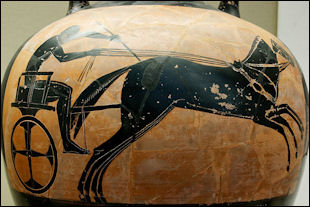
While popular media often depicts ancient Greeks commuting or traveling long distances in chariots, their actual utility in day-to-day transportation was heavily restricted by Greece’s famously rocky, mountainous terrain.
The Mythic and Elite Realm: By the Classical period (5th–4th centuries BCE), the chariot (harma) was obsolete as a practical weapon of war or a standard mode of travel. Instead, it functioned as an ultimate status symbol of the ultra-wealthy aristocracy. Maintaining a team of chariot horses required vast estates, transforming the vehicle into an instrument of pure prestige.
The Agonistic Spectacle: Chariots found their true calling in the pan-Hellenic games, such as the Olympic and Pythian games. The four-horse chariot race (tethrippon) was the most dangerous, thrilling, and prestigious event. Crucially, the victory crown went not to the driver (eniochos), who faced severe risk of injury or death, but to the wealthy elite who funded and owned the horses.
Sacred and Ritual Journeys: Beyond the racetrack, chariots played an indispensable role in religious processions (pompai) and weddings. A Greek bride was formally transported from her paternal home to her new husband’s house sitting on a two-wheeled chariot (apene), a ritual journey symbolizing her transition under the protective gaze of the community.