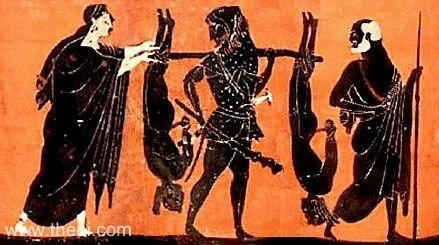
The Cercopes are among the more unusual figures in Greek mythology. Unlike the great warriors, gods, and monsters who dominate the major epic traditions, the Cercopes are remembered primarily as comic tricksters, thieves, and masters of deception. Their stories are closely associated with Heracles and provide a humorous counterpoint to the hero's normally violent and heroic adventures.
The name Cercopes is generally understood to refer to a group of mischievous beings rather than a single individual. Ancient traditions vary concerning their exact number, parentage, appearance, and eventual fate. In many accounts, they are portrayed as small, cunning creatures who survive through theft and trickery. Their encounter with Heracles demonstrates an important feature of Greek mythology: even the strongest hero can be temporarily outwitted by intelligence, humor, and deception.
The surviving traditions about the Cercopes are fragmentary, but their story appears in several ancient sources and later mythographical collections. The most familiar episode concerns two Cercopes who attempted to steal from Heracles and eventually found themselves captured by him.
Who Were the Cercopes?
The Cercopes were traditionally described as mischievous creatures associated with theft and deception.
Their names vary among ancient sources. Two of the most frequently mentioned are Passalus and Acmon. Some traditions give different names, while others describe the Cercopes collectively rather than individually.
They were sometimes associated with the region of Thermopylae or other parts of central Greece and Asia Minor, depending upon the tradition.
Their most important characteristic was their behavior.
They were:
thieves,
tricksters,
deceivers,
opportunists,
and practical jokers.
Rather than confronting enemies directly, they relied on cunning.
This made them almost the opposite of Heracles.
Heracles represented overwhelming physical strength and heroic endurance.
The Cercopes represented manipulation and cleverness.
Their eventual encounter therefore becomes a comic contest between strength and cunning.
The Encounter with Heracles
One of the best-known versions describes the Cercopes attempting to steal Heracles' belongings while he was asleep.
Heracles eventually discovered them and captured them.
The punishment was severe but also intentionally humorous.
According to one tradition, Heracles tied the Cercopes to a pole or carried them away suspended from his shoulders.
While being transported upside down, the Cercopes noticed Heracles' distinctive appearance, particularly his darkened buttocks.
This led them to remember a warning their mother had previously given them.
She had apparently warned them not to deceive or provoke a particular individual identified by a characteristic involving his backside.
The irony was that the warning had been forgotten until the moment when they were literally confronted with the evidence.
Their laughter eventually attracted Heracles' attention.
Rather than simply killing them, he released them.
The story therefore ends not with heroic violence but with comedy.
Why Would Heracles Release Them?
This detail is important because Heracles is frequently portrayed as a violent hero.
Yet Greek mythology does not always present him as relentlessly destructive.
The Cercopes are too ridiculous to function as serious enemies.
Their punishment becomes a comic lesson rather than a tragic confrontation.
Heracles recognizes their humor and releases them.
This creates a rare situation in which the hero's strength is moderated by amusement.
The Cercopes therefore survive because they make Heracles laugh.
Tricksters in Greek Mythology
The Cercopes belong to a much larger mythological category: the trickster.
Trickster figures appear throughout world mythology.
They frequently possess characteristics such as:
intelligence,
dishonesty,
curiosity,
adaptability,
greed,
humor,
and a willingness to violate social rules.
Unlike traditional heroes, tricksters do not necessarily respect conventional morality.
They survive by exploiting weaknesses.
In Greek mythology, Hermes sometimes displays trickster characteristics, particularly in the Homeric Hymn to Hermes, where he steals Apollo's cattle shortly after birth.
The Cercopes are considerably less sophisticated than Hermes, but they occupy a similar mythological space.
They demonstrate that intelligence can challenge physical power.
Their Relationship to Heracles
The Cercopes are especially interesting because their story is embedded within the mythology of Heracles.
Heracles is one of the strongest figures in Greek mythology.
He kills the Nemean Lion.
He defeats the Hydra.
He captures the Erymanthian Boar.
He defeats giants and monsters.
Yet the Cercopes do not attempt to defeat him physically.
They use deception.
This contrast reinforces a recurring mythological idea:
Physical strength does not eliminate the possibility of being deceived.
Even the greatest hero can be vulnerable when he is distracted or unaware.
The Cercopes as Comic Monsters
The Cercopes occupy an unusual position between humans, monsters, and comic creatures.
They are dangerous enough to steal and deceive, but not powerful enough to become major antagonists.
Their purpose is partly entertainment.
Ancient audiences would have recognized the humor in watching powerful Heracles deal with absurd little thieves.
This suggests that mythology was not exclusively concerned with serious religious or heroic themes.
Mythological storytelling could also be deliberately funny.
The Warning of Their Mother
One of the most memorable elements of the Cercopes tradition is the maternal warning.
Their mother supposedly warned them against deceiving a particular person.
Yet the Cercopes ignored or forgot the warning.
This resembles a recurring structure in Greek mythology:
A warning is given.
The characters ignore it.
They encounter the danger.
The warning becomes meaningful only afterward.
Greek mythology repeatedly emphasizes the consequences of failing to recognize wisdom.
However, in the Cercopes story, the result is comic rather than tragic.
The Punishment and the Joke
The humor depends upon a reversal.
The Cercopes thought they were clever thieves.
Instead, they became captives.
Yet even as prisoners, they manage to make Heracles laugh.
Their greatest weapon is therefore not theft.
It is humor.
This makes the Cercopes unusually resilient.
They lose physically but win socially.
They cannot overpower Heracles, but they can influence his emotional response.
The Symbolic Meaning of the Cercopes
The Cercopes can be interpreted as symbols of several ideas.
Cunning versus strength
The story demonstrates that intelligence and deception can temporarily overcome physical superiority.
Humor as survival
The Cercopes escape death because they turn their predicament into comedy.
The limits of heroism
Heracles' strength does not automatically solve every problem.
The danger of greed
Their initial motivation is generally associated with theft and dishonest gain.
The importance of adaptability
Tricksters survive because they respond quickly to changing circumstances.
Later Interpretations
The Cercopes became increasingly associated with comic and grotesque imagery.
Their appearance varies between sources, but they are often imagined as small, strange creatures with animal-like characteristics.
Later artistic representations sometimes portray them with monkey-like features.
This reflects the tendency of Greek and Roman artists to visualize mythological creatures according to their perceived behavior.
Because the Cercopes were mischievous and animal-like in their behavior, later representations could emphasize their physical resemblance to monkeys.
The Legacy of the Cercopes
Although the Cercopes never achieved the fame of Medusa, the Minotaur, or the Hydra, their story remains valuable for understanding Greek mythology.
They remind us that mythology was not simply a collection of stories about powerful heroes defeating powerful monsters.
It also contained humor, absurdity, satire, and mischievous characters.
The Cercopes demonstrate that even in a world dominated by gods and heroes, there was room for characters whose greatest weapon was simply the ability to cause trouble.
Their story ultimately suggests that strength may win a battle, but cleverness and humor can sometimes change the outcome entirely.