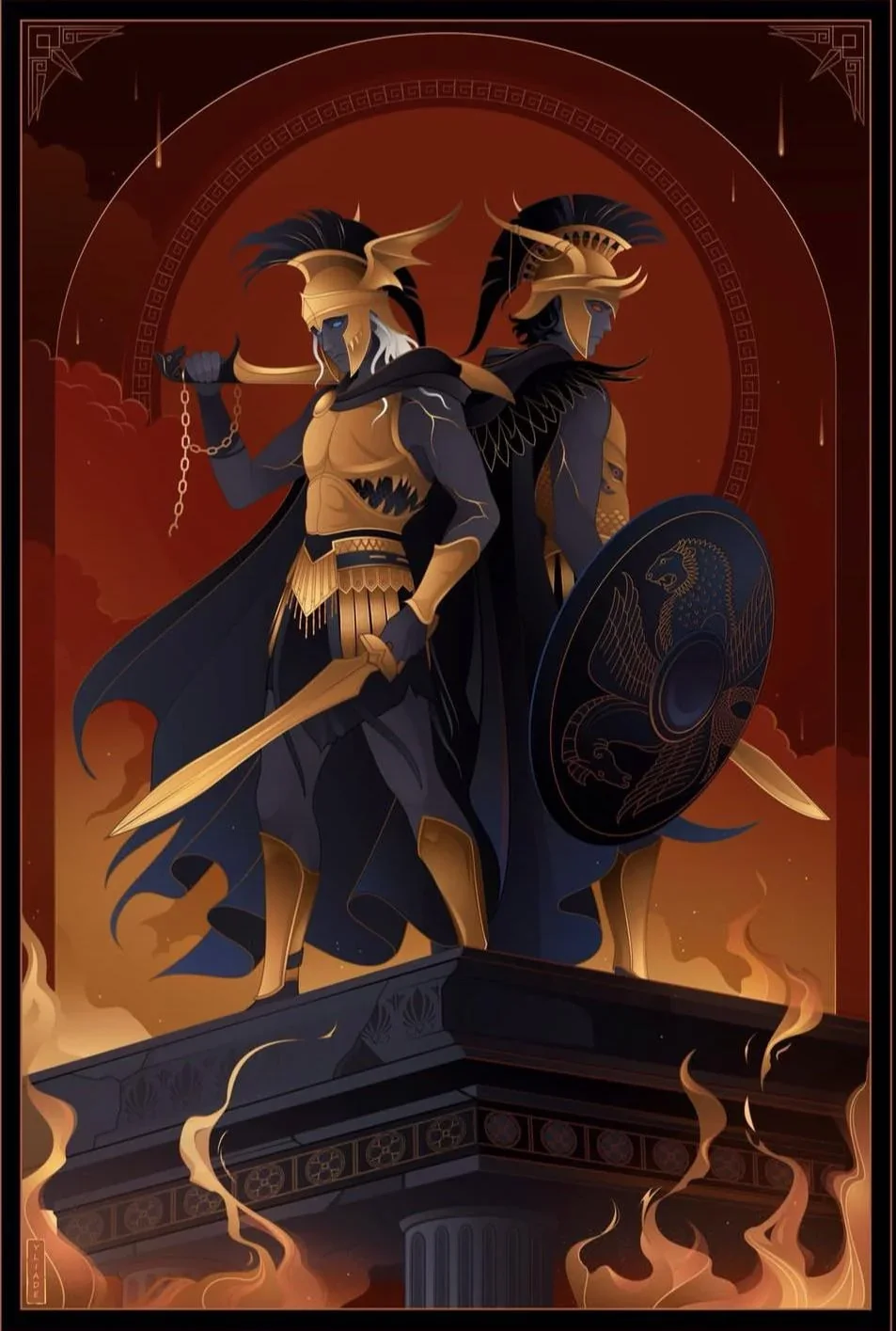
In Greek mythology, war is not represented only by weapons, armies, and heroic combat. It is also represented through the psychological experiences that accompany violence: fear, panic, terror, confusion, courage, and the instinct to flee.
Among the most fascinating personifications of these forces are Phobos and Deimos, the divine embodiments of fear and terror.
The two brothers are traditionally described as sons of Ares, the Olympian god of war, and Aphrodite, the goddess of love. Their parentage is symbolically significant. Their father represents violent conflict, while their mother represents desire and attraction. Together, their lineage connects the emotional experience of love with one of humanity's most powerful negative emotions: fear of loss.
Who Were Phobos and Deimos?
The names themselves reveal their functions.
Phobos is associated with fear, panic, and flight.
Deimos is associated with dread and terror.
Although they are often collectively described simply as "the gods of fear," the ancient literary tradition allows for distinctions between their psychological functions.
Phobos is particularly associated with the sudden fear that causes people to flee.
Deimos represents the deeper sense of terror and dread that overwhelms the mind.
They are therefore not merely two interchangeable gods.
They personify different dimensions of fear.
The Sons of Ares and Aphrodite
Hesiod's Theogony identifies Phobos and Deimos as children of Ares and Aphrodite.
Hesiod describes them as terrible divine figures who accompany Ares and disturb the ranks of warriors during battle.
Their parentage creates an intriguing symbolic contrast.
Ares represents warfare and violence.
Aphrodite represents love and desire.
From their union emerge Fear and Terror.
This can be interpreted as a reminder that intense attachment can create fear of loss.
The stronger the emotional investment, the greater the potential fear of losing what one values.
Thus, their genealogy has a psychological dimension in addition to its mythological one.
Phobos and Deimos on the Battlefield
The battlefield was their natural environment.
Greek warfare was not merely physical combat. Ancient soldiers experienced uncertainty, noise, confusion, exhaustion, injury, and the possibility of sudden death.
Fear could therefore determine the outcome of a battle as much as weapons could.
An army that lost its courage could collapse.
Once soldiers began to flee, panic could spread rapidly through an entire formation.
Phobos and Deimos represent precisely these forces.
They are the psychological weapons of war.
Their Appearance in the Iliad
Homer repeatedly associates Phobos and Deimos with Ares.
In the Iliad, Phobos accompanies Ares into battle, while another passage describes Ares commanding Deimos and Phobos to prepare his horses.
This imagery makes them part of Ares' divine military retinue.
They do not merely observe war.
They actively accompany its god.
Their presence indicates that battle produces consequences beyond physical injury.
Fear itself becomes a supernatural participant.
Fear as a Weapon
One of the most sophisticated ideas contained within the mythology of Phobos and Deimos is that fear can function as a weapon.
A warrior does not necessarily have to kill an opponent to defeat him.
If the opponent becomes terrified and runs away, the battle may already be won.
This makes fear a form of invisible force.
It cannot be held like a spear.
It cannot be blocked by a shield.
It operates within the mind.
Greek mythology personifies that invisible force through Phobos and Deimos.
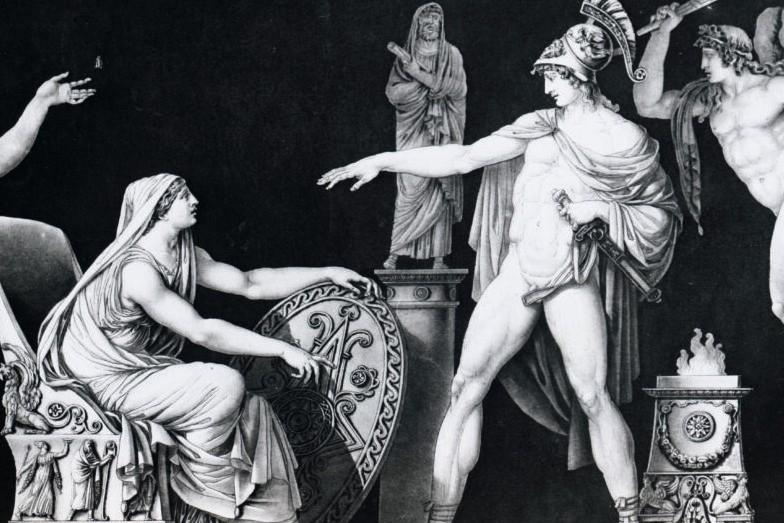
The Shield of Agamemnon
Phobos is also associated with frightening imagery on heroic equipment.
Ancient descriptions connect Phobos with the shield of Agamemnon and with images designed to terrify enemies. Theoi's collection of classical references notes representations of Phobos with leonine characteristics and his appearance in descriptions of martial imagery.
This is significant because Greek warriors deliberately used terrifying imagery.
Weapons and shields were not purely practical objects.
They could communicate power and intimidate enemies.
A frightening image could therefore function psychologically before combat even began.
Phobos, Deimos, and Ares
The relationship between the twins and Ares is particularly close.
They are described as companions and attendants of the war god. They may drive his chariot and accompany him into battle.
This creates a symbolic structure:
Ares = war and violence
Phobos = fear and panic
Deimos = terror and dread
Together, they represent different dimensions of warfare.
Ares creates or embodies the violence of battle.
Phobos and Deimos represent what that violence does to the human mind.
Fear and Courage
An interesting paradox emerges from their role.
Fear is the opposite of courage, but courage cannot exist without fear.
A person who feels no danger has no need to demonstrate courage.
Greek mythology therefore indirectly acknowledges that fear is a necessary component of heroic experience.
Heroes such as Achilles, Hector, and Heracles are courageous precisely because they confront danger despite its terrifying nature.
Phobos and Deimos consequently provide the psychological background against which heroism becomes meaningful.
Fear Is Not Cowardice
It is also useful to distinguish fear from cowardice.
Fear is an emotional response to danger.
Cowardice involves how a person responds to that fear.
A soldier may experience intense fear and nevertheless remain in battle.
Another may surrender to panic and flee.
The mythology of Phobos and Deimos is therefore not simply an attack on fear.
Instead, it acknowledges fear as a powerful force that can influence human behavior.
This is consistent with the larger Greek interest in emotional forces and their personification.
Phobos and Deimos as Daimones
Phobos and Deimos belong to the broader category of divine personifications known as daimones.
These were supernatural beings associated with abstract conditions or forces.
Greek mythology contains numerous examples:
Nike personifies victory.
Eris personifies strife.
Eros personifies love.
Hypnos represents sleep.
Thanatos represents death.
Nemesis represents retribution.
Phobos represents fear.
This system demonstrates that Greek mythology did not restrict divinity to gods who behaved like human rulers.
Abstract concepts themselves could become divine personalities.
Fear could therefore walk beside Ares.
Victory could possess wings.
Strife could enter a battlefield.
Death could take physical form.
The Relationship Between Love and Fear
Their birth from Aphrodite is particularly fascinating.
At first glance, love and fear appear completely unrelated.
Yet Greek mythology frequently associates love with vulnerability.
To love someone is to become emotionally invested in them.
That creates the possibility of loss.
Aphrodite therefore becomes, symbolically, a fitting mother for Phobos and Deimos.
They can represent the fear that accompanies attachment.
A warrior fears death because he values life.
A parent fears losing a child because the child is loved.
A lover fears separation because the relationship matters.
Fear, in this sense, is not always evidence of weakness.
It can be evidence of attachment.
Modern Legacy
The names Phobos and Deimos survived beyond mythology and entered modern astronomy.
They are the names of Mars's two moons.
The choice is particularly appropriate because Mars is the Roman counterpart of Ares, the father of Phobos and Deimos in Greek mythology.
Thus, the ancient mythology has been preserved in modern scientific language.
Whenever scientists refer to the Martian moons Phobos and Deimos, they are indirectly invoking the ancient Greek personifications of fear and terror.
The Psychological Meaning of Phobos and Deimos
The importance of Phobos and Deimos extends beyond ancient warfare.
Their mythology demonstrates that ancient Greeks recognized fear as a powerful force capable of shaping human behavior.
Fear can:
cause people to flee;
weaken armies;
alter decisions;
create panic;
magnify danger;
encourage caution;
and influence the outcome of conflict.
By turning fear and terror into divine beings, Greek mythology gave physical form to an invisible psychological experience.
Conclusion
Phobos and Deimos are more than minor companions of Ares.
They represent one of the central truths of warfare: battles are fought not only with weapons but also within the human mind.
Ares may embody the violence of combat, but Phobos and Deimos represent what happens when people confront that violence.
Their presence reminds us that war produces psychological consequences as well as physical ones.
Through their parentage, literary appearances, artistic representations, and eventual appearance in the names of Mars's moons, Phobos and Deimos have survived for more than two millennia.
They remain powerful symbols of two emotions that are as ancient as humanity itself: fear and terror.