The story of Glaucus and Scylla is one of the darker love stories preserved in classical mythology. It involves desire, rejection, magic, jealousy, transformation, and revenge. Unlike stories in which love leads to union or reconciliation, this narrative demonstrates how unreturned desire can become destructive when combined with supernatural power.
The best-known surviving version comes from Ovid's Metamorphoses, particularly Books XIII and XIV. Ovid's account presents Glaucus as a transformed sea deity who falls deeply in love with the beautiful nymph Scylla. When Scylla rejects him, Glaucus seeks the help of Circe. Instead of solving his problem, Circe's intervention produces a catastrophe that permanently transforms Scylla into the monstrous figure later encountered by Odysseus.
The story therefore functions as both a love tragedy and an origin story for one of Greek mythology's most famous sea monsters.
Who Was Glaucus?
Glaucus was originally a mortal fisherman.
According to the tradition preserved by Ovid, Glaucus discovered a mysterious herb that caused him to undergo a supernatural transformation. After consuming the plant, he became a marine deity.
This transformation placed him in an unusual position.
He was no longer an ordinary human being, but his newly acquired divinity did not eliminate human emotions.
He still experienced desire, longing, and rejection.
That tension between divine transformation and human emotion is central to his story.
Glaucus Meets Scylla
Glaucus eventually encounters Scylla.
At this stage of the story, Scylla is not yet the monstrous creature familiar from Homer's Odyssey. Ovid portrays her as a beautiful young woman associated with the sea and coastline.
Glaucus falls in love with her.
However, Scylla does not return his affection.
Her rejection becomes the turning point of the story.
Instead of accepting her decision, Glaucus seeks supernatural assistance.
The Journey to Circe
Glaucus travels to the realm of Circe, the famous enchantress and daughter of the Sun.
Ovid describes Glaucus arriving at Circe's lands after crossing the sea. Her surroundings are filled with magical plants and transformed animals, establishing from the beginning that this is a world where nature itself can be altered through supernatural power.
Glaucus asks Circe to help him obtain Scylla's love.
Circe, however, becomes attracted to Glaucus herself.
This creates a triangle:
Glaucus desires Scylla.
Scylla rejects Glaucus.
Circe desires Glaucus.
The tragedy becomes inevitable once Circe realizes that Glaucus's affection cannot be redirected toward her.
Circe's Jealousy
Circe explains to Glaucus that he should not pursue Scylla.
But Glaucus remains devoted to the nymph.
His refusal enrages Circe.
Instead of accepting Glaucus's choice, she decides to punish the woman he loves.
This is a critical distinction.
Circe cannot force Glaucus to love her, so she attacks the person who has his affection.
The story therefore transforms romantic rejection into supernatural revenge.
The Transformation of Scylla
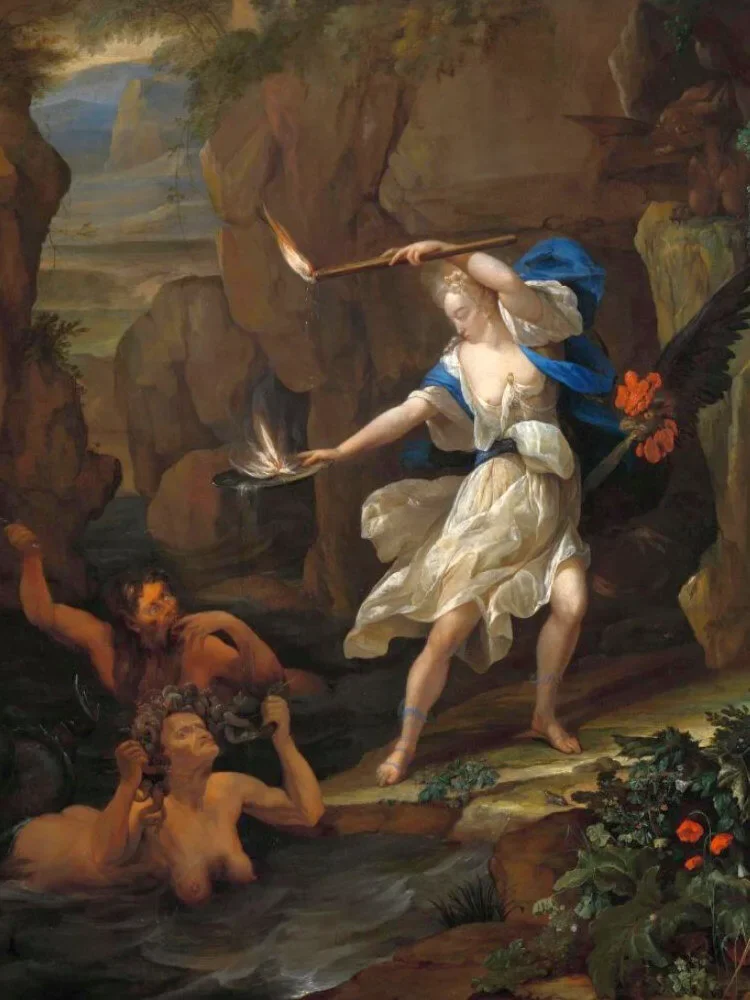
Circe prepares a magical substance and contaminates the waters where Scylla regularly bathes.
When Scylla enters the water, her body begins to transform.
The result is horrifying.
The beautiful nymph becomes a monstrous creature.
In Ovid's account, Scylla's lower body becomes surrounded by barking dogs, transforming her into a terrifying hybrid.
The transformation is especially tragic because Scylla has done nothing to deserve it.
Her only "crime" is rejecting Glaucus.
She becomes the victim of another person's jealousy.
From Nymph to Monster
The transformation of Scylla has an important symbolic dimension.
Before the transformation, Scylla is desired because of her beauty.
Afterward, her body becomes terrifying.
Her transformation therefore demonstrates the destructive consequences of treating another person's body as something that can be controlled or punished.
The myth also explores how beauty and monstrosity can coexist within the same individual.
Scylla does not choose her transformation.
Her identity is forcibly rewritten by another person's anger.
The Scylla of the Odyssey
Ovid's story is particularly important because it provides an origin narrative for the Scylla later encountered by Odysseus.
In Homer's Odyssey, Scylla is already a terrifying marine monster living near the dangerous strait opposite Charybdis.
She possesses multiple heads and attacks passing sailors.
However, the Odyssey does not provide Ovid's detailed story of how she became a monster.
This distinction matters.
The Scylla of Homer and the Scylla of Ovid belong to related but different literary traditions.
Ovid takes the established monster and supplies an emotionally dramatic explanation for her transformation.
The Tragedy of Scylla
One of the most compelling aspects of the story is that Scylla's transformation does not result from her own moral failure.
She becomes monstrous because someone else is jealous.
This makes her different from many Greek mythological monsters that are presented as inherently dangerous.
Scylla is a victim before she becomes a monster.
Her monstrosity is therefore tragic.
She has lost her original identity but retains the consequences of the actions committed against her.
Love, Rejection, and Possession
The story also provides a warning about the difference between love and possession.
Glaucus genuinely desires Scylla, but he does not accept her refusal.
Instead of moving on, he seeks magical intervention.
Circe goes even further: because she cannot obtain Glaucus's affection, she attempts to destroy the object of his desire.
Both characters therefore respond to unfulfilled desire by attempting to change reality rather than accepting another person's autonomy.
The result is catastrophic.
The Failure of Magic
An especially interesting feature of Ovid's version is that magic does not produce the desired outcome.
Glaucus seeks magic to obtain love.
Circe uses magic to eliminate a rival.
But neither action produces genuine love.
This supports one of the broader themes of Ovid's Metamorphoses: transformation can change bodies, appearances, and circumstances, but it cannot reliably control human affection.
Modern scholarship has noted the importance of mutual love in interpreting this section of Ovid's poem and the limitations of magic when love is not reciprocated.
Scylla and the Theme of Transformation
Transformation is the central mechanism of Ovid's Metamorphoses.
Characters repeatedly change form because of:
love,
revenge,
divine punishment,
grief,
violence,
desire,
and divine intervention.
Scylla's transformation combines several of these themes at once.
She changes because of jealousy.
Her body becomes the physical record of another person's emotional violence.
The transformation therefore functions as more than a supernatural event. It is a metaphor for how destructive relationships can permanently alter people's lives.
Why the Story Remains Powerful
The story of Glaucus and Scylla has survived because it contains a familiar emotional structure beneath its supernatural elements.
Someone falls in love.
The love is not returned.
Another person becomes jealous.
Power is abused.
An innocent person suffers.
The tragedy is universal even though the setting is mythological.
The sea, magic, gods, and monsters provide the extraordinary framework, but the emotional conflict remains recognizable.
The Legacy of Scylla
Scylla eventually became one of the defining monsters of the Mediterranean imagination.
Her name became associated with danger at sea, particularly through her appearance alongside Charybdis.
The phrase "between Scylla and Charybdis" later came to symbolize a situation in which a person must choose between two dangers.
Her story therefore evolved from an individual tragedy into a broader cultural metaphor.
The myth of Glaucus and Scylla reminds readers that monstrosity is not always born from evil.
Sometimes, mythology suggests, the monster is created by violence done to someone else.