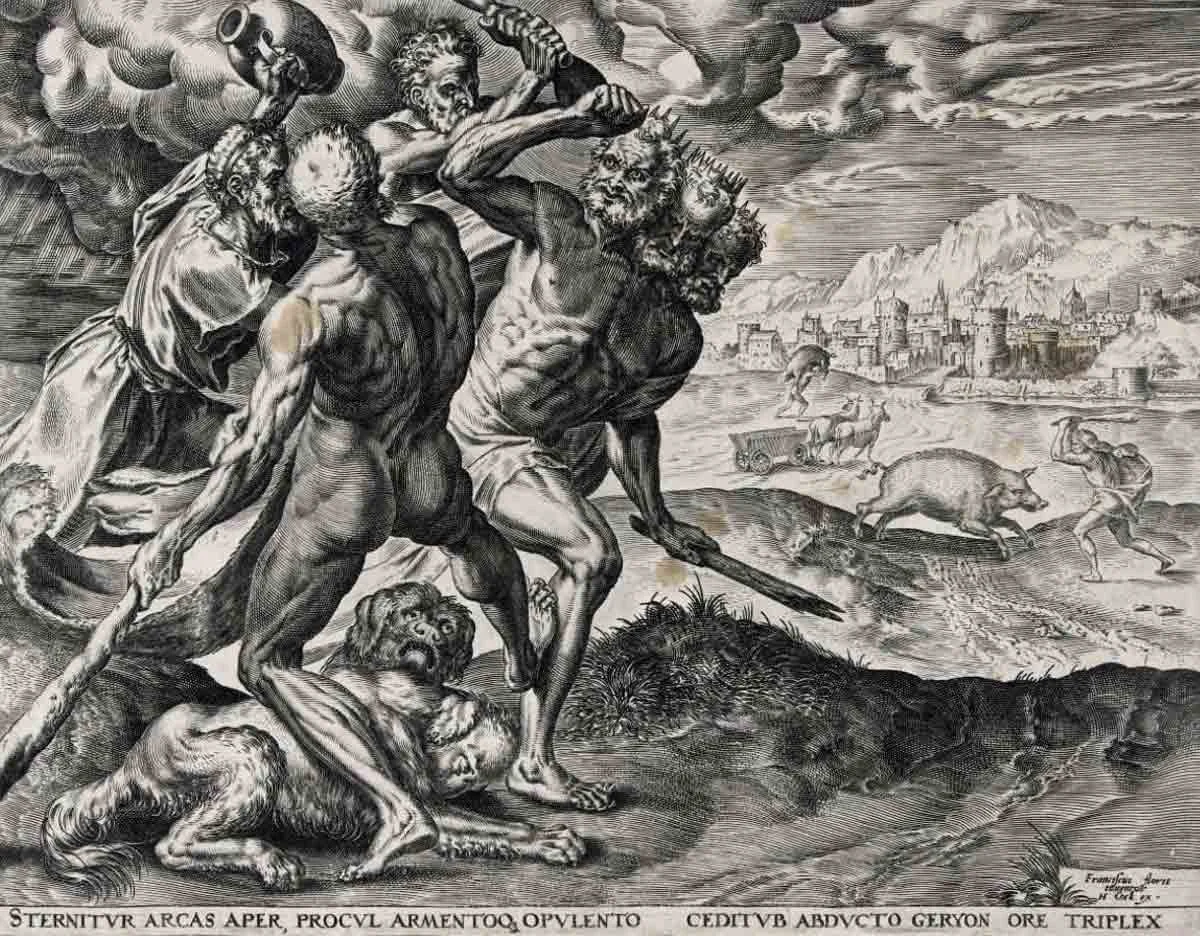
The tale of Eurytion belongs to the mythology surrounding one of Heracles' most distant and extraordinary labors: the acquisition of the cattle of Geryon.
Eurytion was the herdsman responsible for tending the cattle of Geryon, a fearsome being associated with the far western limits of the Greek mythological world. Although Eurytion is a relatively minor character, his role is important because he represents the final human—or quasi-human—guardian standing between Heracles and the cattle he has been ordered to obtain.
The story is also notable because traditions about Eurytion's appearance vary. Some later retellings describe him as a one-eyed herdsman, while the earliest major literary accounts do not consistently emphasize this feature. This distinction is important when studying mythology because later popular descriptions can sometimes become confused with details belonging to other figures.
Who Was Eurytion?
Eurytion was the herdsman of Geryon.
His task was to guard the famous red cattle belonging to the monstrous giant.
He is commonly associated with the dog Orthrus, another guardian of Geryon's herd.
According to Apollodorus, Orthrus was a two-headed dog and the offspring of Echidna and Typhon. Eurytion worked alongside the creature to protect Geryon's cattle. (perseus.tufts.edu)
This made the herd extremely difficult to approach.
Heracles was therefore confronted by two levels of guardianship:
Eurytion — the herdsman
Orthrus — the monstrous watchdog
Behind them stood Geryon himself.
Geryon and His Cattle
Geryon was an extraordinary monster.
He is generally described as having three bodies or three interconnected human forms.
His cattle were famous for their distinctive red color.
The herd lived in the far western region of the mythological world, near the land associated with the setting sun.
For Greek audiences, this was effectively the edge of the known world.
The journey therefore represented much more than simply retrieving livestock.
Heracles had to travel beyond familiar civilization into an almost mythical geographical frontier.
The Tenth Labor
The cattle of Geryon constituted the tenth labor of Heracles in the traditional sequence.
Eurystheus ordered Heracles to bring the cattle back.
Unlike some earlier labors, this task involved enormous geographical distance.
Heracles had to travel toward the western edge of the world.
The journey became so difficult that Heracles eventually erected the famous Pillars of Heracles, traditionally identified with the region around the Strait of Gibraltar.
These pillars symbolized the boundary between the Mediterranean world and the vast Atlantic Ocean beyond it.
Eurytion's Responsibility
Eurytion's primary role was practical.
He guarded the cattle.
His duty was not to seek glory or challenge Heracles.
He simply performed his role as guardian.
Yet in heroic mythology, fulfilling an ordinary duty can place a character directly in the path of extraordinary events.
Eurytion became one of the first obstacles Heracles had to eliminate before obtaining the herd.
Heracles Arrives
When Heracles reached the cattle, he was confronted by Orthrus.
The dog attacked him.
Heracles killed Orthrus with his club.
Eurytion then attempted to intervene.
According to Apollodorus, Heracles also killed Eurytion. (perseus.tufts.edu)
This brief encounter demonstrates the brutal structure of the labor.
Heracles does not negotiate with the guardians.
He removes them.
The purpose of the labor is to obtain the cattle, and anything preventing that objective becomes an obstacle.
The One-Eyed Tradition
The description of Eurytion as one-eyed requires some caution.
The surviving classical sources do not uniformly describe Eurytion as a one-eyed figure.
The more securely established description concerns his role as Geryon's herdsman.
Some later or modern retellings may characterize him as one-eyed, potentially blending traditions involving other monstrous guardians or herdsmen.
This is an excellent example of why mythological research should distinguish:
ancient primary sources,
later mythographical traditions,
medieval adaptations,
modern retellings,
and popular interpretations.
A detail repeated frequently online does not necessarily mean it appears in the earliest surviving source.
Eurytion and Orthrus
The relationship between Eurytion and Orthrus is one of the most interesting features of the story.
They represent two different kinds of guardianship.
Eurytion represents intelligence and responsibility.
Orthrus represents physical force and supernatural protection.
Together, they create a complete defense system.
The cattle cannot simply be stolen by an ordinary traveler.
They are protected by both a supernatural beast and a dedicated guardian.
Heracles therefore has to defeat both.
The Tragic Dimension
Although Eurytion is not portrayed as a major tragic hero, his death illustrates an important pattern in Greek mythology.
Heracles' heroic achievement depends upon the destruction of other beings.
From the hero's perspective, killing Eurytion is necessary.
From Eurytion's perspective, however, he is simply defending the property entrusted to him.
This creates a morally ambiguous dimension.
The mythology celebrates Heracles' success, but the guardians are not necessarily evil.
They are simply on the opposing side.
The Symbolism of the Herdsman
The herdsman is a recurring figure in ancient mythology.
Cattle represented:
wealth,
status,
agricultural prosperity,
and social power.
Guarding cattle was therefore an important responsibility.
The theft of cattle was not simply the loss of animals.
It represented the destruction or transfer of wealth.
Heracles' acquisition of Geryon's herd can therefore be understood as an extraordinary act of appropriation.
The hero takes wealth from the far edge of the world and brings it back to Eurystheus.
Eurytion as a Threshold Guardian
Mythologically, Eurytion functions as a threshold guardian.
He stands between Heracles and the objective.
This role appears repeatedly in mythology.
A hero approaches a forbidden or difficult destination.
Before reaching the prize, the hero must defeat a guardian.
Examples include:
Cerberus guarding the Underworld,
the dragon guarding the Golden Fleece,
the Minotaur occupying the labyrinth,
and Orthrus and Eurytion guarding Geryon's cattle.
Eurytion therefore participates in a much broader mythological pattern.
The Death of Eurytion
Eurytion's death is remarkably brief in the surviving account.
There is no elaborate duel.
There is no long speech.
There is no tragic farewell.
This brevity reflects his narrative function.
He exists primarily to establish the difficulty of reaching Geryon's cattle.
His death marks the removal of the first major obstacle.
Geryon himself remains.
Heracles versus Geryon
After killing Orthrus and Eurytion, Heracles must face Geryon.
The encounter becomes the central confrontation of the labor.
Geryon's unusual multi-bodied form makes him an especially formidable opponent.
Eventually, Heracles kills him and takes the cattle.
The death of Eurytion therefore forms part of a larger sequence:
Heracles → Orthrus → Eurytion → Geryon → cattle
Each obstacle must be overcome before the labor can be completed.
The Meaning of Eurytion's Story
Eurytion's story is relatively small, but it provides valuable insight into Greek heroic narratives.
He demonstrates that mythology often gives narrative importance to characters who are not themselves famous.
His role emphasizes:
duty,
guardianship,
loyalty,
conflict,
and the cost of heroic achievement.
He also demonstrates why source criticism matters.
The "one-eyed" image may be familiar in later retellings, but the central ancient tradition identifies Eurytion primarily as Geryon's herdsman.
The most historically responsible approach is therefore to preserve the famous tradition while acknowledging the uncertainty surrounding specific physical descriptions.