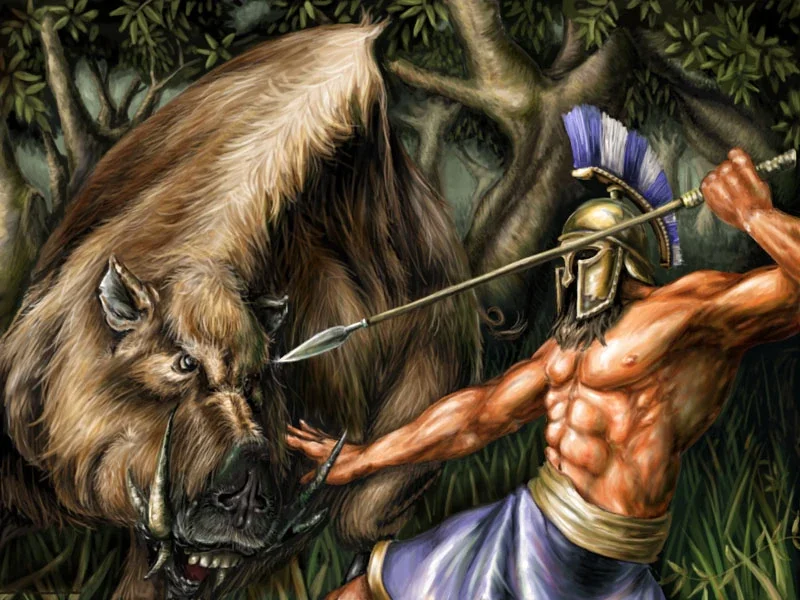
The story of the Erymanthian Boar forms the fourth of the famous labors imposed upon Heracles, the Greek hero whose extraordinary strength became legendary throughout the ancient Mediterranean world. Unlike some of his other labors, this task did not simply require Heracles to kill a dangerous creature. Eurystheus ordered him to capture the boar alive and bring it back to him.
This seemingly simple requirement transformed the labor into a test of strategy, endurance, and restraint. The episode also became connected with several other important stories, including Heracles' encounter with the centaur Pholus, the accidental wounding of the immortal Chiron, and the fearsome confrontation between Heracles and the other centaurs.
The surviving account of the labor in the Bibliotheca attributed to Apollodorus is particularly valuable. It states that the boar was ravaging the region of Psophis and lived on Mount Erymanthus. Eurystheus therefore commanded Heracles to bring the animal back alive.
Who Was Heracles?
Heracles, known to the Romans as Hercules, was the son of Zeus and the mortal woman Alcmene. His extraordinary strength made him one of Greek mythology's greatest heroes, but his life was also defined by suffering and divine hostility.
Hera, Zeus's wife, resented Heracles because of Zeus's relationship with Alcmene. Her hostility contributed to many of the difficulties that eventually shaped Heracles' heroic career.
The Twelve Labors are traditionally understood as a form of penance imposed upon him after a terrible episode of madness in which he killed his own family. The exact circumstances vary among traditions, but the basic narrative is that Heracles was required to perform extraordinary tasks under the authority of Eurystheus, king of Mycenae.
The Erymanthian Boar was the fourth labor in the sequence preserved by Apollodorus.
The Erymanthian Boar
The creature itself was not simply an ordinary wild boar.
It was an enormous and destructive animal associated with Mount Erymanthus in Arcadia. According to Apollodorus, the boar descended from the mountain and ravaged the surrounding territory, particularly the region of Psophis.
For an ancient agricultural society, a huge predator or destructive animal represented a serious threat. Livestock, crops, and human settlements could all be endangered.
The boar therefore represents the wild forces of nature that exist outside human control.
Heracles' task was to restore order—not by simply destroying the creature, but by mastering it.
The Journey to Mount Erymanthus
Before Heracles reached the boar, his journey became complicated by an encounter with the centaur Pholus.
Pholus was a centaur who lived in a cave at Mount Pholoe. Unlike many of the violent centaurs in Greek mythology, Pholus was portrayed as hospitable and civilized.
He welcomed Heracles and provided him with food.
When Heracles requested wine, Pholus hesitated because the wine belonged collectively to the centaurs. Nevertheless, Heracles persuaded him to open the container.
The scent of the wine eventually attracted the other centaurs.
According to Apollodorus, the centaurs arrived armed with rocks and fir branches. The situation escalated into violence, and Heracles fought them using his weapons.
The Tragedy of Chiron
One of the most significant consequences of this confrontation was the accidental wounding of Chiron.
Chiron was unlike the other centaurs. He was renowned for wisdom, medicine, education, and knowledge. Heroes such as Achilles and other legendary figures were associated with his instruction.
During the conflict, Heracles fired an arrow that had been dipped in the deadly venom of the Lernaean Hydra. The arrow passed through one centaur and struck Chiron in the knee.
The wound created a tragic paradox.
Chiron was immortal, meaning that he could not simply die from the injury. Yet the poison caused him terrible suffering.
His immortality therefore became a source of torment rather than protection.
This episode became one of the most poignant examples in Greek mythology of the difference between living forever and living without suffering.
Eventually, Chiron would give up his immortality, allowing death to end his pain.
The Capture of the Boar
After the confrontation with the centaurs, Heracles continued his journey toward Mount Erymanthus.
The most important part of the labor was not killing the boar but capturing it alive.
According to Apollodorus, Heracles chased the animal through the wilderness until he drove it into deep snow. Once the exhausted animal became trapped in the snow, Heracles seized it and brought it back to Mycenae.
The snowy landscape is significant.
Rather than relying entirely on brute force, Heracles manipulated the environment. He exhausted the animal and used the deep snow to restrict its movement.
In this sense, the labor demonstrates that Heracles' heroism was not merely physical.
He possessed extraordinary strength, but he also had to understand how to use the environment strategically.
Eurystheus and the Bronze Jar
The final scene of the labor became one of the most humorous episodes in the Heracles tradition.
When Heracles returned to Mycenae carrying the enormous boar, Eurystheus became terrified.
According to traditions discussed in modern scholarship, Eurystheus hid inside a large bronze storage jar, or pithos, to protect himself from the animal. Artistic representations sometimes show Heracles threatening to place the boar directly on top of the frightened king.
The contrast is deliberate.
Eurystheus is the king who commands the labors, yet he repeatedly becomes terrified by the very creatures he orders Heracles to confront.
Heracles, meanwhile, demonstrates the courage and competence that Eurystheus lacks.
The scene therefore provides comic relief while reinforcing the hero's superiority.
More Than a Monster Hunt
It is tempting to interpret the Erymanthian Boar simply as another monster defeated by a hero.
But the story contains deeper themes.
Nature versus civilization
The boar emerges from the wilderness and threatens settled human communities.
Heracles represents civilization's attempt to impose order upon the dangerous natural world.
Strength versus intelligence
Heracles does not simply overpower the animal. He uses pursuit, exhaustion, and the snow to capture it.
Courage versus cowardice
Eurystheus orders the task but becomes terrified when the boar arrives.
Immortality versus suffering
The connected story of Chiron introduces a more philosophical question: is immortality necessarily a blessing?
Heroism and responsibility
Heracles' journey repeatedly demonstrates that heroic power comes with consequences. His violence can solve problems, but it can also create new tragedies, as seen in the accidental injury to Chiron.
Variations in the Tradition
It is important to recognize that ancient mythology does not have one fixed canonical version.
Different ancient writers describe the Erymanthian Boar differently. The details of its location, capture, and relationship to other episodes can vary.
Modern scholarship has also examined how the story developed within the broader cycle of Heracles' labors. The Oxford Handbook of Heracles notes that the Erymanthian Boar episode functions as an important insertion point for other stories, particularly Heracles' encounter with Pholus and the centaurs.
Thus, the labor is not an isolated adventure. It acts as a narrative bridge connecting several different heroic traditions.
The Legacy of the Erymanthian Boar
The fourth labor illustrates an important characteristic of Greek heroic mythology: the greatest hero is not necessarily the one who destroys the most enemies, but the one who can master forces that others cannot control.
Heracles does not need to kill the boar.
He must capture it.
That distinction matters.
The labor is therefore a demonstration of controlled power. Heracles' strength becomes meaningful because he can direct it toward a specific objective.
The frightened Eurystheus, the dangerous centaurs, the tragic fate of Chiron, and the wild boar itself all contribute to a story that is much more complex than a simple monster hunt.
The Erymanthian Boar ultimately represents the wild, unpredictable forces that threaten civilization and Heracles' ability to confront those forces without simply destroying everything in his path.