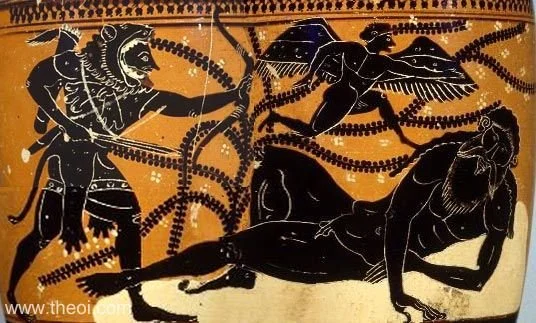
The story of the Alcyonides is one of the lesser-known but particularly poignant tales of Greek mythology. It concerns seven daughters of the giant Alcyoneus, whose death at the hands of Heracles transformed their grief into a permanent connection with the natural world.
The myth combines several recurring elements of Greek mythology: the conflict between gods and Giants, familial grief, suicide, divine intervention, transformation, and the symbolic relationship between human emotion and nature.
Unlike some famous Greek myths, the story of the Alcyonides survives primarily through later references and lexicographical traditions rather than through a single long surviving epic narrative. This makes it especially important to distinguish the surviving evidence from later popular retellings.
Who Were the Alcyonides?
The Alcyonides were traditionally described as the seven daughters of the giant Alcyoneus.
Their names are usually given as:
Alcippe
Anthe
Asteria
Drimo
Methone
Pallene
Phthonia
The tradition is preserved particularly in the Suda, a Byzantine Greek encyclopedia that recorded and transmitted material from much older sources. Theoi's compilation of the tradition identifies these seven daughters and describes their transformation into kingfishers.
The names themselves are significant because they demonstrate how mythology could preserve fragments of stories even when the original literary works in which they appeared have been lost.
Alcyoneus, the Giant
The father of the Alcyonides was Alcyoneus, one of the Gigantes—the Giants who fought the Olympian gods during the Gigantomachy.
The Giants were not simply large humans. In Greek mythology, they represented a primordial generation of powerful beings who challenged the authority of the Olympians.
Alcyoneus was considered one of the strongest among them.
According to one important tradition, he possessed a special form of immortality: he could not be killed while he remained within his homeland of Pallene. Heracles therefore had to drag him beyond the boundaries of his native territory before killing him.
This detail is important because it reflects a recurring feature of Greek mythology: supernatural beings often possess powers that depend upon particular locations or conditions.
Heracles and Alcyoneus
The connection between Heracles and Alcyoneus demonstrates that the hero's adventures extended beyond the Twelve Labors.
Heracles encountered the giant during his travels and attacked him. In one tradition, Heracles struck Alcyoneus while the giant was sleeping and then dragged him outside Pallene, where he could finally be killed.
The death of Alcyoneus had consequences that extended beyond the giant himself.
His seven daughters were left without their father.
Their grief became so overwhelming that they eventually threw themselves into the sea.
The Transformation
According to the tradition recorded by the Suda, the daughters leapt into the sea from Canastraeum, described as a peak associated with Pellene.
Before they died, Amphitrite—the divine wife of Poseidon—transformed them into birds.
They became halcyons, or kingfishers.
This transformation follows one of the most characteristic patterns of Greek mythology: metamorphosis.
A person who suffers an unbearable fate becomes permanently integrated into nature.
Instead of disappearing completely, the daughters survive in another form.
The transformation can therefore be understood as both tragic and consoling.
Their human lives end, but their identities continue through the natural world.
The Halcyon and the Sea
The association with the halcyon is especially appropriate because the bird is strongly connected with the sea.
The transformation turns the daughters of Alcyoneus into creatures associated with the same element into which they had attempted to throw themselves.
The sea therefore changes from an instrument of death into the environment of their transformed existence.
This is a subtle but powerful reversal.
The daughters attempt to disappear into the sea, but instead become permanently associated with it.
The Halcyon Days
The Alcyonides tradition is also connected with the expression "Halcyon Days."
In ancient Greek and later Mediterranean traditions, Alkyonides could refer to periods of calm weather associated with winter. The Suda explicitly connects the name with windless and calm days at sea.
The term is particularly interesting because another famous Greek myth involving a woman named Alcyone is also associated with the halcyon bird and calm winter weather.
This has sometimes led to confusion between two separate mythological traditions.
The Alcyonides and Alcyone
The Alcyonides should not automatically be confused with Alcyone, the Pleiad associated with the tragic story of Ceyx.
These are different mythological traditions.
Alcyone, the Pleiad, was a daughter of Atlas and Pleione and was associated with Poseidon.
The Alcyonides, by contrast, were the daughters of the Giant Alcyoneus.
Their names and stories became associated because both traditions involved the halcyon bird.
This is an excellent example of how Greek mythology can become complicated through the similarity of names and symbols.
Why Transformation Matters in Greek Mythology
Metamorphosis is one of the most common mechanisms through which Greek mythology explains the natural world.
People become:
birds,
trees,
flowers,
springs,
rocks,
constellations,
and other natural phenomena.
These transformations often occur because of intense emotional experiences.
Grief is especially important.
The Alcyonides are therefore part of a much broader mythological tradition in which emotional suffering becomes physically embedded in nature.
Their transformation effectively makes grief permanent.
Every appearance of the halcyon can be imagined as a reminder of the daughters' tragedy.
A Story About Family and Grief
The emotional center of the myth is not the battle between Heracles and Alcyoneus.
It is the aftermath.
The daughters do not participate in the conflict that killed their father. They are innocent observers who experience the consequences of a conflict between powerful beings.
This makes their story fundamentally different from the heroic narrative of Heracles.
From Heracles' perspective, Alcyoneus is an enemy.
From the perspective of the Alcyonides, he is their father.
This difference illustrates an important theme in mythology: the same event can be heroic from one perspective and tragic from another.
The Symbolism of the Seven Sisters
The number seven frequently appears in ancient mythological traditions, although it should not automatically be assumed to possess a single universal meaning.
The seven Alcyonides form a collective group rather than seven fully developed individual characters. Their names survive, but the surviving tradition provides relatively little individual characterization.
This suggests that their importance lies primarily in their collective identity.
They are sisters united by a common tragedy.
Their transformation preserves them together as a flock.
Legacy
The Alcyonides have left traces far beyond the original myth.
The name appears in geographical traditions, including the Alkyonides Islands in the Corinthian Gulf. Several astronomical objects have also received names derived from individual Alcyonides, including Methone, Anthe, and Pallene among the moons of Saturn.
Their story has therefore moved from ancient mythology into geography and astronomy.
This is one of the remarkable features of Greek mythology: even obscure figures can continue to influence modern scientific naming systems.
The Meaning of the Alcyonides
The story of the Alcyonides can be interpreted through several themes:
Grief: Their transformation begins with overwhelming mourning.
Family: Their identity is defined through their relationship as daughters and sisters.
Violence: Their tragedy originates in the larger conflict between gods, Giants, and heroes.
Transformation: Death does not completely erase their existence.
Nature: Their grief becomes embodied in birds and the sea.
Memory: The story preserves the daughters long after their deaths.
The Alcyonides may not be among the most famous figures of Greek mythology, but their story demonstrates one of the mythology's most enduring ideas: human suffering can be transformed into something that survives beyond the individual.
Their tragedy becomes part of nature itself.