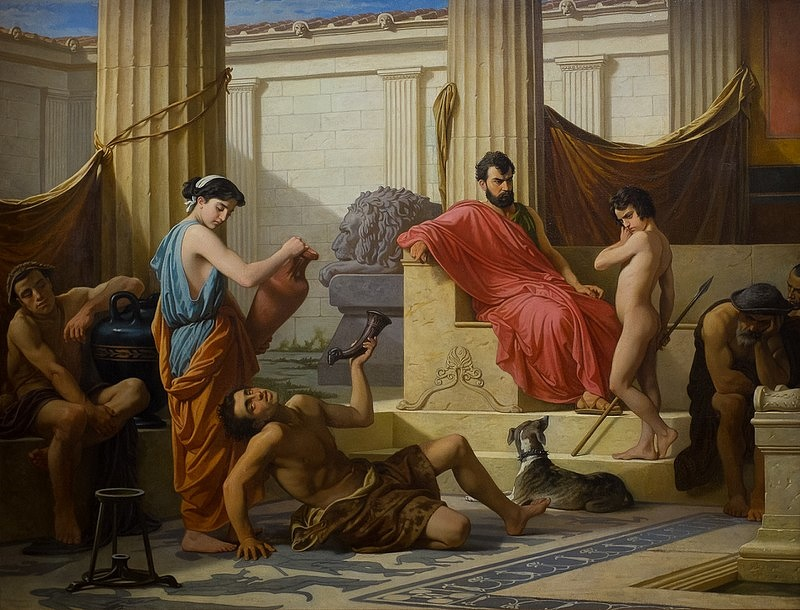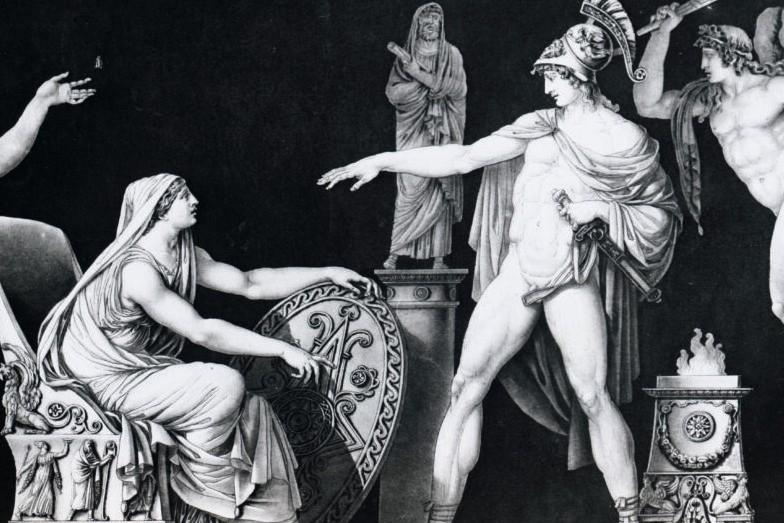
The story of Penelope's suitors is one of the central episodes of Homer's Odyssey. After Odysseus disappears following the Trojan War, a large group of aristocratic men gathers in his palace on Ithaca, seeking to marry his wife, Penelope.
What begins as an extended courtship gradually develops into a crisis of political authority, hospitality, family inheritance, and social order.
The "curse" of the suitors is not presented in Homer as a single supernatural curse pronounced by one deity. Rather, the phrase can be understood as describing the disastrous fate that overtakes the suitors as a consequence of their actions.
They consume Odysseus' wealth, abuse the rules of hospitality, pressure Penelope into remarriage, insult Telemachus, and ultimately attempt to kill Odysseus' son.
Their destruction therefore becomes a form of divine and moral retribution.
Why Did the Suitors Gather?
Odysseus had been absent from Ithaca for many years.
After fighting in the Trojan War, he spent another long period attempting to return home.
During his absence, uncertainty developed over whether he was still alive.
Penelope remained faithful to him.
However, the suitors believed that Odysseus was unlikely to return.
They therefore competed for Penelope's hand.
Their presence created an enormous problem.
The suitors did not simply ask Penelope to marry them.
They effectively occupied Odysseus' household.
The Abuse of Hospitality
One of the most important themes in the Odyssey is xenia, the ancient Greek concept of hospitality.
Hospitality involved reciprocal obligations between host and guest.
A guest was expected to behave respectfully.
A host was expected to provide food, shelter, and protection.
The suitors violate this relationship repeatedly.
They consume Odysseus' livestock.
They drink his wine.
They use his household resources.
They treat his palace as if it belongs to them.
Their behavior is therefore not merely rude.
It represents a fundamental violation of social order.
Penelope's Resistance
Penelope does not simply surrender to the pressure.
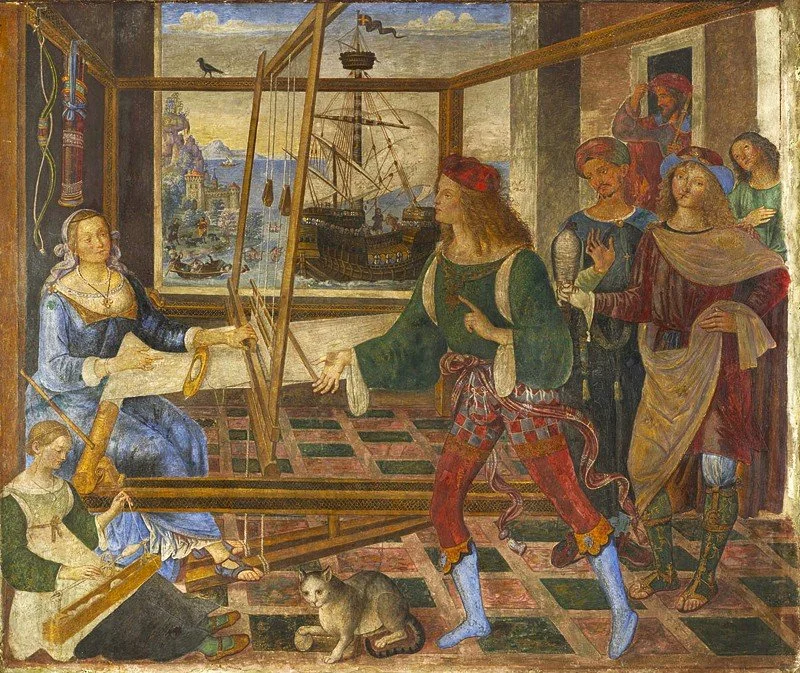
Instead, she devises a famous deception.
She announces that she will marry once she finishes weaving a burial shroud for Laertes, Odysseus' father.
During the day, she weaves.
At night, she secretly unravels the work.
This allows her to delay the suitors for an extended period.
The deception eventually becomes known.
Nevertheless, it demonstrates Penelope's intelligence.
She cannot defeat the suitors physically.
She therefore uses strategy.
Penelope as a Counterpart to Odysseus
Penelope's cleverness mirrors Odysseus'.
Odysseus survives through:
disguise,
deception,
strategic thinking,
patience,
and psychological manipulation.
Penelope demonstrates many of the same qualities.
Her weaving trick is not simply a clever domestic act.
It represents her ability to control the situation despite being surrounded by powerful men.
The Odyssey therefore presents intelligence as a form of power available even to someone without military authority.
The Threat Against Telemachus
The suitors' behavior becomes increasingly dangerous when they begin considering the possibility of killing Telemachus, Odysseus' son.
Telemachus has begun asserting himself.
As long as he remains alive, he represents Odysseus' legitimate household authority.
His death would remove an important obstacle to the suitors' ambitions.
Their willingness to murder him transforms their behavior from social misconduct into outright criminal violence.
The Return of Odysseus
Odysseus eventually returns to Ithaca disguised as an elderly beggar.
This disguise allows him to observe the situation without revealing his identity.
He discovers the extent of the suitors' abuse.
He also begins identifying which servants remain loyal.
The disguise gives him a strategic advantage.
Instead of immediately attacking, he gathers information.
This reflects one of the defining characteristics of Odysseus:
he prefers intelligence before action.
The Contest of the Bow
Penelope eventually announces a contest.
She will marry the man who can string Odysseus' great bow and shoot an arrow through a series of axe heads.
The suitors attempt to complete the challenge.
None succeeds.
Then Odysseus, still disguised, asks to try.
He strings the bow effortlessly.
The moment reveals his identity to those who are prepared for the next stage of the plan.
The Destruction of the Suitors
Odysseus and his allies then turn against the suitors.
The ensuing battle is violent.
The suitors are trapped inside the palace.
Their weapons are removed or inaccessible.
One by one, they are killed.
The scene represents the restoration of Odysseus' authority.
The palace that had been occupied by the suitors becomes his again.
Why Do the Suitors Die?
The suitors' deaths can be understood through several interconnected principles.
Violation of hospitality
They abused the household that sheltered them.
Theft
They consumed Odysseus' wealth.
Disrespect
They insulted Odysseus' family.
Threat to legitimate succession
They attempted to replace Odysseus and potentially eliminate Telemachus.
Arrogance
They assumed Odysseus would never return.
Failure to recognize divine order
The Odyssey repeatedly suggests that excessive pride and disrespect toward the gods eventually lead to destruction.
Antinous and Eurymachus
Two of the most important suitors are Antinous and Eurymachus.
Antinous is particularly aggressive.
He insults Odysseus while the hero is disguised as a beggar and becomes the first suitor killed when Odysseus reveals himself.
Eurymachus attempts to negotiate after the violence begins, but Odysseus refuses.
Their deaths represent the collapse of the suitors' authority.
Is There Really a "Curse"?
The word "curse" requires some qualification.
Homer does not present a simple supernatural curse placed upon every suitor.
Their fate results from their own actions, the return of Odysseus, and the broader divine and moral order of the epic.
The phrase can therefore be understood metaphorically.
Their "curse" is their own arrogance.
They create the conditions for their destruction.
They believe Odysseus is dead.
They believe Penelope can eventually be forced to choose one of them.
They believe Telemachus is too young to challenge them.
Every assumption proves wrong.
The Restoration of Order
The suitors' deaths are not simply revenge.
They represent restoration.
Before their arrival:
Odysseus → household → family → social order
During their occupation:
Suitors → consumption → disorder → threatened succession
After their deaths:
Odysseus → household restored → Penelope reunited → legitimate authority restored
The Odyssey therefore uses the suitors to dramatize the consequences of violating social and divine boundaries.
Conclusion
The story of Penelope's suitors is one of the clearest examples in Greek epic of wrongdoing producing its own punishment.
The suitors believe that power belongs to those who can seize it.
The Odyssey argues otherwise.
Authority must be legitimate.
Hospitality must be respected.
Marriage cannot simply be treated as a political prize.
Family inheritance cannot be ignored.
And arrogance can blind people to danger.
The suitors' ultimate "curse" is therefore not simply supernatural.
It is the consequence of their own choices.