The story of Tlepolemus is one of the lesser-known heroic traditions connected to Heracles, yet it occupies an important place in the mythology and legendary history of Rhodes. Tlepolemus was traditionally regarded as a son of Heracles and Astoche, and he eventually became the leader of the Rhodians during the Trojan War. His story combines themes of heroic ancestry, accidental violence, exile, migration, colonization, and the transmission of identity from one generation to another.
Although Tlepolemus does not receive the same attention as famous sons of Heracles such as Hyllus, his role in Homer's Iliad makes him an important figure for understanding the mythological genealogy of the Greek world. Homer places him among the leaders who sailed to Troy, where he commanded the Rhodian contingent.
The story is particularly interesting because Tlepolemus' connection to Heracles is not presented simply as a source of prestige. His relationship with his father also creates a violent family conflict that ultimately forces him to leave his homeland and establish himself elsewhere.
Who Was Tlepolemus?
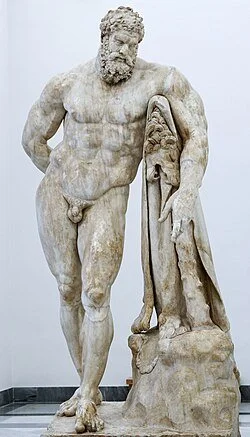
Tlepolemus was a Greek hero and son of Heracles.
In Homer's Iliad, he is identified as the leader of the Rhodians during the Trojan War. Homer describes three Rhodian settlements—Lindus, Ialysus, and Cameirus—and states that Tlepolemus led nine ships from Rhodes to Troy. (perseus.tufts.edu)
This makes Tlepolemus significant not merely as the son of a famous hero but as a founder-like figure in Rhodian tradition.
His identity is therefore connected to two worlds:
Heracles — his heroic ancestry
Rhodes — his political and geographic legacy
Tlepolemus and Heracles
Heracles had numerous children according to different mythological traditions.
Because Greek mythology developed across different regions and generations, the identities of his children vary between sources.
Tlepolemus is generally identified as the son of Heracles and Astoche, although some traditions provide alternative maternal genealogies.
His connection to Heracles gave him heroic status.
However, being the son of Heracles also placed him within a complicated family network marked by violence and succession disputes.
The Killing of Licymnius
The most important event in Tlepolemus' early life was the killing of Licymnius, an elderly relative of Heracles.
Licymnius was associated with the Heraclid family and was traditionally described as the son of Electryon.
According to Apollodorus, Tlepolemus accidentally killed Licymnius while striking him with a club.
The incident forced Tlepolemus to leave the region.
This is a crucial part of his story because exile becomes the mechanism through which he eventually reaches Rhodes.
Accidental Violence and Exile
Greek mythology frequently uses exile as a consequence of bloodshed.
The logic is understandable within the religious framework of ancient Greek society.
Even accidental killing could produce ritual pollution, known as miasma.
A person responsible for bloodshed might therefore need purification or separation from the community.
Tlepolemus' exile fits this broader mythological pattern.
He does not simply leave because he wants to explore.
He leaves because his position within the community has become compromised by violence.
Arrival in Rhodes
Tlepolemus eventually traveled to Rhodes.
There, according to tradition, he became associated with the island's Greek population and established himself as its leader.
The island was already home to several important settlements.
Homer identifies the Rhodians associated with:
Lindus,
Ialysus,
and Cameirus.
Tlepolemus became the leader of the combined Rhodian contingent during the Trojan War.
Tlepolemus in the Iliad
Tlepolemus appears prominently in the second book of Homer's Iliad, within the famous Catalogue of Ships.
The Catalogue lists the Greek forces participating in the expedition against Troy.
Homer states that Tlepolemus brought nine ships from Rhodes.
This is an important historical-literary detail because the Catalogue of Ships is one of the major sources for understanding how Greek communities were represented within the epic tradition.
Tlepolemus is therefore not simply an isolated mythological character.
He represents Rhodes itself.
Tlepolemus and Sarpedon
Tlepolemus's most important battlefield encounter was with Sarpedon, the Lycian hero and son of Zeus.
The confrontation is described in Book 5 of the Iliad.
Tlepolemus boasts about his lineage and challenges Sarpedon.
Both men belong to distinguished heroic families.
Tlepolemus is descended from Heracles.
Sarpedon is descended from Zeus.
Their confrontation therefore becomes a clash between two heroic genealogies.
The Battle
Tlepolemus attacks Sarpedon with a spear.
Sarpedon responds.
Both heroes are wounded.
However, Sarpedon's injury is ultimately fatal for Tlepolemus.
Tlepolemus dies in battle.
Sarpedon also suffers serious injury but survives the encounter long enough to continue participating in the war.
The episode reinforces one of the central themes of the Iliad:
great lineage does not guarantee survival.
Even descendants of gods and legendary heroes remain vulnerable to death.
The Tragedy of Tlepolemus
Tlepolemus' story is therefore remarkably compressed.
He is:
born into heroic ancestry,
involved in accidental bloodshed,
exiled,
established as leader of Rhodes,
joins the Trojan expedition,
and dies fighting another hero of divine ancestry.
His entire life follows a pattern of movement.
He is repeatedly displaced.
First, violence forces him from his original homeland.
Then, migration leads him to Rhodes.
Finally, war takes him to Troy.
His identity is therefore shaped by movement and conflict.
Tlepolemus as a Founder Figure
Tlepolemus can also be understood as a founder figure.
Greek mythology frequently explains the origins of cities and populations through heroic ancestors.
A famous hero arrives somewhere, establishes a settlement, and becomes the ancestor of later generations.
Tlepolemus' connection to Rhodes serves a similar function.
By connecting the Rhodians to a son of Heracles, mythology provides the island with a prestigious heroic genealogy.
This gives geography a mythological history.
Rhodes is no longer simply an island.
It becomes a place connected to the descendants of one of Greece's greatest heroes.
The Meaning of His Story
Tlepolemus represents several recurring themes in Greek mythology.
Heroic ancestry
His descent from Heracles gives him legitimacy and status.
Exile
Accidental violence forces him to leave his original community.
Migration
His displacement leads to a new homeland.
Leadership
He becomes the leader of the Rhodians.
Mortality
Despite his famous ancestry, he dies in battle.
Identity
His reputation becomes connected to Rhodes rather than only to Heracles.
Conclusion
Tlepolemus may not be among the most famous heroes of Greek mythology, but his story is historically and mythologically significant.
He demonstrates how Greek mythology connected heroic genealogy with geography.
The Rhodians of Homer are not simply anonymous soldiers. They are represented through Tlepolemus, a descendant of Heracles who carries his family's heroic legacy into a new homeland.
His life ultimately demonstrates that heroic identity is not determined only by one's ancestry.
It is shaped by exile, leadership, migration, conflict, and ultimately mortality.