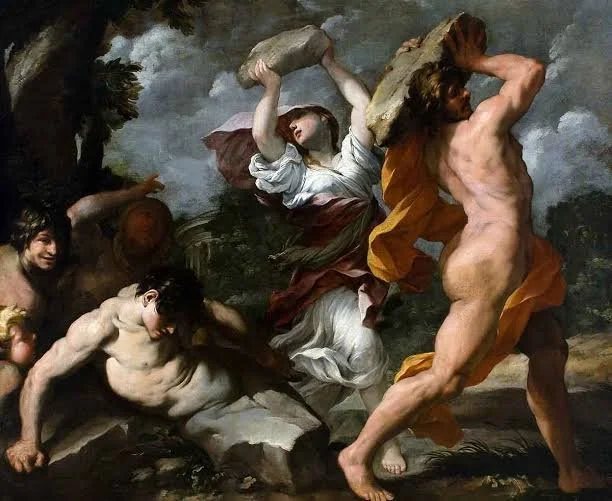
The myth of Deucalion and Pyrrha is one of the most important Greek stories concerning destruction, survival, and the rebirth of humanity.
The story describes a catastrophic flood sent by Zeus to destroy humanity because of widespread corruption and violence. Deucalion, the son of Prometheus, and his wife Pyrrha survive the disaster because of their piety and righteousness.
After the waters recede, the couple discovers that they are essentially alone.
They turn to the goddess Themis for guidance.
Her cryptic instruction—to throw the "bones of their mother" behind them—is initially confusing.
Eventually, they understand that the "mother" is Earth and her "bones" are the stones of the earth.
They throw stones behind them.
The stones transform into human beings.
From these stones, humanity is renewed.
Deucalion
Deucalion was traditionally the son of Prometheus and Pronoia or Clymene, depending on the source.
His ancestry is significant.
Prometheus is famous for helping humanity, particularly through the acquisition of fire.
Deucalion therefore inherits a mythological association with human survival and intelligence.
When Zeus decides to destroy humanity, Deucalion becomes the person through whom humanity survives.
Pyrrha
Pyrrha was the daughter of Epimetheus and Pandora in a major tradition.
This creates a remarkable genealogical connection.
Pandora is traditionally regarded as the first woman in Greek mythology.
Her daughter Pyrrha therefore becomes one of the ancestors of renewed humanity.
The genealogy is symbolically appropriate:
Pandora → Pyrrha → reborn humanity
The flood does not simply preserve individuals.
It resets the human race.
Why Did Zeus Send the Flood?
Different ancient sources provide different reasons.
In Ovid's Metamorphoses, Zeus becomes horrified by the wickedness of humanity after witnessing the violence and corruption of mortals.
He decides that humanity must be destroyed.
The flood becomes a divine purification.
This resembles a recurring mythological pattern in which civilization becomes so corrupt that the gods intervene catastrophically.
The Flood
Zeus unleashes an enormous flood.
Rain falls continuously.
Rivers overflow.
The land disappears beneath the water.
Cities and settlements are destroyed.
Humans and animals perish.
The world becomes almost entirely aquatic.
The imagery emphasizes the reversal of civilization.
Human beings believe they have conquered nature.
The flood reminds them that nature remains more powerful.
Deucalion's Survival
Deucalion and Pyrrha survive because they construct a vessel.
The exact details vary between traditions, but the central idea is consistent.
They remain together while the flood destroys the rest of humanity.
Their survival is connected to their righteousness.
They are not selected because they are physically powerful.
They survive because they maintain proper relationships with the divine order.
The Flood Recedes
Eventually, Zeus stops the rain.
The waters begin to retreat.
The couple's vessel comes to rest.
Ovid places their landing near Mount Parnassus.
When they emerge, the world is empty.
They have survived.
But survival creates a new problem.
There is no human community left.
The Appeal to Themis
Deucalion and Pyrrha seek divine guidance.
They approach the oracle of Themis.
Themis is the goddess associated with divine law, order, and proper custom.
Her role is significant.
The couple does not simply rebuild humanity through personal effort.
They need divine instruction.
Themis tells them to "throw the bones of their mother" behind them.
The instruction initially horrifies Pyrrha.
She assumes that they are being asked to violate the remains of their ancestors.
Understanding the Oracle
Deucalion interprets the riddle differently.
Their "mother" is Earth.
Her "bones" are the stones of the earth.
The couple therefore begins throwing stones behind them.
The stones undergo a miraculous transformation.
Those thrown by Deucalion become men.
Those thrown by Pyrrha become women.
Humanity is reborn from the earth.
The Symbolism of Stones
The stone transformation is one of the most distinctive elements of the Greek flood myth.
Why stones?
Stone is:
ancient,
durable,
resistant,
and part of the earth itself.
Humanity emerging from stone therefore symbolizes a new beginning.
The new generation is stronger and more resilient.
The myth also creates an etymological explanation.
The Greek word laos, meaning "people," was traditionally connected in ancient interpretation with laas, meaning "stone."
Whether or not the modern linguistic connection is historically accurate, the ancient mythological interpretation demonstrates how Greeks used language to explain their origins.
Deucalion as a Greek Noah Figure
Deucalion is frequently compared with Noah from the biblical flood narrative.
The similarities are obvious:
divine judgment,
widespread human corruption,
catastrophic flood,
survival of a righteous couple or family,
preservation of humanity,
and renewal after destruction.
However, the two traditions are not identical.
The Greek story has a distinctive conclusion.
Noah's descendants reproduce naturally.
Deucalion and Pyrrha create new humans from stones.
This makes the Greek myth fundamentally a story of creation after destruction.
Flood Myths Across Cultures
Flood stories appear in numerous ancient cultures.
Examples include:
the Mesopotamian story of Utnapishtim in the Epic of Gilgamesh,
the Atrahasis tradition,
the biblical story of Noah,
and the Greek story of Deucalion.
The widespread presence of flood traditions has generated extensive scholarly discussion.
Possible explanations include:
cultural transmission,
shared ancient traditions,
environmental experiences,
or the symbolic power of floods as representations of destruction.
A flood is an especially effective mythological symbol because it can erase an entire civilization while leaving the possibility of renewal.
The Difference Between Deucalion and Noah
Although comparisons are useful, it is important not to collapse the traditions into one story.
In the Greek myth:
Deucalion and Pyrrha → stones → new humans
In the biblical narrative:
Noah and his family → descendants → renewed humanity
The Greek version therefore places greater emphasis on metamorphosis and divine creation.
The Role of Piety
One of the central themes of the Deucalion story is piety.
Deucalion and Pyrrha survive because they remain respectful toward the gods.
The myth therefore presents a moral contrast:
Human corruption → destruction
Piety → survival
This reflects a recurring principle in ancient Greek mythology.
The gods are not always benevolent.
But respect for divine order is repeatedly portrayed as essential.
Destruction and Renewal
The flood is not simply a story about punishment.
It is also a creation story.
The old humanity disappears.
A new humanity emerges.
This creates a mythological cycle:
corruption → destruction → purification → rebirth
The cycle resembles other Greek myths in which an old order is replaced by a new one.
The Titanomachy, for example, replaces the Titans with the Olympians.
The flood replaces the corrupt human population with a renewed generation.
Pyrrha's Importance
Pyrrha should not be overlooked.
Although Deucalion is often treated as the central survivor, Pyrrha plays an equally important role.
She is the female counterpart to Deucalion.
The new human population requires both of them.
Her lineage also connects the story to Pandora.
Thus, the renewal of humanity depends upon both male and female ancestry.
The Birth of Hellen
According to later Greek genealogical traditions, Deucalion and Pyrrha became the parents of Hellen.
Hellen was regarded as the ancestor or personification of the Hellenic people.
His descendants included important ancestral figures associated with:
Aeolus,
Dorus,
and Xuthus.
Through Xuthus came:
Ion,
and Achaeus.
This genealogy became a mythological explanation for the major Greek ethnic groups.
The flood story therefore becomes connected to the origins of the Greek people themselves.
Deucalion as an Ancestral Figure
The significance of Deucalion extends beyond surviving the flood.
He becomes a foundational ancestor.
The myth effectively says:
"After the destruction of the old world, Greek humanity began again."
This gives the Greek people a sacred origin story.
Their ancestry is not simply biological.
It begins with divine judgment and miraculous renewal.
The Mythological Meaning of the Flood
The flood can be interpreted on several levels.
Divine punishment
The gods destroy humanity because of corruption.
Purification
Water removes the old world.
Survival
Deucalion and Pyrrha represent hope.
Creation
Humanity is recreated through stone.
Resilience
Life returns after catastrophe.
Ancestry
The survivors become ancestors of future Greek generations.
Ovid's Version
Ovid's Metamorphoses provides one of the most detailed surviving literary versions of the story.
His treatment emphasizes transformation, which fits the larger theme of the poem.
The world changes repeatedly.
People become plants.
Humans become animals.
Bodies become stars.
The flood itself becomes another great transformation.
The destruction of humanity is followed by the creation of new people from stones.
Deucalion and Pyrrha in Greek Literature
The myth was known well before Ovid.
Ancient Greek writers, including mythographers and poets, referred to Deucalion and the flood.
The tradition was particularly associated with Thessaly and central Greek geography in different versions.
Mount Parnassus became one of the important locations associated with their survival.
A Myth of Human Resilience
Perhaps the most enduring aspect of the story is its optimism.
The flood is devastating.
Almost everything is destroyed.
Yet the myth does not end with extinction.
It ends with creation.
Deucalion and Pyrrha stand in an empty world and ask how humanity can continue.
The answer comes from the earth itself.
Stones become people.
The world begins again.