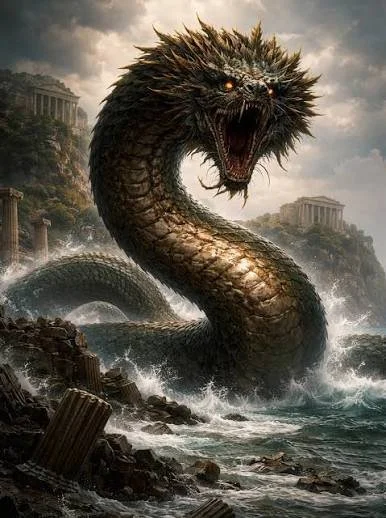
The story of Cychreides is one of the lesser-known dragon myths of ancient Greece and is closely associated with the island of Salamis.
Cychreides was a monstrous serpent or dragon that terrorized the island until it was defeated or driven away by the hero Cychreus.
The traditions surrounding the creature are relatively brief, and different ancient sources preserve different details. Nevertheless, the myth is significant because it illustrates a recurring Greek pattern in which a heroic founder or ruler establishes order by eliminating a dangerous creature.
The story also demonstrates how myths could explain the identity and history of particular cities and islands.
The Dragon of Salamis
Cychreides was associated with Salamis.
Ancient sources describe the creature as a serpent or dragon that caused destruction on the island.
The monster's presence represented disorder.
A dangerous creature occupying inhabited territory threatened both people and livestock.
The eventual defeat of Cychreides allowed the island to become associated with civilization and heroic rule.
Cychreus the Hero
The hero who defeated the creature was Cychreus, a figure traditionally connected with Salamis.
Cychreus is generally presented as a son of Poseidon and Salamis, the nymph who gave her name to the island.
This genealogy is significant because it connects the hero directly to the island itself.
Cychreus is therefore more than a monster slayer.
He becomes part of Salamis' mythological identity.
The Defeat of the Dragon
According to the tradition, Cychreus killed the dragon.
His victory established him as an important heroic figure.
However, one version provides an unusual twist.
Rather than completely disappearing, the creature's role was transformed.
The dragon became associated with sacred service to Demeter.
This is characteristic of Greek mythology.
A dangerous creature can sometimes become incorporated into the religious order rather than simply being destroyed.
The Mythological Meaning of the Dragon
The dragon represents wilderness.
It lives outside human social order.
It threatens the community.
The hero defeats it.
The pattern is familiar:
Chaos → Hero → Victory → Civilization
The story therefore resembles other Greek monster-slaying myths.
Perseus defeats Medusa.
Heracles defeats the Hydra.
Theseus defeats the Minotaur.
Bellerophon defeats the Chimera.
Cychreus defeats the dragon of Salamis.
Cychreus and the Island's Identity
The connection between hero and geography is essential.
Greek mythology often explains the names of places through stories involving gods, heroes, and monsters.
The island of Salamis was therefore not simply a geographic location.
Its name was connected to a divine ancestry.
Its hero was Cychreus.
Its monster was Cychreides.
Its mythology created a narrative history for the island.
The Serpent as Sacred Creature
Greek mythology has an interesting relationship with serpents.
They can represent:
danger,
wisdom,
healing,
fertility,
the earth,
guardianship,
and sacred power.
The meaning depends upon the particular myth.
Cychreides primarily represents danger, but the later association with Demeter suggests that the creature's identity could become integrated into a sacred context.
This ambiguity is typical of ancient Greek serpent symbolism.
Cychreus and the Trojan War
Cychreus' story became connected with later Greek traditions.
Some accounts associate him with the heroic genealogy of Salamis.
The island itself played an important role in Greek mythological geography.
Salamis was also famous historically for the Battle of Salamis during the Persian Wars.
Although the historical battle belongs to a much later period than the mythological age, the island's heroic reputation contributed to its cultural prestige.
The Cychreian Serpent
The name Cychreides is sometimes associated with the broader tradition of the Cychreian serpent.
The creature's identity demonstrates how ancient mythology could preserve local traditions that did not receive extensive treatment in major epic poems.
Many Greek communities possessed local myths about:
dragons,
springs,
sacred animals,
founding heroes,
and divine ancestors.
These traditions helped establish local identity.
A Local Heroic Myth
Cychreus' story can therefore be understood as a foundation myth.
The hero creates order.
The monster represents danger.
The community survives.
The island receives a heroic protector.
Such stories served an important cultural function.
They explained why a particular place was special.
They gave communities a heroic past.
Cychreides and Demeter
The association between the serpent and Demeter is particularly intriguing.
Demeter was the goddess of:
agriculture,
grain,
fertility,
and the cultivated earth.
A serpent associated with Demeter can therefore symbolize the connection between the earth and fertility.
This creates an interesting transformation.
The dragon begins as a threat.
Eventually, its existence becomes integrated into sacred mythology.
The creature is no longer simply a monster.
It becomes part of the divine landscape.
The Meaning of the Myth
The story of Cychreides reflects several themes:
Civilization versus wilderness
The dragon occupies a dangerous space outside human order.
Heroic authority
Cychreus gains legitimacy through defeating the creature.
Local identity
The story explains Salamis through its own heroic tradition.
Transformation
The defeated serpent can become associated with a deity.
Sacred geography
The physical landscape becomes connected with divine stories.
Conclusion
Cychreides may not be as famous as the Hydra or the Nemean Lion, but the myth is valuable precisely because it represents the local character of Greek mythology.
Ancient Greek religion was not built only from universally known stories.
Every region could possess its own heroes, monsters, sacred places, and legends.
The dragon of Salamis represents this localized dimension of mythology.
Through Cychreus, the island's dangerous wilderness is transformed into a story of heroic order.
The myth ultimately presents the familiar Greek idea that civilization is established when the hero confronts and overcomes the forces of chaos.