Ancient Greek warfare was not limited to hoplites fighting in open fields.
Greek engineers developed increasingly sophisticated siege technologies capable of attacking fortified cities.
By the Hellenistic period, siege warfare had become a specialized science involving engineers, artillery, towers, tunnels, battering devices, and complex logistical operations.
Early Greek Siege Warfare
Early Greek armies generally preferred open battle.
Strong fortifications were difficult to overcome.
A city protected by thick walls could resist an army for months or even years.
This encouraged technological innovation.
The Battering Ram
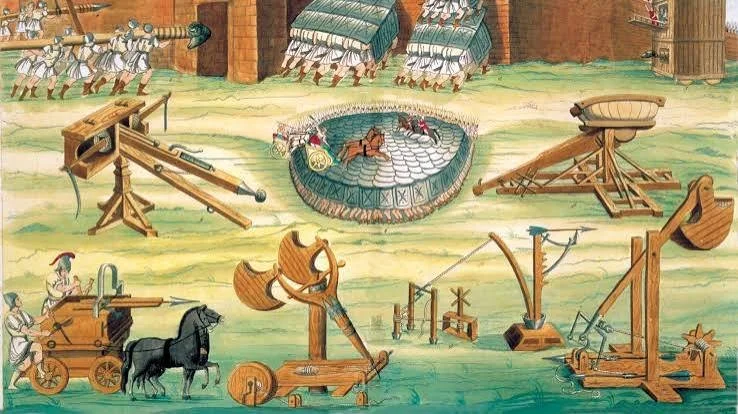
One of the simplest siege weapons was the battering ram.
A heavy beam was suspended or mounted so that soldiers could repeatedly strike a wall or gate.
Protective structures shielded the operators from defenders.
Siege Towers
Siege towers allowed attackers to approach defensive walls from an elevated position.
Troops inside could fire missiles or attempt to reach the top of the fortification.
Large towers required enormous amounts of timber and labor.
Catapults
Greek engineers developed artillery capable of launching projectiles.
Early designs included devices that fired large arrows or bolts.
Later machines could hurl stones.
These weapons became increasingly sophisticated during the Hellenistic period.
Dionysius and Syracusan Engineering
The rulers of Syracuse invested heavily in military engineering.
The city became an important center for the development of siege technology.
Engineers experimented with machines designed both to attack and defend fortified positions.
Archimedes
Archimedes became famous for his engineering contributions during the Roman siege of Syracuse.
Ancient sources describe machines capable of attacking Roman ships and throwing projectiles.
Some descriptions may contain exaggerations, but the broader historical evidence confirms that Syracuse possessed sophisticated defensive technology.
Siege Tunnels
Attackers could dig beneath walls.
The objective was to weaken foundations and cause sections of the fortification to collapse.
Defenders could counter by digging their own tunnels.
This created a subterranean battle beneath the walls.
Siege Logistics
Technology alone could not win a siege.
Armies needed:
Food
Water
Timber
Metal
Engineers
Laborers
Transport animals
Ammunition
Long sieges could become contests of endurance.
Psychological Warfare
Siege weapons also had psychological effects.
The appearance of enormous towers or artillery could undermine defenders' morale.
The ability to destroy walls from a distance changed how cities thought about defense.
Hellenistic Innovation
After Alexander's conquests, siege warfare became increasingly sophisticated.
Kings competed to employ engineers and construct enormous machines.
Siege warfare became one of the defining technological features of Hellenistic military culture.