The hoplite was one of the defining figures of ancient Greek warfare. He was not simply a heavily armed soldier but the product of a military system in which equipment, social status, battlefield organization, civic identity, and collective discipline were closely connected. From roughly the seventh century BCE onward, the heavily armed infantryman became central to warfare in many Greek communities, particularly during the Archaic and Classical periods.
The word hoplite derives from the Greek hoplon, a term associated with a shield and, more broadly, military equipment. Contrary to the popular image of every Greek soldier wearing identical armor, hoplite equipment varied considerably according to period, region, wealth, and personal preference. Soldiers generally supplied much of their own equipment, meaning that military service was closely related to economic status.
Understanding how hoplites were equipped therefore provides insight not only into ancient weapons but also into Greek society itself.
The Hoplite as a Citizen-Soldier
In many Greek city-states, the hoplite was a citizen who could afford the equipment required for heavy infantry service.
The military system was therefore connected to the social structure of the polis.
A prosperous farmer might serve as a hoplite because he possessed enough property to purchase armor and weapons. In Athens, the political importance of the hoplite class was particularly significant because military service and civic participation were closely intertwined.
The hoplite's primary strength was not individual combat.
It was collective action.
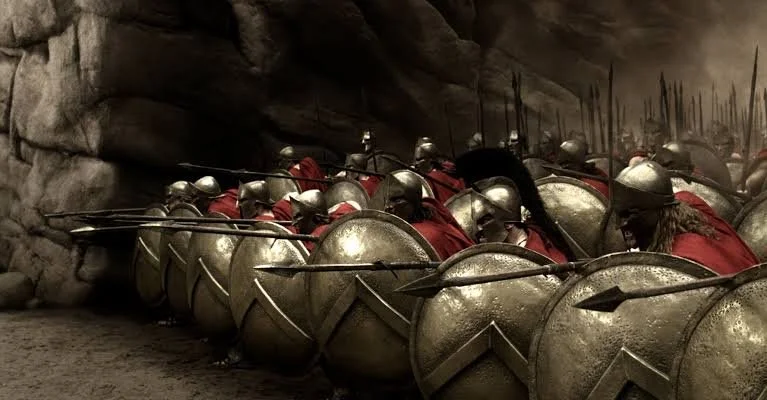
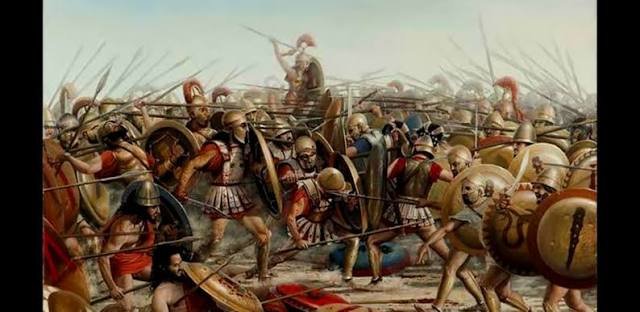
Hoplites normally fought in formations, most famously the phalanx, where shields and spears worked together to create a dense fighting line.
The Hoplon Shield
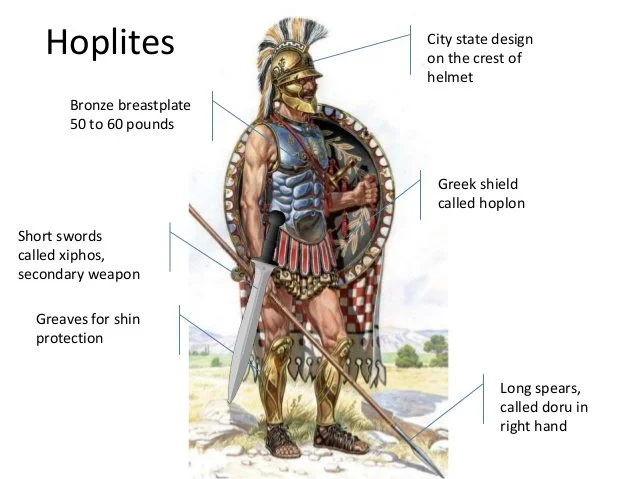
The most distinctive piece of hoplite equipment was the large round shield.
It was usually made from a wooden core covered with material such as bronze or leather, depending on the period and construction.
The shield was approximately circular and generally around 80–100 centimeters in diameter, although dimensions varied.
Its construction was particularly innovative.
Rather than being held by a simple central grip, the shield commonly used an arm-brace system called an antilabē together with a handgrip known as a porpax.
The forearm passed through the shield, allowing the soldier to support its weight more effectively.
This arrangement provided excellent stability in close-order combat.
The Importance of the Shield
The shield protected much of the soldier's body.
It could cover:
The torso
Part of the legs
The left side of the body
Portions of the neighboring soldier's body
This last characteristic was particularly important.
Because the shield was carried on the left arm, the soldier's right side was more exposed.
Maintaining formation therefore became essential.
A soldier who moved too far away from his comrades could create gaps in the defensive line.
The shield was consequently both personal protection and a collective weapon of formation warfare.
The Spear
The primary hoplite offensive weapon was the spear.
The traditional hoplite spear generally consisted of a wooden shaft with an iron or bronze spearhead.
Its exact length varied, but it was commonly around two to three meters.
The spear could be used for thrusting rather than primarily for throwing.
A rear spike or butt-spike, often called a sauroter, could serve several purposes, including balancing the weapon and potentially functioning as a secondary point.
The Sword
Hoplites also carried swords as secondary weapons.
Two major forms became particularly important.
The xiphos was a relatively short double-edged sword.
It was useful for close combat when a spear broke or when formations became disrupted.
The kopis was a heavier, curved blade associated especially with certain Greek and later Mediterranean military traditions.
Not every hoplite carried exactly the same sword.
Bronze Helmets
The helmet was another important defensive element.
Several forms existed.
The Corinthian helmet became one of the most recognizable.
It was made from bronze and covered much of the head and face.
The helmet typically incorporated:
Nose protection
Cheek guards
Brow protection
Openings around the eyes
Its extensive coverage provided excellent protection but restricted hearing and peripheral vision.
Later Helmet Designs
As warfare developed, Greek soldiers adopted helmets that offered greater mobility and visibility.
The Attic helmet, for example, generally provided a more open face.
The Chalcidian helmet represented another transitional design.
These changes demonstrate that Greek armor was not static.
Military equipment continually evolved in response to practical experience.
Body Armor
Hoplites could wear body armor in several forms.
The famous bronze bell cuirass protected the torso and was shaped to resemble the human body.
Bronze cuirasses were expensive and therefore represented a substantial investment.
Other soldiers used linen armor, commonly called linothorax.
The exact construction of the linothorax remains debated because few complete examples survive.
It may have consisted of layers of linen glued or stitched together.
Greaves
Greaves were protective coverings for the lower legs.
They were generally made from bronze and shaped to fit the soldier's calves.
Some were designed so that the bronze itself provided enough spring tension to hold the greave in position.
Greaves protected the shins, which could be vulnerable during close combat.
Clothing Beneath the Armor
Armor was not normally worn directly against bare skin.
A soldier could wear a tunic beneath his equipment.
A cloak could also be used when traveling or resting.
Footwear varied.
Many soldiers probably fought wearing sandals or simple footwear, although some may have fought barefoot depending on circumstances.
Wealth and Equipment
The equipment of a hoplite reflected economic inequality.
A wealthy citizen might own:
High-quality bronze armor
A decorated shield
An elaborate helmet
A sword
Greaves
Multiple weapons
A poorer soldier might possess only the equipment considered essential.
This meant that the image of a completely standardized hoplite army is misleading.
Shield Decoration
Shields could carry painted symbols and designs.
Athens famously used the owl as a civic symbol.
Spartans were associated with the lambda, representing Lacedaemon.
Other communities used different symbols.
Shield designs could communicate identity and perhaps intimidate opponents.
Armor and Mobility
Heavy armor provided protection but imposed disadvantages.
A fully equipped hoplite carried a substantial amount of weight.
Exact estimates vary because equipment differed, but a heavily equipped soldier could carry well over 15 kilograms of armor and weapons.
This affected endurance and mobility.
Hoplites therefore generally relied on disciplined formation fighting rather than prolonged individual pursuit.
The Phalanx
Equipment made sense because of the phalanx.
Hoplites formed several ranks deep.
The exact depth varied according to period and circumstances.
The front ranks carried shields and spears toward the enemy.
Rear ranks helped maintain pressure and formation.
The effectiveness of the phalanx depended upon cohesion.
Training
Hoplites were not necessarily professional soldiers.
Many were citizen farmers.
However, Greek communities increasingly recognized the importance of military training.
Athenians, Spartans, and other states developed different approaches.
Sparta developed the most famous system of continuous military training.
Other states relied more heavily on seasonal campaigning and citizen participation.
The Hoplite's Equipment as a Symbol
Hoplite armor eventually became more than military equipment.
It represented citizenship, masculinity, wealth, and participation in the defense of the polis.
Funerary monuments sometimes depicted soldiers in military equipment.
The hoplite therefore became an important cultural symbol of Greek civic identity.
From Hoplite to Hellenistic Soldier
By the fourth century BCE, Greek warfare was changing.
The rise of Macedon introduced longer spears, new formations, powerful cavalry, and increasingly sophisticated combined-arms tactics.
The traditional hoplite did not disappear immediately.
Instead, he became part of a broader military system.
Conclusion
Hoplite equipment was a carefully developed combination of offensive and defensive technology.
The shield, spear, helmet, cuirass, greaves, and sword each had a specific function, but their greatest effectiveness emerged when soldiers operated collectively.
The hoplite's real weapon was therefore not simply his spear.
It was the organized formation of citizens standing together.
That combination of equipment, discipline, social identity, and collective action made the hoplite one of the most influential military figures of ancient Greece.