Few stories in Greek mythology are as psychologically and philosophically powerful as the tragedy of Laius and Oedipus. The myth became the foundation of Sophocles' Oedipus Tyrannus and later inspired centuries of philosophical, literary, and psychological interpretation.
At its center is a prophecy: King Laius of Thebes is warned that his own son will kill him and marry his wife, Jocasta.
In attempting to prevent the prophecy, Laius sets in motion the very events that will fulfill it.
The Prophecy of Laius
Laius was king of Thebes.
According to the mythological tradition, an oracle warned him that if he fathered a son, that son would eventually kill him and marry Jocasta.
The prophecy created an apparently impossible dilemma.
If Laius allowed the child to live, he risked losing his life and kingdom.
If he killed the child, he would commit an extraordinary act against his own family.
Laius chose the second option.
The Abandoned Infant
When Jocasta gave birth to a son, Laius ordered the infant to be exposed.
In some versions, the baby's ankles were pierced or bound, explaining the name Oedipus, commonly connected with the meaning “swollen foot.”
However, the servant entrusted with killing the child could not bring himself to do so.
The infant was instead given to another shepherd and eventually reached Corinth.
There, King Polybus and Queen Merope raised him as their own son.
Oedipus Learns of the Prophecy
As a young man, Oedipus eventually learned a disturbing rumor that Polybus was not his biological father.
He traveled to Delphi to discover the truth.
The oracle did not directly answer his question. Instead, Oedipus was told that he was destined to kill his father and marry his mother.
Horrified, he decided never to return to Corinth.
Ironically, he believed Corinth was his home.
By leaving it, he moved directly toward his biological family.
The Meeting at the Crossroads
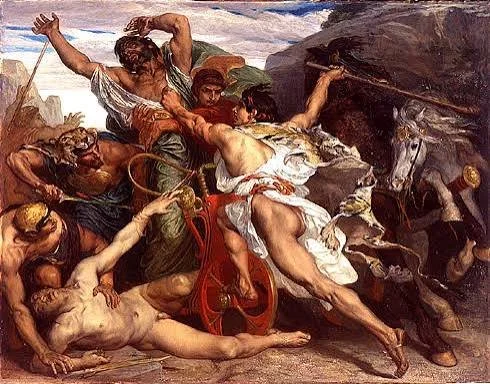
On the road, Oedipus encountered an older man traveling with servants.
A dispute occurred over the right of way.
Violence followed.
Oedipus killed the man and several members of his group.
The murdered traveler was Laius.
Neither man recognized the other.
The first half of the prophecy had therefore been fulfilled.
The Sphinx
Oedipus eventually reached Thebes, where the city was being terrorized by the Sphinx.
The creature posed a famous riddle:
What walks on four legs in the morning, two legs at noon, and three legs in the evening?
Oedipus answered correctly: humanity.
The infant crawls, the adult walks upright, and the elderly person uses a staff.
The Sphinx was defeated, and Oedipus became a hero.
The Marriage to Jocasta
The people of Thebes rewarded Oedipus by making him king.
Because Laius had died, Oedipus married the widowed queen, Jocasta.
She was his biological mother.
The second half of the prophecy was now complete.
Neither knew the truth.
The Discovery
Years later, Thebes suffered another crisis.
Oedipus attempted to discover the cause.
The investigation gradually revealed the horrifying truth.
The shepherd who had saved Oedipus eventually testified.
Oedipus realized that the man he had killed at the crossroads was Laius.
Jocasta realized that Oedipus was her son.
She killed herself.
Oedipus, discovering her body, blinded himself.
Fate and Free Will
The tragedy raises one of Greek mythology's central philosophical questions:
Can human beings escape fate?
Laius attempts to defeat prophecy.
Oedipus attempts to avoid it.
Both fail.
The myth does not necessarily suggest that every human action is meaningless. Instead, it demonstrates how limited human knowledge can be.
People make decisions based on incomplete information.
Laius does not know that abandoning his child will contribute to the prophecy.
Oedipus does not know the identities of the people he encounters.
The tragedy arises from the interaction between human decisions and forces beyond human understanding.
The Oedipus Tradition
The story continued through several generations.
Oedipus and Jocasta's children included Eteocles, Polynices, Antigone, and Ismene in the dominant tradition.
The curse therefore continued to affect the next generation.
The conflict between Eteocles and Polynices eventually led to the civil war described in the Theban cycle.
Conclusion
The curse of Laius and Oedipus is powerful because it is not merely a story about a prophecy.
It is a story about ignorance, fear, political power, family, identity, and the consequences of attempting to control an uncertain future.
Oedipus becomes a tragic hero not because he is evil, but because he seeks truth relentlessly and eventually discovers that the truth destroys the identity he has constructed for himself.
His story became one of the foundational tragedies of Western literature.