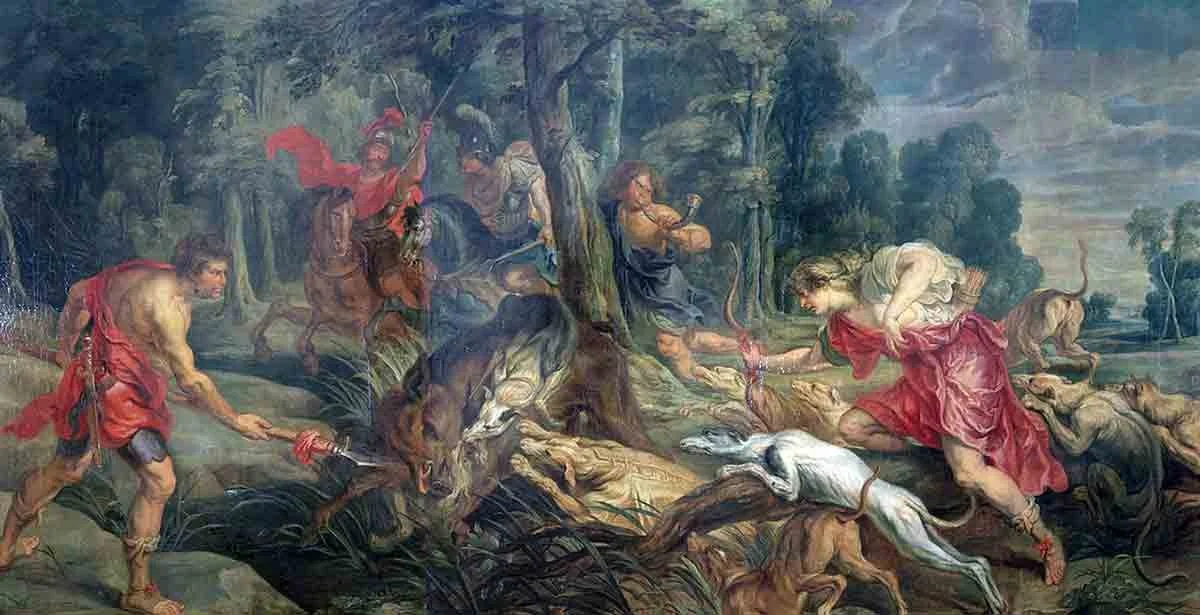
The Arcadian hunters belong to the broader world of Greek mythology surrounding the forests and mountains of Arcadia. Arcadia, located in the mountainous interior of the Peloponnese, was imagined by Greek poets as a rugged landscape populated by hunters, shepherds, nymphs, satyrs, and gods associated with wilderness.
The phrase “Arcadian hunters” does not refer to one universally standardized group with a single canonical story. Instead, it evokes a collection of mythological traditions concerning heroic hunters connected with Arcadia, especially the followers and companions of Artemis.
Among the most important stories associated with Arcadian hunting culture is the Calydonian Boar Hunt, in which numerous famous heroes gathered to pursue a monstrous boar.
Arcadia and the Wilderness
Arcadia's mountainous geography strongly influenced its mythology.
Unlike coastal Greek regions dominated by cities and maritime trade, Arcadia was characterized by forests, mountains, valleys, and pastoral communities.
Greek literature consequently associated Arcadia with a more primordial form of existence.
The god Pan was especially important in Arcadian religion. As a deity of shepherds, wilderness, sexuality, music, and untamed nature, Pan represented the boundary between civilization and the wild.
Hunting similarly occupied this boundary.
A hunter entered wilderness but did so with specialized knowledge and equipment. Hunting required courage, cooperation, endurance, and familiarity with animals and terrain.
Artemis and the Hunters
Artemis was the principal Greek goddess associated with hunting.
She was traditionally depicted carrying a bow and accompanied by animals such as deer. Her identity connected wilderness with divine power.
Artemis also maintained a strict distinction between herself and ordinary human society. Numerous myths demonstrate the danger of violating her boundaries.
The story of Actaeon is a famous example. According to the most widely known version, Actaeon accidentally encountered Artemis while she was bathing. Artemis transformed him into a stag, after which his own hunting dogs killed him.
The story communicates an important mythological principle: the wilderness belongs to divine powers, and humans who cross sacred boundaries may suffer catastrophic consequences.
The Calydonian Boar Hunt
The greatest gathering of legendary hunters occurs during the Calydonian Boar Hunt.
King Oeneus of Calydon had failed to honor Artemis during a religious sacrifice. In anger, the goddess sent a gigantic boar to ravage the region.
The animal destroyed crops and threatened the population.
Oeneus' son Meleager organized an expedition to kill it.
The hunting party included numerous famous heroes, although ancient sources differ about the exact participants.
Among the best-known were Meleager, Atalanta, Castor and Polydeuces, Jason, Theseus, Peleus, and several other heroic figures.
Atalanta
One of the most significant hunters was Atalanta.
She was an exceptional female hunter and athlete who challenged traditional gender expectations within Greek heroic mythology.
Atalanta was often associated with Artemis and wilderness. In the boar hunt, she is credited in many versions with striking the animal first.
Meleager then delivered the killing blow.
This creates a dispute over the hunting prize. Meleager gives the boar's hide to Atalanta, but other hunters object because they believe the prize should belong to a male warrior.
The conflict eventually becomes deadly.
Hunting as a Test of Heroism
Greek heroic stories frequently use hunting as a test of character.
A dangerous animal represents uncontrolled nature. The hero demonstrates his ability to confront it.
However, Greek myths rarely present hunting as purely glorious.
The Calydonian Boar Hunt ends in tragedy. Rivalries over the prize result in violence among the hunters, demonstrating how quickly cooperation can collapse into competition.
The story therefore contains a warning about heroic pride.
The Relationship Between Humans and Nature
The Arcadian hunting traditions reveal an important aspect of Greek attitudes toward nature.
The wilderness was not simply empty space. It was inhabited by gods, spirits, monsters, and sacred animals.
Hunters entered this environment at their own risk.
This helps explain why Greek mythology repeatedly connects hunting with divine punishment.
Animals may be sacred. Mountains may belong to gods. Springs may be inhabited by nymphs.
The hunter must therefore understand boundaries.
Conclusion
The Arcadian hunters represent more than a collection of legendary warriors. They embody Greek ideas about wilderness, courage, masculinity, femininity, divine authority, and the fragile boundary between civilization and nature.
The Calydonian Boar Hunt is especially important because it gathers heroes together while ultimately demonstrating the destructive consequences of rivalry.
In Greek mythology, hunting is never merely the pursuit of animals. It is an encounter with the untamed world—and with the untamed aspects of human nature itself.