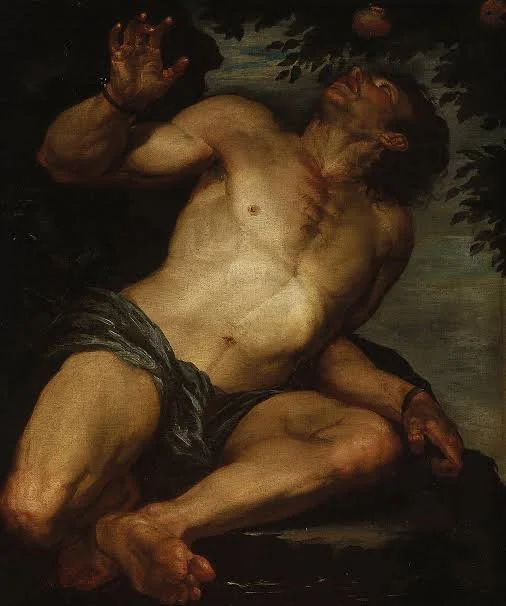
The Curse of Tantalus is one of the most famous examples of divine punishment in Greek mythology. Tantalus was a wealthy and powerful king who enjoyed an unusual relationship with the gods. He was permitted to dine with them and share in their divine company.
Yet Tantalus eventually committed an offense so severe that he was condemned to an eternity of frustration.
He was placed in the Underworld, where food and water remained constantly within his reach but were impossible for him to obtain.
From his name comes the modern word “tantalize,” meaning to tease or torment someone by presenting something desirable that remains just beyond reach.
Tantalus the King
Tantalus was traditionally associated with the kingdom of Sipylus in Lydia or the surrounding region of western Anatolia.
He possessed great wealth.
His royal status made him powerful among mortals.
But his most extraordinary characteristic was his relationship with the gods.
He was not an ordinary human who merely worshipped them.
He was welcomed into their company.
A Favorite of the Gods
According to several traditions, Tantalus was honored by the gods and allowed to participate in their feasts.
This was an extraordinary privilege.
Greek mythology often emphasizes the boundary separating gods from mortals.
Humans normally could not enter divine banquets.
Tantalus somehow crossed that boundary.
His elevated position, however, contributed to his downfall.
The Offenses of Tantalus
Ancient sources provide different explanations for his crime.
He was accused of stealing divine food or revealing secrets of the gods to humans.
He may have taken nectar and ambrosia from Olympus and distributed them among mortals.
Other traditions accuse him of abusing divine hospitality.
But the most horrifying story concerns his son Pelops.
The Feast of Pelops
According to the most famous version, Tantalus wanted to test whether the gods were truly omniscient.
He killed his own son, Pelops.
He then prepared the boy's body as food and served it to the gods.
The act was an unimaginable violation of the relationship between humans and gods.
Tantalus had crossed every moral boundary.
The Gods Recognize the Crime
The gods immediately recognized what had happened.
They refused to consume the meal.
Most of them understood the deception.
One tradition states that Demeter, distracted by grief over the disappearance of Persephone, unknowingly ate part of Pelops' shoulder.
The gods then restored Pelops to life.
His shoulder was replaced with one made of ivory.
This explains the legendary ivory shoulder associated with Pelops.
Pelops and the Olympic Games
Pelops later became a major figure in Greek mythology.
The Peloponnese was traditionally associated with him, and his name was connected with the region.
He also became associated with the origins of the Olympic Games in certain traditions.
The contrast is striking.
A horrific act committed by his father is followed by Pelops' transformation into an important heroic figure.
The Punishment of Tantalus
Tantalus was condemned to the Underworld.
There he stood in a pool of water beneath fruit trees.
Whenever he tried to drink, the water receded.
Whenever he reached for fruit, the branches moved beyond his grasp.
He was therefore surrounded by everything he needed but could never satisfy his hunger or thirst.
The Meaning of the Punishment
The punishment perfectly reflects the crime.
Tantalus had possessed extraordinary access to divine abundance.
He abused that privilege.
His punishment removes abundance while leaving him surrounded by its appearance.
He sees what he desires.
He reaches for it.
But he can never possess it.
Hunger and Thirst
The physical experience of hunger and thirst is central to the punishment.
These are basic human needs.
To deny them eternally creates suffering without end.
The punishment is not a single moment of pain.
It is repetition.
Every attempt creates hope.
Every failure creates renewed suffering.
Psychological Torture
The punishment can also be understood psychologically.
Tantalus is not placed in a barren wasteland.
He is placed somewhere that looks promising.
Food hangs above him.
Water surrounds him.
The cruelty lies in the contrast between appearance and reality.
His environment constantly reminds him of what he cannot have.
The Origins of the Word “Tantalize”
The English word “tantalize” derives from Tantalus.
Its modern meaning captures the essential structure of his punishment.
To tantalize someone is to place something desirable close enough to stimulate desire while keeping it inaccessible.
The ancient myth therefore continues to influence everyday language thousands of years after it was first told.
Tantalus and Hubris
Like many Greek myths, the story is connected with hubris.
Tantalus does not merely commit a crime.
He assumes that he can manipulate the gods.
His wealth and privileged position encourage him to believe that ordinary rules do not apply to him.
This arrogance becomes his downfall.
Divine Justice
Greek mythology often portrays divine punishment as reflecting the nature of the offense.
The punishment of Tantalus follows this pattern.
He misuses divine abundance.
He receives eternal deprivation.
He violates sacred hospitality.
He loses access to the divine world.
He treats his own son as an object.
He becomes eternally separated from satisfaction.
The House of Tantalus
Tantalus' punishment is only part of a larger cycle of suffering associated with his family.
His descendants include several famous and tragic figures.
Pelops' family line eventually produces Atreus and Thyestes.
Their descendants include Agamemnon, Menelaus, and other central figures of the Trojan War traditions.
The House of Tantalus therefore becomes one of Greek mythology's great dynasties of inherited conflict.
Tantalus and Atreus
The family mythology becomes increasingly violent.
Atreus and Thyestes become enemies.
Their rivalry leads to horrific acts involving revenge and kinship.
The family's history demonstrates how Greek myths often portray violence as something that can pass through generations.
Tantalus' original crime becomes the beginning of a long cycle of suffering.
The Question of Inherited Curse
The concept of a family curse raises an important question.
Are descendants responsible for crimes committed by their ancestors?
Greek mythology frequently suggests that families can inherit consequences.
Yet later generations also make independent choices.
The House of Tantalus therefore represents both inherited fate and individual responsibility.
Tantalus in the Underworld
Tantalus is one of the most memorable inhabitants of the Greek Underworld.
Unlike some punished figures who perform a repetitive physical task, Tantalus experiences perpetual deprivation.
His punishment has no visible end.
There is no moment when he can succeed.
The Underworld therefore becomes a place where time itself becomes part of punishment.
Comparison with Other Punishments
Greek mythology contains several famous eternal punishments.
Sisyphus must push a stone uphill repeatedly.
Ixion is bound to a burning wheel.
The Danaids must endlessly fill a leaking vessel.
Tantalus must endlessly attempt to eat and drink.
Each punishment reflects a particular form of futility.
The Human Fear Behind the Myth
The myth speaks to a universal fear: having something within reach but being unable to obtain it.
Modern people experience similar frustrations in less extreme forms.
We may desire success, wealth, recognition, love, or security while constantly feeling that these things remain just beyond our grasp.
The myth exaggerates this experience into eternal punishment.
The Moral Lesson
Tantalus' story contains several interconnected warnings.
Power does not eliminate moral limits.
Wealth does not guarantee wisdom.
Divine favor can be lost.
Abusing trust carries consequences.
And attempting to manipulate sacred powers can result in catastrophe.
The Enduring Image
The image of Tantalus standing beneath fruit that moves away whenever he reaches for it has become one of the strongest visual representations of frustration in classical mythology.
It is simple and immediately understandable.
The punishment requires no complicated explanation.
Everyone understands the agony of wanting something that remains inaccessible.
Conclusion
The Curse of Tantalus is one of Greek mythology's most memorable explorations of punishment, desire, and arrogance.
Tantalus begins as a privileged king welcomed among the gods.
His extraordinary access to divine society should have made him grateful.
Instead, he abuses his position and commits terrible offenses.
His punishment reverses his fortune completely.
He is surrounded by abundance but can never consume it.
The myth's enduring influence is evident even in modern language. To be “tantalized” is to experience the same fundamental frustration that defines Tantalus' eternal existence: seeing what you want, reaching for it, and discovering that it will always remain just beyond your grasp.
In this sense, the punishment of Tantalus is not merely an ancient story about the Underworld. It is a powerful metaphor for desire itself—and for the terrible consequences that can arise when ambition, privilege, and arrogance exceed their limits.